
A medical device with machine learning that updates itself after certification is, for the regulator, a different device from the one that was certified. It is the constraint that separates AI-enabled software from the rest of the medical device market: compliance frameworks were built for objects that stay identical over time, and a model retrained on new data is not. The FDA and the European Union tackle the same knot with different tools and different timelines, and the asymmetry can now be measured.
Context
Regulation (EU) 2017/745 (MDR, Medical Device Regulation), fully applicable since May 2021, classifies medical software through Rule 11 of Annex VIII. Software that provides information for diagnostic or therapeutic decisions falls at least in Class IIa, rising to IIb or III depending on the severity of the consequences. Almost any Software as a Medical Device (SaMD) with a clinical function therefore sits above the threshold that requires a Notified Body.
In the United States most software devices clear through the 510(k) pathway, which demonstrates substantial equivalence to a device already on the market (the predicate). The FDA keeps a public list of AI/ML-enabled devices: in December 2024 there were 1,016, and over the course of 2025 they passed 1,350. Radiology stays dominant, around 76% of cumulative authorisations.
The adaptive-AI problem
A deep-learning model can be designed to improve as it meets new data. For clinical practice that is an advantage; for certification it is a discontinuity. There are three regulatory answers.
The first is the locked algorithm: the model is frozen at conformity assessment, and any substantial change requires a new submission. It is the road taken by the large majority of AI devices authorised today, across every jurisdiction.
The second is predetermined change control: the manufacturer declares in advance which changes the model may undergo (retraining on new data, weight updates, extension to new populations), how they will be validated, and which performance thresholds must hold. Declared changes need no new submission as long as they stay within the plan.
The third is continuous learning, where the model updates itself in production. As of today no regulator has authorised it for medical devices; it remains a matter for the literature and for sandboxes.
PCCP architecture
On 3 December 2024 the FDA published the final guidance Marketing Submission Recommendations for a Predetermined Change Control Plan for Artificial Intelligence-Enabled Device Software Functions. Against the draft, the final version widens the field from ML-enabled to all AI-enabled devices, and places the Predetermined Change Control Plan (PCCP) inside the initial submission.
A PCCP describes three things: the planned modifications (Description of Modifications), the protocol by which they will be developed, validated and implemented (Modification Protocol), and an assessment of their impact. Once authorised, the plan becomes part of the clearance: the manufacturer carries out the declared modifications without returning to the FDA, as long as it stays within the specified bounds. Control moves from the individual update to a perimeter set up front.
On principles, the FDA, Health Canada and the UK MHRA had published together the ten Good Machine Learning Practice (GMLP) guiding principles in October 2021. The International Medical Device Regulators Forum (IMDRF) turned them into a final document on 29 January 2025, reference IMDRF/AIML WG/N88 FINAL:2025: a shared baseline across jurisdictions on data quality, model transparency and performance evaluation along the whole lifecycle.
The critical point
MDR has no instrument equivalent to the PCCP. The Regulation handles changes through the notion of a significant change: a change that touches safety or performance requires a fresh conformity assessment. For a model that retrains periodically, drawing the line in advance between significant and non-significant is hard, and without dedicated guidance the concrete risk is that every serious update reopens the path through the Notified Body.
A second layer sits on top. Regulation (EU) 2024/1689 (the AI Act) classifies as high-risk, under Article 6(1) and Annex I, AI systems that are medical devices or safety components of devices subject to third-party conformity assessment under MDR or IVDR. For these devices the AI Act’s high-risk obligations kick in from 2 August 2027 — a longer deadline than the general regime, set to hook onto the Notified Body route already required by MDR.
The result is an overlap: risk management, technical documentation, post-market surveillance and human oversight come from two distinct regulations and add up rather than replace one another. A European manufacturer must satisfy MDR now and prepare for the AI Act by 2027, whereas in the United States the PCCP has offered a single route for planned updates since December 2024.
Measurable implications
The asymmetry becomes time. In 2025 the median time to decision for an FDA 510(k) was 142 days, roughly five months. For CE marking of an AI-enabled SaMD under MDR the figures reported by industry usually sit between twelve and eighteen months, bound to Notified Body availability: in October 2025 the NANDO database listed 51 designated under MDR, up from the transition years but still under pressure from application volume.
For anyone designing an AI SaMD, some consequences are operational rather than strategic. The target market decides the documentation architecture from the design phase, because a PCCP is conceived before submission, not added afterwards. Post-market surveillance for an AI device needs metrics that classical monitoring lacks: drift detection, bias monitoring, performance disaggregated by subpopulation. Device cybersecurity is an explicit requirement in every jurisdiction and belongs inside risk management, not in a separate exercise.
Limits
The timing figures should be taken with care: the 510(k) median bundles very different devices, and the twelve-to-eighteen-month MDR range is an industry estimate, not an official comparable statistic. The FDA AI/ML-enabled list counts authorisations, not clinical quality or in-use safety. The PCCP lowers submission frequency but does not remove the manufacturer’s responsibility for declared performance; a badly written plan only moves the risk further forward. And the AI Act is still bedding in: the deadlines cited here are those in force at the time of writing, and coordination with MDR is still being built.
https://www.fda.gov/regulatory-information/search-fda-guidance-documents/marketing-submission-recommendations-predetermined-change-control-plan-artificial-intelligence https://www.fda.gov/medical-devices/software-medical-device-samd/artificial-intelligence-and-machine-learning-aiml-enabled-medical-devices https://www.fda.gov/medical-devices/software-medical-device-samd/good-machine-learning-practice-medical-device-development-guiding-principles https://www.imdrf.org/documents/good-machine-learning-practice-medical-device-development-guiding-principles https://eur-lex.europa.eu/eli/reg/2017/745/oj https://eur-lex.europa.eu/eli/reg/2024/1689/oj https://ec.europa.eu/growth/tools-databases/nando/ https://www.noze.it/en/insights/medical-software-ai-certifications-global/
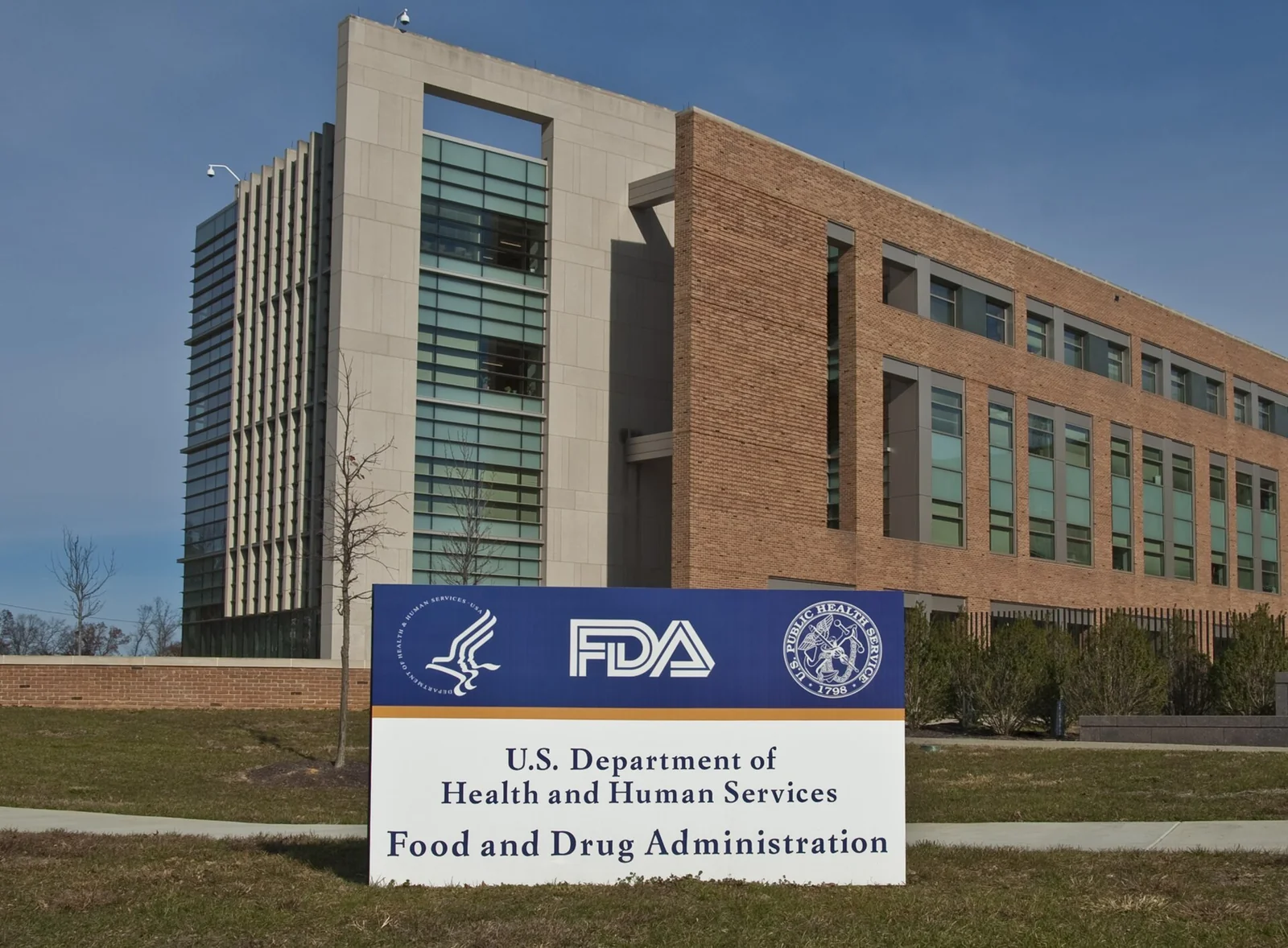
Cover image: White entrance sign bearing the U.S. Food and Drug Administration logo at the White Oak campus, with the brick-and-glass FDA building… — logo by U.S. Food and Drug Administration, public domain — https://commons.wikimedia.org/wiki/File:FDA_Sign_%26_Bldg_21_at_Entrance_(5204602349).jpg