Admina 0.9.1: public release of the AI governance framework
Admina 0.9.1 release notes ā SDK, proxy, plugin system, CLI and dashboard in a single install. Apache 2.0 licence, hybrid Python + Rust engine.
Read morePosts tagged Open Source.
Admina 0.9.1 release notes ā SDK, proxy, plugin system, CLI and dashboard in a single install. Apache 2.0 licence, hybrid Python + Rust engine.
Read moreIn NVIDIA's DGX platforms the interconnect silicon (NVLink, NVSwitch) is proprietary, while the software and mechanical layers around it are public: NCCL under a BSD licence, the GB200 NVL72 rack contributed to the Open Compute Project. Where the line falls between what is documented and reusable and what stays tied to a single vendor.
Read moreNVIDIA's Linux GPU kernel modules have been open source since 2022, but the boundary of that openness runs through the GSP and the closed CUDA user space. What stays proprietary, and why the open driver depends on a closed firmware.
Read moreWith 2.0 the declarative layer derives columns from PEP 484 annotations and the select() API becomes the single form for Core and ORM. What actually changes for anyone maintaining a Python application.
Read moreTechnical notes from the close of SMARTOUR: what it takes to move a multi-tenant Kubernetes system from lab prototype to verifiable deliverable, across headless portals and a standards-drift debt.
Read moreMetal is an explicit, low-overhead model for rendering and compute on Apple GPUs, with a single shader language and unified memory on Apple Silicon. Notes on MSL, MPS/MPSGraph and Metal 3 after WWDC 2022.
Read moreEvery industrial robot maker has its own language. A shared model that crosses brands can be built, but the level you bind it to decides what becomes portable.
Read moreVersion 4.0 of Hugging Face's transformers library (30 November 2020) makes Rust tokenizers and return_dict the default, reorganises the package and splits out sentencepiece. Migration notes and consequences for the shared-model ecosystem.
Read moreTechnical notes on multi-cluster orchestration with Kubernetes, Rancher, GitLab CE and Grafana for hosting the deliverables of a multi-partner research project.
Read moreDjango 3.0 runs under ASGI, yet views, middleware and the ORM stay synchronous. What the new asynchronous handler really enables, and what it defers to the DEP 0009 roadmap.
Read moreThe Jetson Nano announced at GTC 2019 puts 128 Maxwell cores and CUDA 10 into a 99-dollar, 5-10 W device. The interesting part is the continuity of the stack between training on desktop GPUs and inference at the edge, not the price.
Read moreAt KubeCon Seattle (December 2018) Grafana Labs presented Loki, an alpha-stage log aggregator that indexes only the labels of each stream and keeps the compressed content on object storage. Notes on the Cortex-derived architecture and on the cost-versus-search trade-off.
Read morePodman manages containers with a fork-exec model rather than a persistent daemon. Technical notes on the architecture, on rootless via user namespaces, and on current limits, at version 0.12.
Read moreNestJS, a Node.js framework in TypeScript with decorators, dependency injection and modules borrowed from Angular. What the 4.x line offers, and where the cost of the abstraction sits.
Read moreOn 29 March 2017 the CNCF accepted containerd as an incubating project, while CRI-O matured in the Kubernetes incubator. Two answers to the Container Runtime Interface introduced in Kubernetes 1.5.
Read moreGrafana neither collects nor stores metrics: it queries external sources through data source plugins and draws dashboards. Technical notes on a decoupled architecture and on the Apache 2.0 licence.
Read moreWhen a region's data comes from heterogeneous sources, integration is decided on the choice of protocols. A survey of REST, gRPC, GraphQL, MQTT and the OGC standards as of January 2017.
Read moreA fab lab is defined by a shared inventory of machines and a common open-source toolchain. The opening of Fab Lab Toscana in Cascina is an occasion to examine what makes the nodes of the Fab network interoperable.
Read moreOn 26 March 2015 Facebook published the iOS version of React Native on GitHub. Technical notes on native rendering, the asynchronous bridge, and the limits known so far.
Read moreWith version 5.0 (31 March 2015) the 6to5 transpiler, renamed Babel, opens a plugin API and adopts the TC39 process stages. Technical notes on the AST architecture and the chosen defaults.
Read moreHow to read a personal radiofrequency electromagnetic field sensor from a Chrome app over a USB serial port, and why V/m readings only become legible next to the thresholds of ICNIRP 1998 and the Italian DPCM of 8 July 2003.
Read moreOn 19 February 2014 webpack reached version 1.0. Its graph, loaders and code splitting address problems left open by browserify and RequireJS.
Read moreHugo 0.9.0 builds a static site from Markdown with no external runtime: a single Go binary, the Blackfriday engine, html/template, indexes for taxonomies. Technical notes from a hands-on trial.
Read moreTechnical notes on an open-source IaaS stack ā OpenStack, OpenNebula, Eucalyptus ā for the requirements of a tourism and cultural-heritage platform.
Read moreThe Arduino YĆN pairs an ATmega32U4 microcontroller with an Atheros AR9331 SoC running OpenWrt. Technical notes on the serial bridge between the two chips and what changes for anyone prototyping connected objects.
Read moreDocker, open-sourced by dotCloud in March 2013, puts a uniform interface over cgroups, namespaces and a union filesystem already present in the Linux kernel. What changes is not the kernel but the distribution format.
Read moreThe BeagleBone Black ships in April 2013 at $45 with a TI AM335x SoC, 512 MB DDR3, 2 GB eMMC and two 200 MHz PRUs. Next to the core that runs Linux sits a real-time subsystem few same-price boards offer.
Read moreVagrant describes a development virtual machine in a Ruby Vagrantfile and recreates it with vagrant up. The 1.1.0 release, out today, decouples the workflow from the VirtualBox backend through its provider system.
Read moreRFC 6455 standardised WebSocket in December 2011. The least obvious detail is the mandatory XOR masking of client-to-server frames: a rule born from a real attack on transparent proxies, not a stylistic choice.
Read moreArduino 1.0 (30 November 2011) freezes the sketch format and core API: .ino extension, Arduino.h replacing WProgram.h, Stream return values, rewritten String and SoftwareSerial. Notes on the compatibility breaks.
Read moreIn 2011 the production data of a photovoltaic plant lives behind proprietary protocols. The state of open formats and free software that try to make it readable.
Read moreWhy digitising an editorial catalogue is mainly a problem of metadata and content typing, not of storage alone: the role of CMIS, SKOS, DITA and EPUB on top of an Alfresco core.
Read moreOpenStack's third release, Cactus (15 April 2011), brings live migration to Nova and static serving to Swift. Technical notes on the compute architecture and on what is still missing before production.
Read moreLinkedIn open-sourced Kafka in January 2011. Instead of a queue with single-consumption delivery, it builds messaging on top of a persistent, partitioned log.
Read moreOn 29 January 2011 the Hudson community voted to rename the project Jenkins. The code's licence was free; the name and the infrastructure were not. Where the real control of a project sits.
Read moreThe first stable LibreOffice release (25 January 2011) gathers OpenOffice.org 3.3, the Go-oo patches and the Linux distribution patches into a single tree. A technical note on import filters, build and governance.
Read moreA technical reckoning of free software in 2010: from distributed version control to licensing, what really changed in the daily work of standing up sites and applications.
Read moreAdopting free software in the public sector does not end with the licence: someone has to maintain, integrate and support the code over time. A technical note on the role of firms, from the 2010 Tuscan context.
Read morePublishing source code under an open source licence is not the same as surrendering know-how: what remains protectable as a secret and what becomes public, in the light of TRIPS art. 39, Reg. EC 772/2004 and arts. 98-99 of the Italian IP Code.
Read moreROS 1.0, released in January 2010 by Willow Garage under a BSD licence, organises robot software as a graph of processes that talk via publish/subscribe to separate drivers, algorithms and hardware. Architecture, design choices and limits against Player/Stage and earlier middleware.
Read moreArticle 69 of the Italian Digital Administration Code requires public bodies to grant their commissioned software for reuse, in source form and free of charge. I trace the legal chain that led here and the points where the obligation hollows out.
Read moreDoing knowledge management in a risk-analysis setting means indexing heterogeneous, versioned documents. What the open-source stack offers in 2009: semantic wikis, Lucene, Solr.
Read morePuppet 0.24, by Luke Kanies and Reductive Labs, describes a system's configuration as a set of resources with a desired state. Notes on its DSL, catalog, idempotency and agent/master architecture as they stand in 2009.
Read moreHow a visual editor for scientific workflows is translated into WS-BPEL executable on a Globus grid, and why the dataflow the biologist draws does not coincide with BPEL's web-service orchestration model.
Read moreTechnical notes on Xen paravirtualisation, live migration and the running cost of a server estate, written alongside a seminar on free software in public administration.
Read moreTechnical notes on building, in 2009, the website for a bimonthly magazine: an open-source CMS, RSS/Atom feeds, PDF distribution, and the problem of keeping the conversation alive between one issue and the next.
Read morePloneGov brings a co-operative model for the public sector to Italy, built on Plone: bodies pooling code instead of re-purchasing the same applications. Technical notes and the limits of the model.
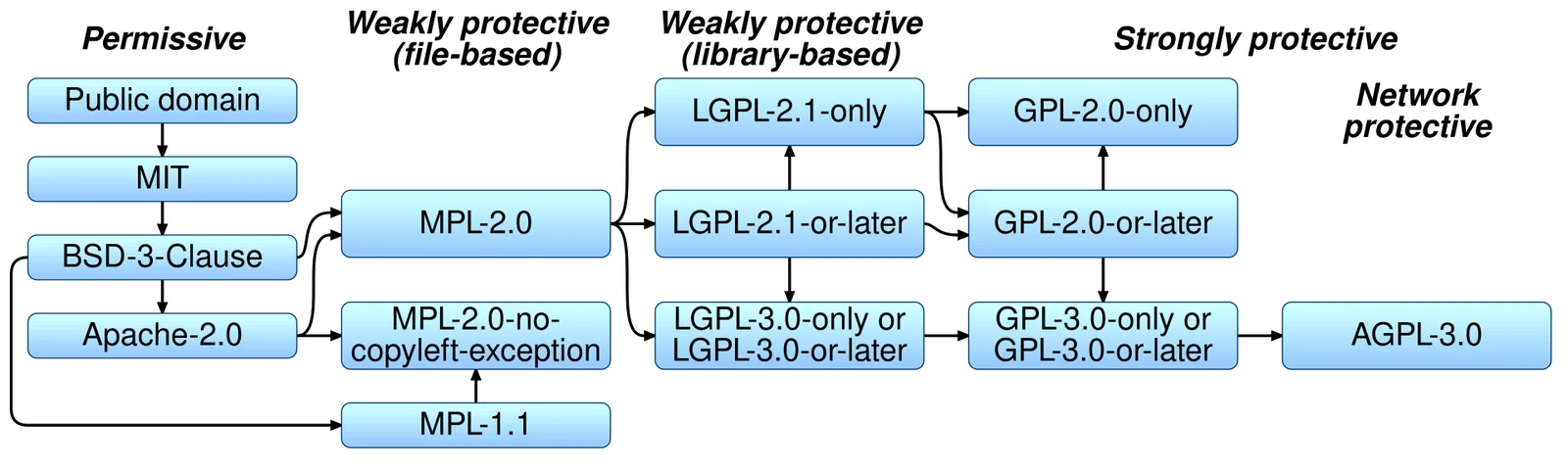
Read moreCompatibility between open licences, and between open and proprietary ones, depends on the clauses, not on the code. GPLv2, GPLv3, LGPL, MPL 1.1, BSD and Apache 2.0 compared, with Italian law 633/1941 in the background.
Read moreOn 9 February 2008 a RepRap 1.0 Darwin produced more than half of its own printed parts. Technical notes on partial self-replication, the GPL licence and the 2008 FDM software chain.
Read moreThe day before the second PyCon Italia, Python 2.6a3 and 3.0a5 ship: notes on migrating the language and on the state of the WSGI web ecosystem.
Read morePostgreSQL 8.3, released on 4 February 2008, brings full-text search and HOT updates into the core. A technical note on MVCC, GIN/GiST indexes, and what it means for a database to absorb functions previously left to external modules.
Read moreMonths after GPLv3 and on the eve of Linux Day, a technical note on licences, proliferation and compatibility: what it now means to talk about free knowledge.
Read moreOn 29 June 2007 the FSF published version 3 of the GNU GPL. Anti-tivoization, an explicit patent grant and Apache 2.0 compatibility redraw the boundary of copyleft, while the Linux kernel stays on v2.
Read moreAs the FP6 MindRACES project closes, a technical look at the open-source AKIRA framework: a daemon pandemonium, an energy model and schemas for anticipatory agents.
Read moreGlobus Toolkit 4 gives state to stateless web services with WSRF and delegates credentials with X.509 proxy certificates (RFC 3820). How the open-source grid middleware reuses existing standards instead of reinventing them.
Read moreTechnical notes on how a web portal plugs into the X.509 authentication of a computing grid, between Grid Security Infrastructure, RFC 3820 proxy certificates and accredited certification authorities.
Read moreWorking on free software, you sell the services around the code, not the licence. A technical note on the subscription model and the state of licensing at the close of 2006.
Read moreWith OpenCV 1.0 and LIBSVM the defect-detection pipeline on a production line becomes reproducible outside the lab: features, classifiers, and the point where precision is actually lost.
Read moreThe first Maker Faire (San Mateo, 22-23 April 2006) brings to the fair projects whose value lies in reproducible documentation, not in the specimen on display. Technical notes on licences, schematics and the reproducibility of open hardware.
Read moreSince June 2005 there has been a standard Java API for reading from and writing to a content repository. What changes for open-source document management, and why repository portability weighs more than any single product.
Read moreShipping training material offline on a CD-ROM forces a format decision: a proprietary authoring tool tied to one platform, or XHTML/CSS files read locally by a browser. The second path outlives the vendor.
Read moreAt the Interaction Design Institute Ivrea, an ATmega8 board is going around, aimed at people who are not engineers: published schematics, the AVR toolchain hidden behind setup() and loop(), a parts cost under thirty euros. Technical notes by Stefano Noferi.
Read moreThe directive of 19 December 2003 requires Italian public bodies to assess open source software and open data formats. Technical notes on how a Province portal is built today on a free stack.
Read moregit keeps a project's history as a graph of immutable objects, each named by its own SHA-1. What that changes for integrity, branches and distributed work, and where the weak point sits.
Read morepapiNet and ebXML (ISO/TS 15000) give B2B exchanges in the paper supply chain a shared vocabulary. Technical notes on schemas, messaging and transport, from the point of view of someone building portals for the sector.
Read moreAs of a few days ago there is an association of Zope and Plone users in Italy. I note why a Python-based server stack needs local coordination, and which technical knots make it hard to sustain without a structured community.
Read moreAn industrial research project on a CMS can prototype on one Open Source stack and ship the definitive platform on another. When the two phases diverge, the verifiable legacy is the analysis and the modular design, more than the prototype's code.
Read moreSince 2002 MIT's Center for Bits and Atoms has been replicating a small group of computer-controlled machines ā roughly 20,000 dollars of equipment ā outside the campus, in Costa Rica, India, Norway and Boston. Technical notes on the model, the software and the limits, as of mid-2004.
Read moreThe proposed European directive on the patentability of computer-implemented inventions reopens a question that Article 52 of the European Patent Convention had already bounded. A technical reading of the text, the Parliament's amendments, and what is at stake for those who write software.
Read moreSubversion 1.0 (23 February 2004) treats a commit as a transaction and versions directories. Technical notes on the Berkeley DB backend, the mod_dav_svn transport over WebDAV/DeltaV, and branches built as copies.
Read moreTechnical notes on a master-slave architecture for a learned society's membership data: an authoritative LDAP directory on site, encrypted replication to a web front-end in hosting, an open-source stack.
Read moreFreeBSD ships kernel, userland and documentation in one source tree under the BSD licence. A technical note on the practical consequences of that model versus assembling a Linux distribution, as of the 4.8 release.
Read moreNotes after a day spent discussing open source in public administration: the problem is not how much a licence costs, but who holds the data formats, the code, and the continuity of the service.
Read moreThe Open Source Definition sets ten criteria a licence must satisfy for OSI certification. The approved licences sit along one axis: strong copyleft, weak copyleft, permissive.
Read moreAn application server with an object database and a content management framework keep content, presentation and workflow separate. Technical notes on Zope and the CMF, and on why the Open Source approach holds up against enterprise products.
Read moreWhy a content management platform should treat multi-channel publishing as a chain of XML transformations, and what it actually takes to get there in 2002.
Read moreThe dual-licence model of MySQL, Qt and Berkeley DB rests on the GPL's reciprocity. A technical anatomy of a 2002 mechanism.
Read moreThe questions put to the Pisa panel already have a measurable answer in 2002: filed licences, foundation governance and third-party market share, not opinion.
Read moreTechnical notes on using Linux, Apache and GPL licensing inside a technology park near Pisa, in the spring of 2002.
Read moreBash 2.05a is a free rewrite of the Bourne shell that extends POSIX.2. Writing portable scripts means choosing when to lean on the extensions and when to stop at the standard.
Read moreJabber routes messages and presence between independent servers via dialback, and bridges the closed networks with transports. Technical notes on a streaming-XML protocol in 2001.
Read moreAn editorial archive with several editors needs explicit publication states and per-transition permissions. DCWorkflow, in Zope CMF, models this as a state machine, kept out of the content type code.
Read moreWhat it takes to serve a high-traffic editorial site on a fully open-source stack: object database, acquisition, page templates and scaling with ZEO.
Read moreBetween 2000 and 2001 the rights to Python changed hands three times. The founding of the Python Software Foundation closes a season of fragmented licences and shows why a project's governance weighs as much as its code.
Read moreIn February 2001 Apache serves nearly 60% of the sites Netcraft found. How the 1.3 prefork works, what the Multi-Processing Modules in the 2.0 development tree change, and why the licence and the governance weigh as much as the code.
Read moreThe network services a small office LAN needs already exist as mature open-source projects. The hard part is making them coexist on one administrable machine.
Read moreDescribe the tables once, in a metadata file, and generate the DDL, queries and forms from there: what holds and what stays manual.
Read moreThe new Zend Engine separates parsing from execution: what actually changes in server-side work, and what it leaves uncovered.
Read moreThe 2.2 kernel keeps everything in kernel space yet loads and unloads code while the machine is running ā a middle way relative to the 1992 microkernel argument.
Read moreIn amateur packet radio the AX.25 link layer carries no routing at all: incompatible network protocols live on top of it. Technical notes on how a Linux node terminates and translates between them on a single machine.
Read moreFree software is defined by the permissions it grants over source code, not by its price. What the four freedoms guarantee and why copyleft makes them inherited.
Read moreWhat actually changes when a small company builds its infrastructure on open-source software: licences, copyleft, supplier dependence.
Read moreBringing amateur packet radio onto Linux means moving the AX.25 and NET/ROM stack into a kernel whose code you can read and fix. An account of the work done at the ARI section in Pisa: patches to the kernel, libraries and tools, the IP-over-radio bridge on the 44/8 network and an IP-IP tunnel to Tampa.
Read more