
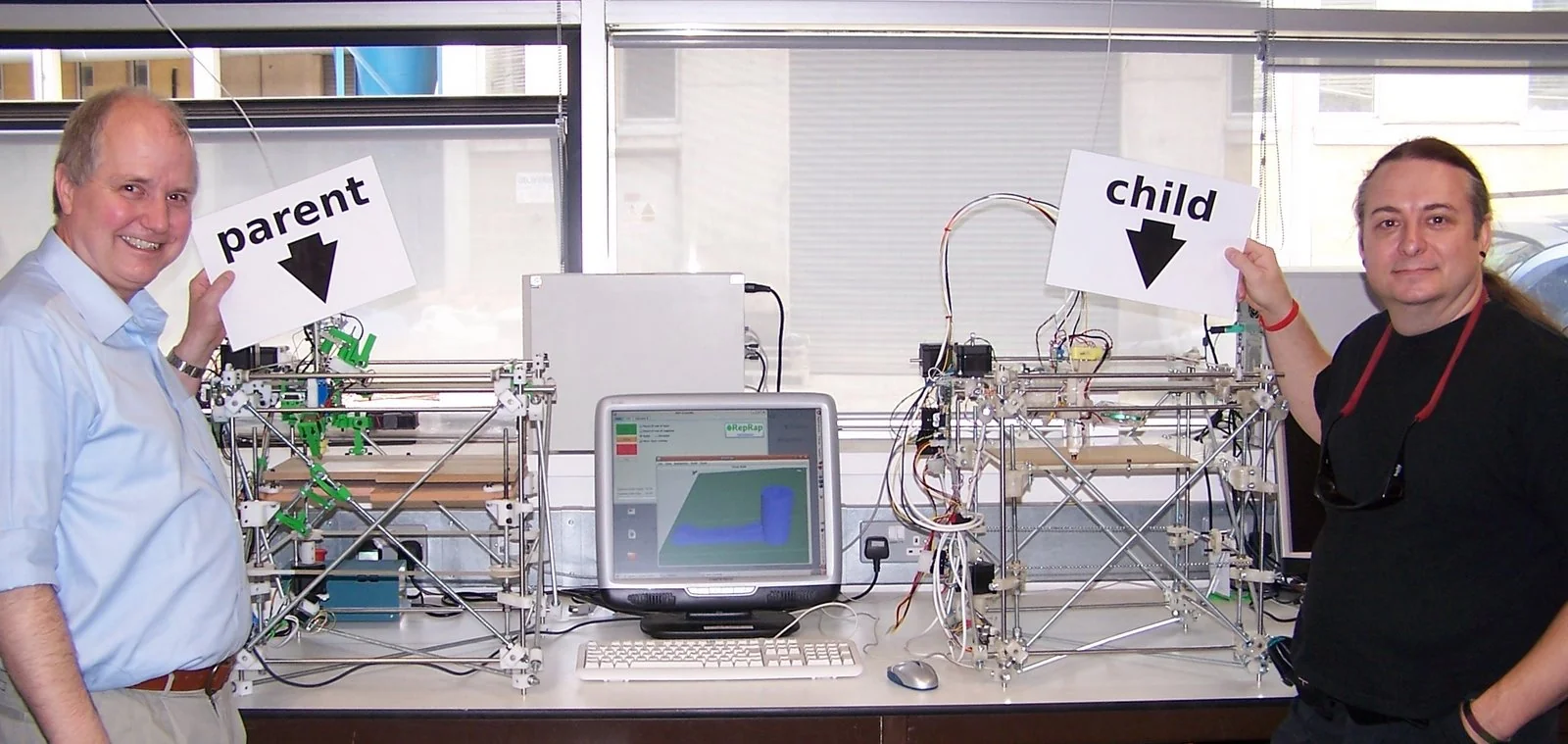
On 9 February 2008 a RepRap 1.0 “Darwin” printed more than half of its own plastic parts, which were then assembled into a second working machine. It is the first concrete test of the claim Adrian Bowyer, a lecturer in mechanical engineering at the University of Bath, had set out in 2005: a Fused Deposition Modelling (FDM) printer can fabricate a good share of itself, and the design can circulate under a free licence the way software does.
Context
In 2005 commercial FDM machines cost tens of thousands of euros and were covered by patents. The original FDM process patent, filed by Stratasys in the late 1980s, was approaching expiry, and that opened a space which had been closed until then. Bowyer built RepRap (Replicating Rapid-prototyper) around a stated constraint: maximise the fraction of components the machine can produce itself, and reduce the rest to bolts, threaded rod, stepper motors and electronics you can buy over the counter at a hardware shop or a component distributor.
The knot is the licensing regime. RepRap’s mechanical designs and software are released under the GNU General Public Licence (GPL). Anyone may download them, modify them, build a machine and sell copies or derivatives, provided the modifications stay free. It is the same mechanism that made free software copyable, applied to physical objects.
Architecture
Darwin is a cubic frame made of M8 threaded rod and printed joints that form its vertices. Three Cartesian axes run on the cube, driven by stepper motors and toothed belts. The extrusion head pulls a plastic filament — in 2008 mostly polylactic acid (PLA) and acrylonitrile butadiene styrene (ABS) — through a resistive heater and lays it down layer by layer along a path computed upstream.
The self-replicating fraction is partial, and worth reading with care. Darwin prints its own joints, brackets, supports and carriages: the free-geometry parts. It does not print the threaded rod, the bearings, the motors, the heating resistors or the electronics. This is why Bowyer speaks of self-replication as an asymptotic goal, not an achieved state. The February 2008 figure — more than 50% of the printed parts reproduced — says exactly that: the machine made its own printable parts, not the whole machine.
Software chain
In 2008 the chain that takes a model to an object is wholly free but fragmented, and it is the weakest point of the set. Two CAM toolchains coexist:
- RepRap Host, written in Java by Adrian Bowyer, which drives the machine directly.
- Skeinforge, a chain of Python scripts by Enrique Perez, which converts a triangulated model in STL format into
G-code, the numerical-control language inherited from machine tools.
The G-code then goes to the machine’s electronics, which in 2008 run on microcontrollers and self-built motor-control boards documented on the project wiki. In parallel Forrest Higgs carries on Tommelise, a machine and a piece of software aimed at even lower cost and complexity. In a young project this variety is healthy, but whoever assembles a RepRap has to make pieces of software agree by hand, written by different people, in different languages, with G-code conventions that do not quite line up.
The critical point
Partial self-replication has a second-order effect, and this is where the project is decided: the cost curve. A machine that prints its own complex-geometry parts shifts the marginal cost of a new unit towards the price of raw materials — filament, bolts, motors — plus the assembler’s time. Under the GPL, where anyone may sell derivative kits, a race to the bottom starts among independent suppliers.
The effect is already visible. A bench FDM machine that started at five or six thousand euros in 2006-2007 is found in 2008, as a RepRap kit or derivative, around two to three thousand, and the price falls as the number of people who can print and resell the joints grows. It was predictable: the drawings and documentation are free, and part of the production is done by the machines that already exist.
Limits
As of June 2008 RepRap is not a machine for someone unwilling to get their hands dirty. Assembly asks for soldering, mechanical alignment of the axes, thermal calibration of the extruder and plenty of patience for the prints that fail. Dimensional repeatability is modest compared with commercial machines; the extruder clogs; ABS warps as it cools and deforms large parts. The non-printable fraction — motors, rod, electronics — stays tied to external suppliers, so “self-reproduction” holds for the printable subset, not for the whole machine.
Bowyer says it openly, and the long-term question stays open: how far can the self-replicating fraction grow before it meets a physical limit? Printing a bearing or a stepper motor with a single-material extruder is not on the 2008 horizon. What can be verified today is more sober, and enough: a machine exists whose free geometry is produced by itself, whose drawings sit under GPL, and which on 9 February showed the step from one instance to the next.
- https://reprap.org/wiki/Main_Page
- https://reprap.org/wiki/Darwin
- https://reprap.org/wiki/Skeinforge
- https://www.gnu.org/licenses/gpl.html
- https://www.noze.it/en/insights/reprap-prusa-stampa-3d/
Cover image: Adrian Bowyer, founder of RepRap, and Vik Olliver with two RepRap Darwin machines: on the left the ‘parent’ machine, on the right the first RepRap it produced — photo by SteveBaker, CC BY-SA 3.0 — https://commons.wikimedia.org/wiki/File:First_replication.jpg