
The European project MindRACES — from Reactive to Anticipatory Cognitive Embodied Systems, FP6-511931 — is closing after a little over three years of work on cognitive architectures able to anticipate the consequences of their own actions. Among the software results is AKIRA, an open-source C++ framework for building agents, developed mainly at ISTC-CNR in Rome and available on SourceForge. I look at it closely because its design choices are less obvious than the word “anticipation” might suggest.
Context
MindRACES started in October 2004 and brought together eight partners: ISTC-CNR as coordinator, IDSIA in Lugano, Instituto Superior Técnico in Lisbon, Lund University, the New Bulgarian University, ÖFAI in Vienna, the University of Würzburg, and an Italian industrial partner. The stated goal was to study mechanisms and architectures for cognitive systems able to predict the outcome of their actions, build a model of future events, control perception by anticipating stimuli, and react to hypothetical scenarios.
Here anticipation is not a function added on top of a reactive agent. It is a constraint that runs through the whole architecture: perception, action selection, attention, categorisation. Hence the decision to start not from a symbolic agent to which prediction is added later, but from an infrastructure where distributed representations and predictive loops are primitives.
Architecture
AKIRA brings together two traditions that usually stay apart: a Multi-Agent System (MAS) and a pandemonium in Selfridge’s sense. The kernel is in fact called Pandemonium and acts as the management structure: it initialises the system, launches and watches over the Daemons, and administers a shared Blackboard.
The Daemons are active objects, each with its own thread of execution, and they carry connectionist features inside them. What matters is how they are scheduled. No round-robin loop, no static priority: the Daemons access a central Energy Pool concurrently, drawing activation from it or releasing it, spreading it to the others through energetic links that are predefined or able to evolve over time. The energy a daemon holds decides how much it “weighs” in the competition, in the same way activation and saliency made Selfridge’s demons shout more or less loudly.
What comes out is a model of parallel, dynamic, context-sensitive computation: no central controller sets the sequence of operations; behaviour emerges from the distribution of energy among processes that compete and cooperate. It is an old idea — the pandemonium dates to 1959 — put back to work with modern tools: real threads, a shared blackboard, a library that places KQML for inter-agent communication alongside fuzzy logic, neural networks, fuzzy cognitive maps and a distributed BDI model (DIPRA).
The critical point
On this base runs the part that bears closely on MindRACES: the schema language, the AKIRA Schema Language (AKSL). A schema, in the tradition running from Piaget to Arbib, is a sensorimotor structure tying a perceptual condition, an action and a prediction of the effect. With AKSL you describe schema-based architectures in which anticipation is not a separate module but the mechanism that makes the other functions work.
This is the conceptual knot. Within a schema the predictor — the forward model that says “if I perform this action, I expect this stimulus” — serves several things at once. It serves to choose the action: among several applicable schemas, the one whose prediction best fits the goal wins. It serves to direct attention: the agent looks where it expects something relevant to happen. It serves to categorise: I recognise an object by how I predict it will react if I interact with it. It even serves to anchor declarative knowledge to the sensorimotor, because a symbol such as “chair” sits attached to the set of predictions about what I can do with it.
The same predictor, then, is reused by functions that in classical architectures are distinct modules. It is a parsimony choice: a single mechanism — the comparison between prediction and reality, the prediction error — instead of many specialised subsystems. Building it on an energy substrate makes sense, because a schema’s prediction error translates directly into a change of energy, and so the competition between schemas needs no external arbiter.
Implications
Bringing MAS, pandemonium and schemas together is less common than it looks. The cognitive architectures of the period tend to sit on one side: either symbolic and modular (ACT-R, Soar), or connectionist and low-level. AKIRA tries to hold both registers together — the documentation calls it “hybridism of the daemons” — letting distributed representations and symbolic protocols such as KQML coexist in one system. For anyone building embodied agents the point weighs: the perceptual-motor part wants continuous, parallel representations, while coordination and communication want discrete messages.
That the code is open-source and on SourceForge is not a detail. A cognitive architecture described only in papers stays hard to replicate: the details that decide everything — exactly how energy propagates, which threshold activates a daemon — do not fit in a paper. With the C++ available the choices can be inspected and the experiments re-run, even by people who did not work on the project. That is the difference between a result and a tool. The consortium’s Italian industrial partner is noze, which documents the project’s closure and its own role in the development and validation of the architectures in a dedicated insight: https://www.noze.it/en/insights/mindraces-conclusion/.
Limits
AKIRA remains research software, with all that entails. The project is declared to be in alpha state; the documentation takes for granted familiarity with the literature on pandemonium, BDI and schema theory; for outsiders the curve is steep. The energy model, which is the heart of the system, is also the most delicate part to tune: the weights of the energetic links and the activation thresholds must be calibrated for each experiment, and little documentation explains how to do so systematically.
More generally, the usual caution applies to any system that calls itself “anticipatory”. Anticipating, here, means something precise and verifiable — comparing the prediction generated by a schema with the observation that follows, and using the error to modulate behaviour — not a general ability to imagine the future. MindRACES produced robotic and software prototypes showing this mechanism at work on bounded tasks; drawing from them conclusions about intelligence in general would be a scale error. What remains, and merits study, is a piece of code that puts prediction error at the centre of an architecture, and not at its margins.
- https://www.istc.cnr.it/en/project/mindraces-reactive-anticipatory-cognitive-embodied-systems
- https://www.mindraces.org/
- https://sourceforge.net/projects/a-k-i-r-a/
- https://link.springer.com/chapter/10.1007/978-3-540-74262-3_8
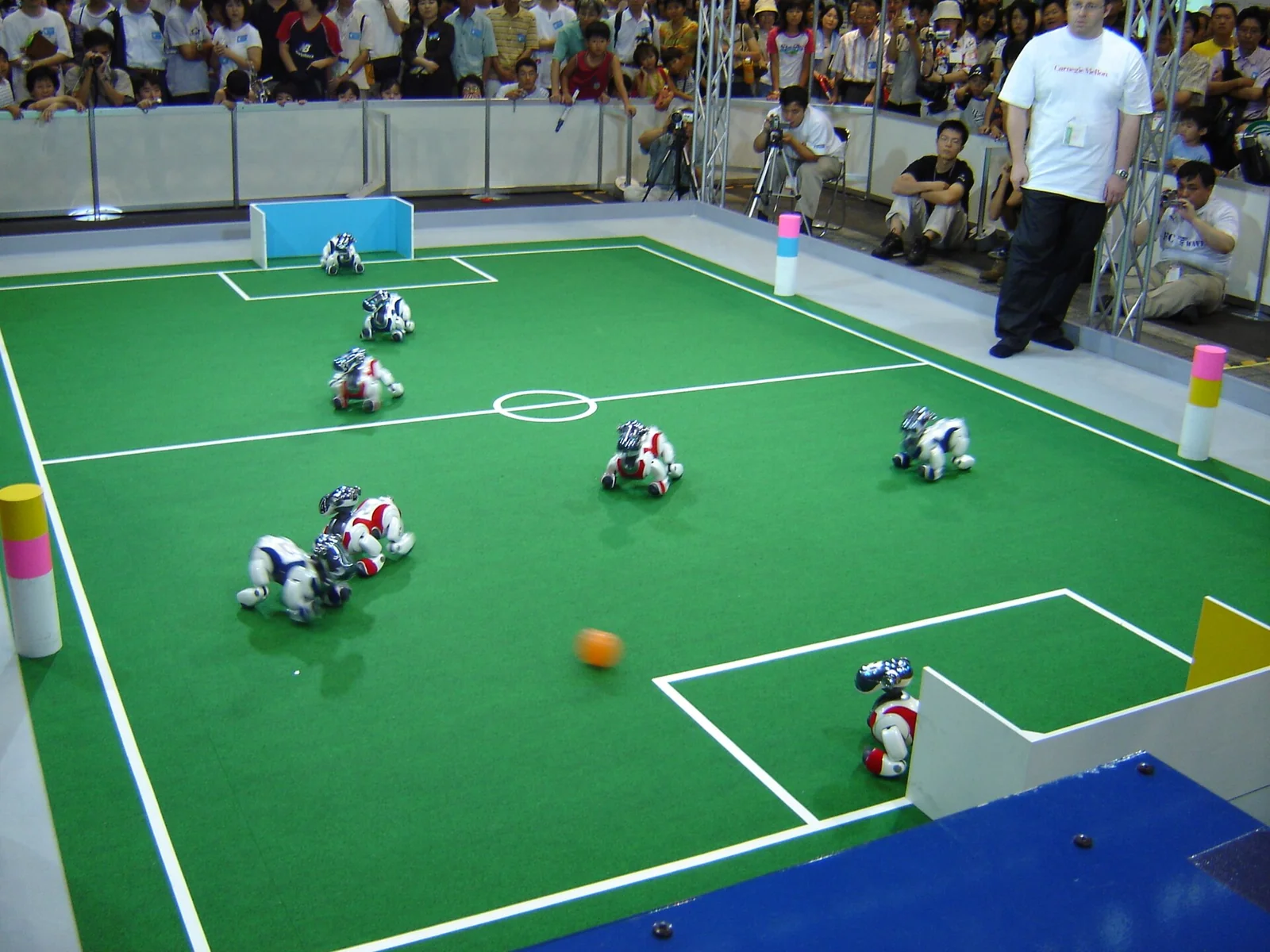
Cover image: Several Sony AIBO ERS-7 robot dogs arranged on a green field playing football during a robotics competition — photo by learza, CC BY-SA 2.0 — https://commons.wikimedia.org/wiki/File:Aibos_playing_football_at_Robocup_2005.jpg