
On 29 June 2007 the Free Software Foundation published the GNU General Public License version 3, the first revision of the most widely used free-software licence since version 2 appeared in 1991. Four months on, that event shifts the practical problem facing anyone who writes or adopts free software: no longer “is it free or not”, but “does this free code combine with that other free code”.
Context
In Italy, autumn 2007 gathers a number of initiatives on the subject. On 27 October there is the Linux Day, coordinated by the Italian Linux Society and run on the ground by the LUGs across more than a hundred towns, with free admission as an explicit requirement of the event. In the same weeks the Tuscany Region hosts, within the Festival della Creatività at the Fortezza da Basso in Florence, two days devoted to free knowledge under the QuiFree banner.
The phrase “free knowledge” widens the discussion beyond software: public data, teaching material, document formats. But the technical core remains software, and there the legal picture has just shifted in a substantial way.
The licence problem
The Open Source Definition, maintained by the Open Source Initiative, has stood at version 1.9 since 22 March 2007. It sets ten criteria a licence must meet to call itself open source: free redistribution, available source code, permitted derived works, no discrimination against persons or fields of endeavour, and so on. It is an admission test, not a guarantee of interoperability.
The point is that the OSI has approved dozens of licences conforming to the Definition, and those licences are not compatible with each other. Code released under a licence with a copyleft clause cannot be combined and redistributed under an incompatible licence, even when both honour the same ten criteria. Conformance to the Definition says a licence is free; it does not say two free licences may sit together in the same executable.
The OSI has acknowledged the phenomenon by opening work on licence proliferation, proposing to group licences into tiers and to discourage the creation of further redundant ones. The problem is structural: every organisation that publishes its own licence, conforming though it may be, adds a node to a compatibility graph that grows harder to traverse.
What GPLv3 introduces
GPLv3, written by Richard Stallman with legal counsel from Eben Moglen and Richard Fontana of the Software Freedom Law Center, after eighteen months of public consultation and four drafts, acts on three fronts that version 2 did not cover.
First, patents: anyone distributing software under GPLv3 grants an explicit licence to the patents they hold and that the software puts into practice, and the licence neutralises arrangements of the Microsoft-Novell sort from November 2006, where a distributor obtained selective patent cover for its own customers.
Second, so-called tivoisation: devices that run GPL software yet refuse to boot user-modified versions, blocked by a hardware signature. For consumer products, GPLv3 requires delivery of the installation information needed to run the modified code.
Third, compatibility: GPLv3 is drafted to accept code released under certain previously incompatible licences, and so widens the set of lawful combinations.
The critical point
The practical snag is that GPLv2 and GPLv3 are not compatible with each other in the general case. A project released as “GPLv2 only” cannot incorporate “GPLv3 only” code, and vice versa. The “or later” clause — the GPLv2 or any later version formula present in many long-standing projects — allows migration, but those who deliberately chose version 2 alone, the Linux kernel among them, stay on a separate track.
This means that, from 29 June 2007 onward, the existing body of free software splits into three sets: code that can migrate to GPLv3, code bound to GPLv2 only, and code under other copyleft or permissive licences. Whoever assembles a system — a distribution, an embedded product, a service — must check that the sets being combined are compatible, and that check cannot be automated by reading the “open source” label alone.
Implications for adopters
For a company or a public body weighing up free software, the operating consequence is that knowing whether a component is free is not enough to settle the question. The concrete checks lie elsewhere: under which exact licence the component sits; whether it carries the “or later” clause; whether it is statically or dynamically linked with other components under a different licence; whether the intended redistribution — selling a device, offering a networked service — triggers specific obligations.
A mature distribution makes that check workable. Ubuntu 7.10, released on 18 October 2007, divides packages into components by licence and support status (main, universe, multiverse, restricted): at repository level it states what the “open source” label alone leaves unsaid. Part of a distribution’s value, read this way, lies in the legal curation it carries with it.
Limits
All of this concerns software. “Free knowledge” includes material for which software licences are unsuited: for text, images and data there are separate licence families — Creative Commons, the GNU Free Documentation License — with their own attribution, share-alike and commercial-use clauses, and with mutual-compatibility problems similar to those of software but not coextensive with them. Treating a dataset or a set of lecture notes by the same criteria as a C library is a mistake.
There remains, too, a distinction the popular debate tends to blur: “free” in the FSF sense and “open source” in the OSI sense pick out sets of licences that nearly coincide yet are not identical, and they start from different motivations. For technical decisions what counts is the actual set of admitted licences, not the label used to name it.
The Florence programme gives room to installing Ubuntu, reusing old PCs and certification: practice, not principle. That is the right level at which to measure whether free knowledge is genuinely adoptable by people who do not write code, or whether it stays a matter for specialists. On that test bench, at the Fortezza da Basso, noze is there too, present at QuiFree.it during the Festival della Creatività: the account is in the insight published by noze https://www.noze.it/en/insights/quifree-creativity-festival/.
- https://www.fsf.org/news/gplv3_launched
- https://www.gnu.org/licenses/quick-guide-gplv3.en.html
- https://opensource.org/osd
- https://web.archive.org/web/20130922092453/http://www.linuxday.it/2007/
- https://wiki.ubuntu.com/GutsyGibbon
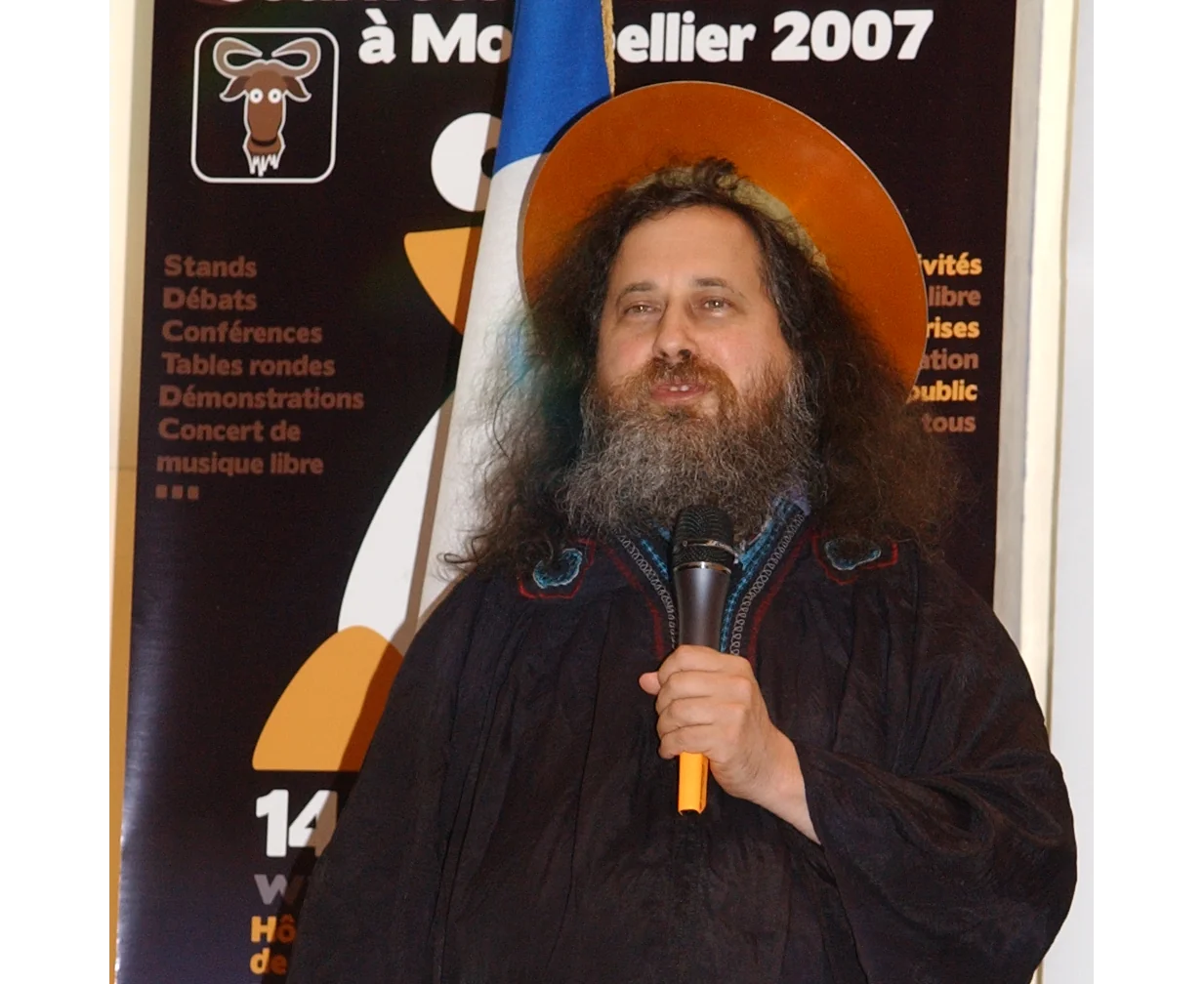
Cover image: Richard Stallman photographed at a 2007 conference, bearded and with long hair, looking to the side — photo by Boro, CC BY-SA 3.0 — https://commons.wikimedia.org/wiki/File:Richard_stallman_portrait.png