
«Epochal shift or flash in the pan?» is a question that, for the most part, can already be answered from public 2002 data: filed licences, foundation governance rules, market share measured by third parties. Tonight in Pisa, at the First Tuesday Italy meeting, I am at the table with a representative of Microsoft Italia, the academy (Scuola Superiore Sant’Anna), public administration (Comune di Pisa) and other engineers. What follows is the set of facts on which, in my view, the debate should be framed.
The question is badly framed
«Open source» is neither a market nor a technology: it is an attribute of the licence under which a program is distributed. The operative reference is the Open Source Definition, which the Open Source Initiative (OSI) published in 1998 starting from Bruce Perens’s Debian Free Software Guidelines. It lists ten verifiable criteria: free redistribution, availability of source code, the right to derived works, no discrimination against persons or fields of use. A licence either meets them or it does not, with no middle ground.
Asking whether «open source» will last therefore means asking whether software already distributed under the GNU General Public License (GPL, version 2 from 1991), BSD (Berkeley Software Distribution) or the Apache License will continue to exist. Code already released under the GPL cannot be withdrawn after the fact: for copies already distributed the licence is perpetual and irrevocable. That is a property of the legal text, not a market forecast.
The licence as mechanism
It helps to distinguish two families, because they drive different economics.
The GPL is copyleft: anyone distributing a derived work must distribute it under the same licence, with source available. The constraint propagates. This is why the Linux kernel, under GPLv2, cannot be closed inside a proprietary product without infringing it: whoever modifies and redistributes it must release the modifications.
BSD, MIT (Massachusetts Institute of Technology) and Apache-style licences are permissive: they allow redistribution in proprietary form too. The Apache web server is under the Apache licence, so its code can end up inside closed commercial products with no duty to give back. These are two opposite strategies on the same axis: the permissive one drives adoption, copyleft drives the return of code to the community.
The licence you choose decides which business model holds downstream: it sets who can earn what, before any technical choice.
Governance is the litmus test
A phenomenon is transient when it depends on a single actor; it is structural when a legal entity exists that can outlive its founders. In 2002 that entity is there, in mature form.
The Apache Software Foundation, incorporated in 1999 as a Delaware non-profit, owns the trademark, holds the rights to contributed code, and governs projects under a documented meritocratic model: commits, committer votes, an elected board. The same goes for the Free Software Foundation, which since 1985 has held the copyright on parts of the GNU project precisely so it can enforce the GPL in court. When code and trademark sit with a foundation, the disappearance of a single corporate sponsor does not close the project.
Market share is also measured, from independent sources. Netcraft’s 2001 surveys credit Apache with an absolute majority of active web servers, with a wide margin over the proprietary competitor. This is the figure I find decisive: no forecast is needed when a dominant position already exists, measured every month by a third party across a sample of millions of hosts. A «flash in the pan» does not hold the majority of the Web’s infrastructure for years.
The economic model already exists
The usual objection — «how do you earn money giving the code away?» — has concrete answers in 2002, not hypotheses.
Red Hat distributes the operating system with source available and sells support, certification and maintenance subscriptions for business use. Revenue does not come from a usage licence but from the continuing service around the software. On the desktop, OpenOffice.org 1.0 shipped on 1 May 2002 under the LGPL (GNU Lesser General Public License): it shares its code base with Sun Microsystems’s StarOffice 6.0, sold commercially. The same code feeds a free community distribution and a paid, supported product. The dual-licence/dual-distribution model is already in production, not an experiment.
For public administration the lever is source availability, more than price: being able to inspect, fix and maintain the software without depending on the original vendor reduces lock-in. In Italy the topic has entered the institutional agenda: in March 2002 Parliament debated a motion on introducing and spreading free software across public administration. The technical reason is the same one that leads a body to prefer documented formats and protocols: continuity of service beyond the term of the contract.
What the 2002 data does not say
Three things remain open and, honestly, are not settled tonight.
The first is the sustainability of funding for non-commercial projects. A foundation owns the trademark and the copyright, but the work is done by people who must be paid, and the volunteer-contribution-plus-corporate-sponsor model has not yet proven robust over a decade-long horizon. The second is application coverage: Apache’s dominance on the web does not transfer automatically to the desktop or to vertical business software, where the open offering in 2002 is still patchy. The third is interoperability with the proprietary formats that have become de facto standards: a cost that falls on open software and does not run out.
The open questions are there. But they are about share, funding and coverage — quantities you measure over time — not about the existence of the phenomenon. That much is already written in the filed licences and the foundations’ charters, and it is not withdrawn by a press release.
The position I bring to the table as CTO of noze — the SME that builds its business on Open Source — is recounted in the insight noze published on the panel: https://www.noze.it/en/insights/first-tuesday-pisa/.
https://opensource.org/osd https://www.gnu.org/licenses/gpl-2.0.html https://www.apache.org/foundation/ https://news.netcraft.com/archives/web_server_survey.html https://www.redhat.com/ https://www.openoffice.org/about_us/ooo_release.html
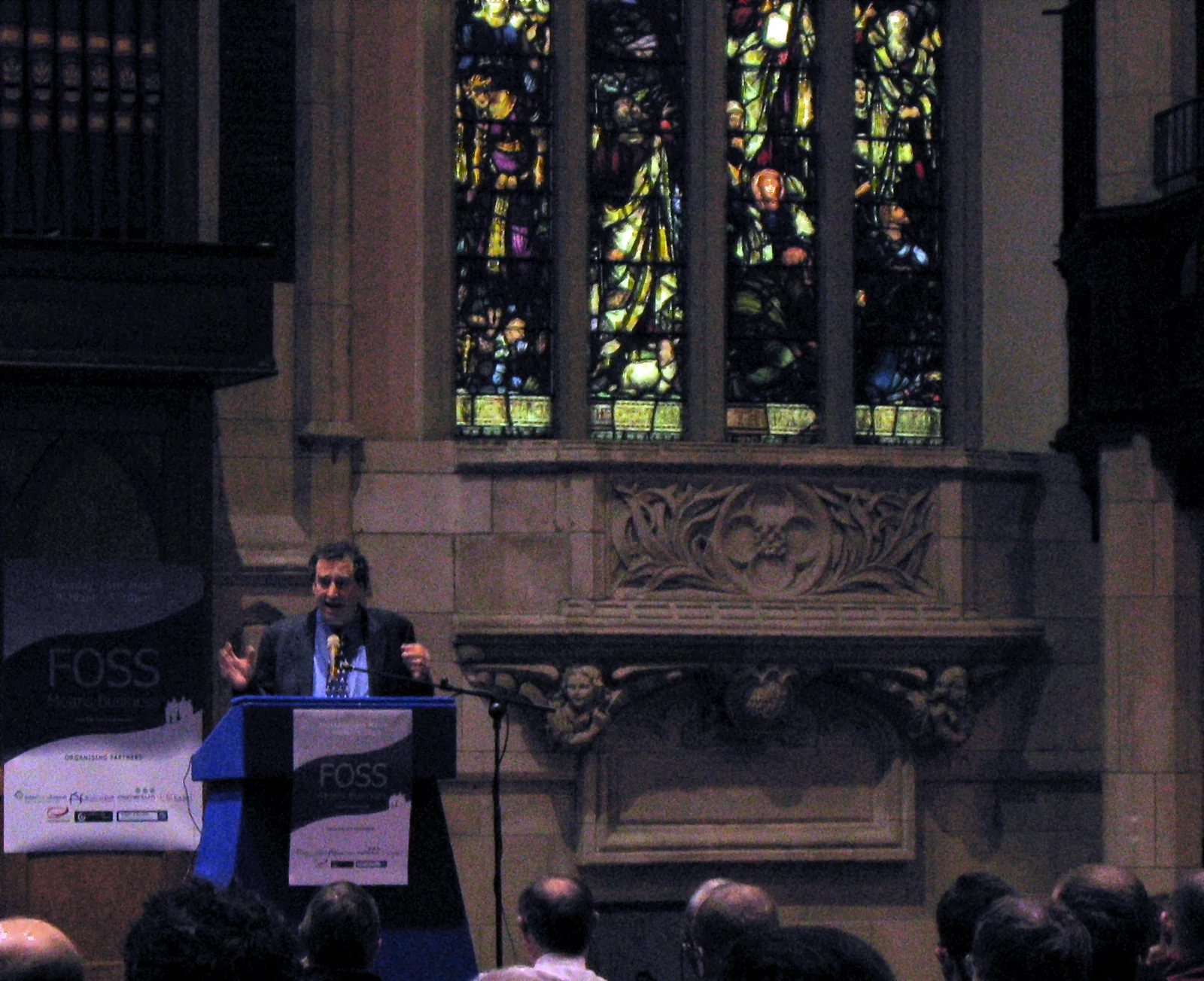
Cover image: Bruce Perens, a bespectacled man, speaking at a free-software event; close-up shot of the speaker — photo by Glenn Strong, CC BY-SA 2.0 — https://commons.wikimedia.org/wiki/File:Bruce_Perens_Belfast_2006.jpg