
For a few weeks now I have been working inside the Polo Tecnologico di Navacchio, on the edge of Pisa. These notes gather what changes, in technical terms, in developing with free software inside a park full of companies rather than in an isolated office.
Context
The Polo Tecnologico di Navacchio has operated since 2000 in the municipality of Cascina, a few kilometres from Pisa, as a facility for hosting technology-oriented firms (polotecnologico.it). Its closeness to the University of Pisa, the Scuola Superiore Sant’Anna and the local branches of the Consiglio Nazionale delle Ricerche (CNR) is the starting fact: networks, people and equipment that until a few years earlier stayed inside academic settings become reachable at short range.
The point I care about is narrow. Anyone building systems on free components — the Linux kernel, the Apache web server, the GNU toolchain — finds, in a setting like this, that the way skills and configurations circulate changes. That is what changes, not the address printed on a business card.
The state of free software in May 2002
It is worth pinning down the facts at the time of writing, because the picture is moving quickly.
The Linux 2.4 kernel series has been stable since 4 January 2001 (kernel.org), and from that date it brings into production support for journalled filesystems, USB and a more robust networking stack than the 2.2 series. On the server side, the Netcraft survey of April 2002 assigns roughly 64% of detected active web servers to Apache, against about 27% for Microsoft Internet Information Services (IIS) (news.netcraft.com). On the desktop, KDE 3.0 came out on 3 April 2002 (kde.org) and moves the graphical environment onto a more mature Qt 3 base.
The licence that holds most of this stack together remains the GNU General Public License version 2, published in 1991 (gnu.org). Its copyleft — whoever distributes a derivative work also distributes its source under the same licence — is the legal constraint that makes it sensible to share configurations and patches between firms that compete in the market.
A shared working architecture
Inside a technology park the interesting part is not the desks, it is the shared infrastructure.
Connectivity comes first. A shared line with adequate bandwidth, at a time when Internet access still weighs heavily on a small firm’s budget, makes practicable things that would otherwise stay theoretical: local mirrors of distribution archives, replicas of CVS repositories for version control, copies of technical mailing lists. The Concurrent Versions System (CVS) is the standard tool for collaborative work on code in this period, and is itself free software under the GPL.
Then there is the sharing of system configurations. An Apache server hosting several domains through virtual hosts, a firewall built with iptables on the 2.4 kernel, a backup scheme using rsync: recipes that pass from one firm to another with no licensing barrier, precisely because the software underneath is free. In a building where several companies solve the same problems, the recipe that works in one room reaches the room next door within a single conversation.
The critical point
The real constraint is not technical: it is the discipline of separating what may be shared from what may not.
The GPL’s copyleft falls on code derived from the GPL components, not on customer data nor on the application logic that stays in-house. Working elbow to elbow with other firms makes it easy, and sometimes convenient, to pass fragments of code around; the distinction between a patch to the web server (which falls under the GPL and must be returned upstream) and the code of a vertical application for a client (which may follow different rules) has to stay sharp. Getting this separation wrong is no detail: it decides whether a firm honours the terms under which it received the software.
There is a second point. Skill-sharing in a park holds as long as firms return general-interest fixes upstream — a kernel bug, an Apache patch. That return flow towards the original projects (apache.org, the kernel development lists) is the condition that keeps the stack usable for everyone. A technology park lowers the cost of extracting value from free software; it does not cancel the duty to contribute to the cycle that produces it.
Implications
In practice, for the circulation of skills physical proximity counts as much as the mailing lists, but with lower latency. A sendmail configuration, or a BIND-managed DNS server, gets corrected in a few minutes if you talk it through in person, rather than across a days-long exchange of messages.
For anyone working entirely on free components, the park cuts two costs that weigh disproportionately on small operations: network infrastructure and technical isolation. Beyond the reach of a single office sit stable bandwidth, the physical presence of someone who has already solved the same problem on a different architecture, and the chance to see real configurations at work instead of reading documentation.
Limits
These observations hold for the specific case — a small firm, focused on free software, in a park with a strong academic presence — and do not extend to every setting. A technology park does not by itself produce good code nor guarantee licence compliance: it amplifies the practices that already exist, for better and for worse. The market-share figures quoted come from a single source (Netcraft) and depend on its sampling method; they should be read as orders of magnitude, not exact data. And the state of the software described here is a snapshot from early May 2002: the releases expected in the months ahead will change part of the picture.
The concrete case these notes grow out of — noze, a firm entirely focused on Open Source settling into this very park — is recounted in an insight published by noze: https://www.noze.it/en/insights/navacchio-tech-park/.
https://www.debian.org/releases/ https://www.kernel.org/pub/linux/kernel/v2.4/ https://kde.org/announcements/1-2-3/3.0/ https://www.gnu.org/licenses/gpl-2.0.html https://news.netcraft.com/ https://httpd.apache.org/ https://www.polotecnologico.it/
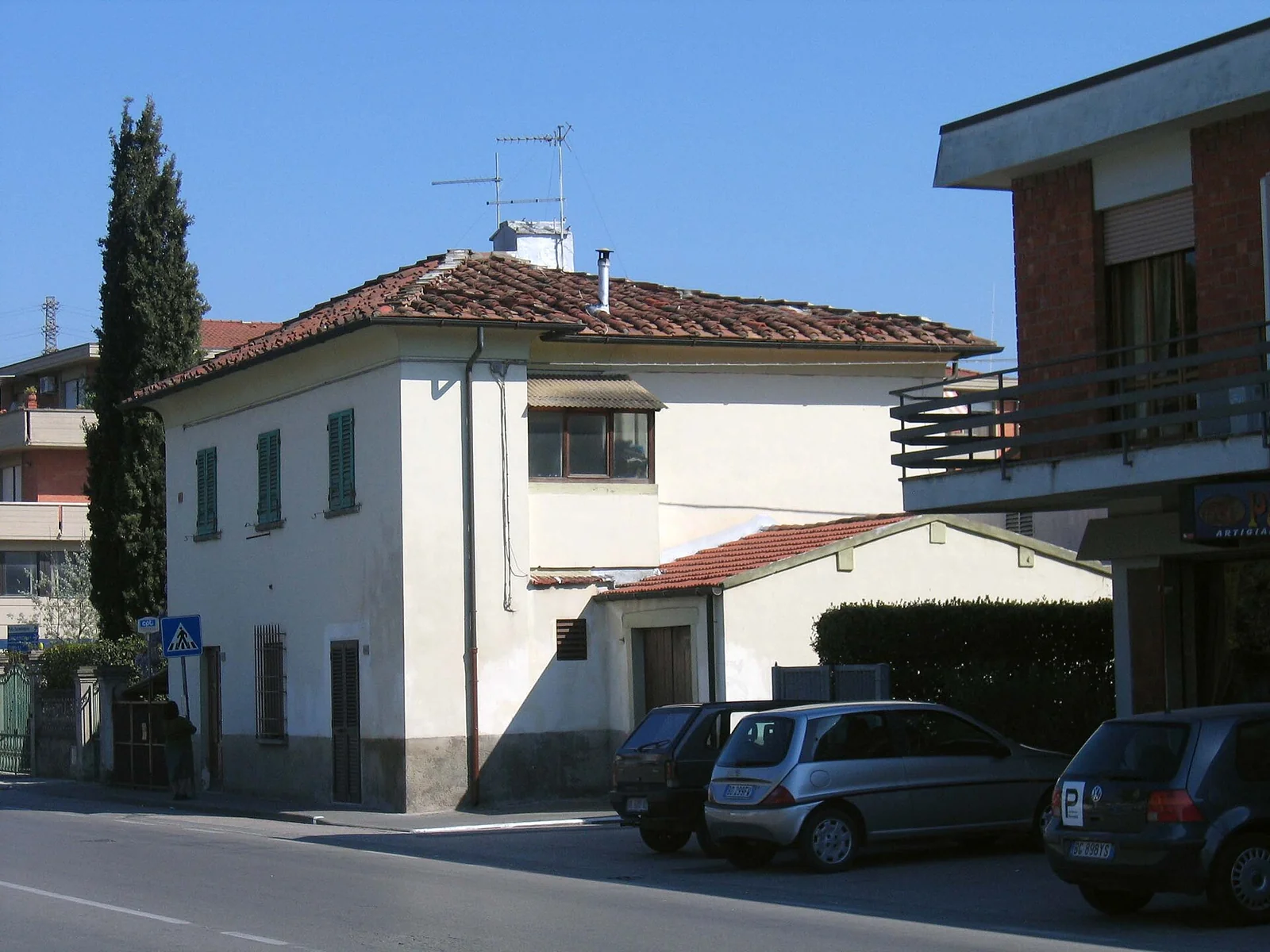
Cover image: Masonry building of the former tramway station in Navacchio, a hamlet of Cascina near Pisa — photo by Ale Sasso, CC BY-SA 3.0 — https://commons.wikimedia.org/wiki/File:Stazione_di_Navacchio.JPG