
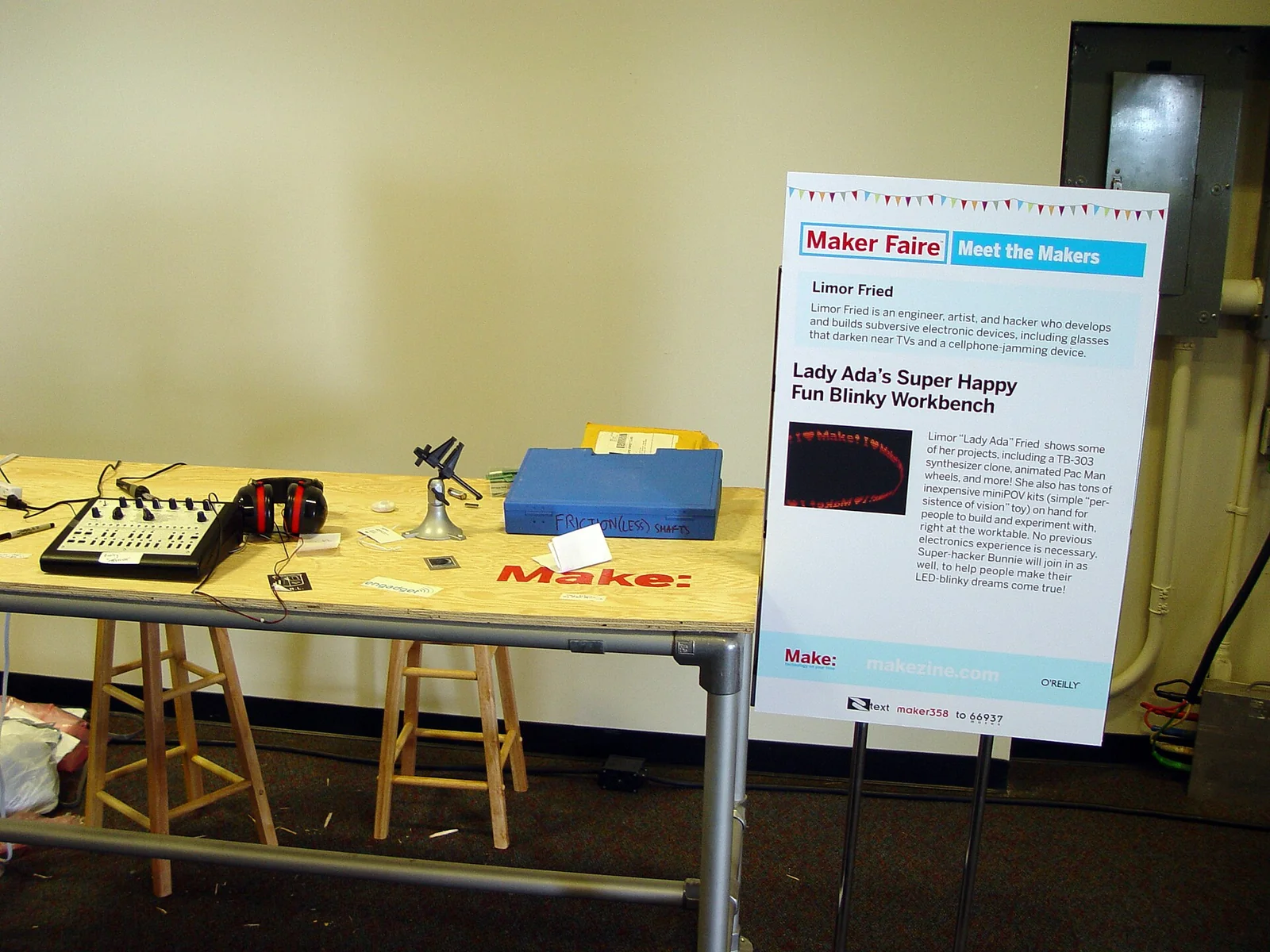
Today and tomorrow, 22-23 April 2006, the San Mateo Event Center hosts the first Maker Faire: more than a hundred exhibitors and workshops on electronics, fabrication and amateur robotics. The fair itself does not interest me, but the kind of object it puts on display does: projects whose value is not the specimen on the stand, but the schematic, the firmware and the parts list that anyone can download and rebuild.
Context
Maker Faire is the public event of Make Magazine, the quarterly that O’Reilly
Media has published since February 2005 with Mark Frauenfelder on the editorial
side. The magazine collects step-by-step projects; the fair is its physical
version, with the projects powered up and running rather than described on paper.
Maker is a recent word, but the practice it points to is the old one: electronics hobbyism and model-making. One measurable thing has changed from fifteen years ago: the documentation layer. A project no longer ends at the object; it carries the Gerber file for the printed circuit board, the microcontroller source, the schematic in a format an electronic CAD program can read, and a licence that says what may be remade.
The reproducibility problem
A hardware project is reproducible when a third party, working from the published documentation alone, obtains a working specimen without writing to the author. The bar is higher than it looks. You need:
- a complete schematic in an editable format, not a
.jpgimage of the schematic; - the board layout, or at least a netlist, because the schematic alone does not produce the board;
- firmware source that compiles with a stated toolchain, not just the
.hexbinary; - a parts list with obtainable part numbers, not discontinued or custom parts with no alternative.
Many projects that call themselves “open” fall on one of these points. The typical case is the firmware: the C source is there, but it compiles only with a precise version of a commercial compiler, and reproduction stays tied to a closed tool. For the hardware the hidden dependency is fabrication: a four-layer layout with blind vias is formally public, yet only someone with access to a process a hobbyist does not have can remake it.
An example: Arduino
The case I have followed closely is Arduino, started in 2005 at the Interaction Design Institute Ivrea around Massimo Banzi, David Cuartielles, Tom Igoe, Gianluca Martino and David Mellis. Beyond the board itself, it is instructive as a reproducibility architecture.
At the base is an eight-bit Atmel ATmega8 microcontroller with a serial bootloader that programs the chip without a dedicated programmer: a serial port and a level converter are enough. The first barrier falls, that of the programming tool, which until yesterday required extra hardware. The development environment derives from Wiring and Processing, is written in Java and runs on the same operating systems the virtual machine runs on.
What counts is the full publication: schematic, board layout and sources come out in editable formats, under licences that allow reproduction and modification. A board like this is a single copper layer with through-hole components, and the choice is deliberate: you remake it with a process within reach of an amateur workshop, not only of an industrial fab. Reproducibility lies in the design; it does not happen by chance because the files were published.
Critical point: the licence is not the software
Transferring software licences wholesale to hardware is the recurring trap of these projects. The GNU General Public Licence covers a copyrightable work: source code. An electrical schematic and a board layout are partly copyrightable expression and partly technical facts and functional topologies, over which copyright has weak or no grip. The GPL applied to a layout file protects the specific form of the drawing, not the function of the circuit, which anyone recovers by measuring the physical board.
The RepRap project too, started by Adrian Bowyer at the University of Bath in March 2005 with EPSRC funding, releases its designs under the GPL and aims at a prototyping machine able to print its own plastic parts. Here too the licence covers the design files of the printable parts; the mechanical principle of a Cartesian extrusion machine is not itself protectable, and rightly so. It follows that “GPL hardware” is an imprecise phrase: the licence binds the documentation you redistribute, it grants no right over the physical object, and anyone wanting effective copyleft on hardware must build it from a mosaic of copyright, trade marks and agreements, not from a single licence text.
Implications
For someone designing with the intent to publish, the practical consequence is to treat documentation as part of the project from the start, not as a final export. Choosing editable, open formats for schematic and layout, declaring the firmware toolchain with its version, preferring obtainable components and low-barrier fabrication processes: these are engineering decisions, taken upstream, that decide whether a third party can really remake the object. A fair such as Maker Faire makes this difference visible, because it places side by side projects anyone replicates and objects that remain one-offs despite the “open” label.
Limits
I have no data on the real reproduction rate of the exhibited projects: how many visitors, back home, really rebuild what they saw. The reproducibility I write about is a verifiable property of the documentation, not a measure of adoption. The component problem also stays open: a project can be impeccably documented and become irreproducible the day a single integrated circuit goes out of production with no pin-compatible equivalent. Documentation captures a state of the component market that is not permanent.
- https://makezine.com/
- https://www.arduino.cc/
- https://reprap.org/
- https://www.gnu.org/licenses/gpl.html
- https://www.noze.it/en/insights/maker-faire-2006/
Cover image: DIY electronics booth with an open-hardware kit (x0xb0x synthesizer) and exposed boards at the first San Mateo Maker Faire, April 2006 — photo by Brandon Daniel, CC BY-SA 2.0 — https://commons.wikimedia.org/wiki/File:Ladyada_booth_@_Maker_Faire_2006.jpg