
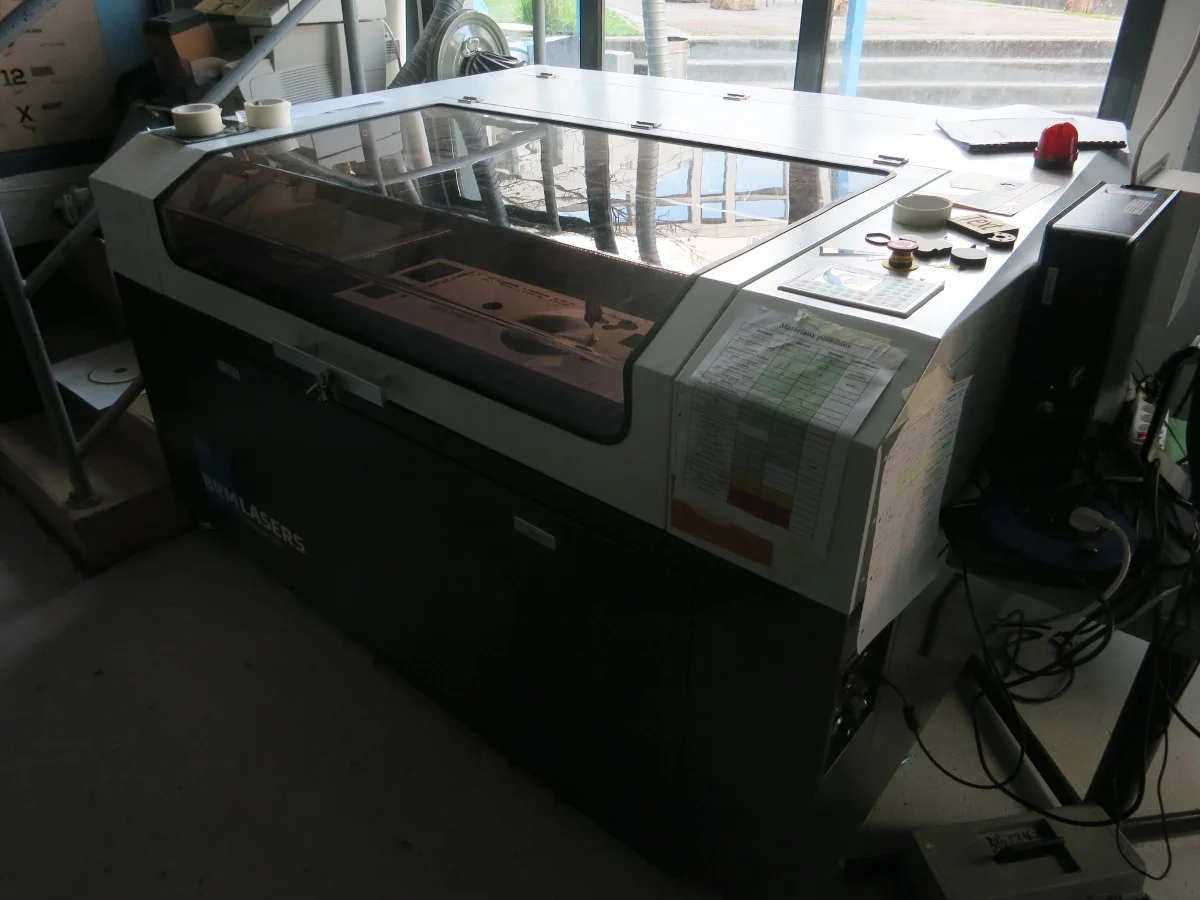
A fab lab is defined by a precise condition: its machines, and the software that drives them, are the same across the whole network. A shared inventory and a common toolchain are what make it possible to pick up in Cascina a project started elsewhere and finish it without rewriting the files. The Fab Lab Toscana just opened at the Polo Tecnologico di Navacchio, in Cascina (Pisa), is a chance to examine what makes this interoperability verifiable: the model it adopts is described in public documents, not left to informal convention.
Context
The fab lab model originates in 1998 with the MAS.863 course How to Make (Almost) Anything, taught by Neil Gershenfeld at the MIT Center for Bits and Atoms (CBA). The working idea is a workshop equipped to cover the full prototyping cycle — from digital design to physical object and back — with a kit that can be replicated identically anywhere. The network that grew out of it now lists thousands of sites in the fablabs.io registry and identifies with a document, the Fab Charter, which sets out what a fab lab is expected to guarantee.
The Polo Tecnologico di Navacchio has operated since the late 1990s as a science park in the municipality of Cascina, a few kilometres from Pisa and from Navacchio station, and hosts high-technology companies and university laboratories. Siting the fab lab in this setting does not change the technical substance of the model: a node of the Fab network counts for how far it conforms to the shared inventory, and the park that houses it matters less.
Architecture
A fab lab is one by virtue of a documented minimum set of capabilities. The CBA Fab Charter puts it this way: labs share an evolving inventory of core capabilities, and it is precisely this that makes it possible to share people and projects across sites. In practice the standard inventory comprises:
- a laser cutter for 2D cutting and engraving on wood, acrylic, cardboard, textile;
- a large-format CNC router for rigid materials and a small mill (usually a Roland MDX) for producing printed circuit boards (PCBs) and moulds;
- a vinyl cutter for masks, stickers and flexible circuits;
- one or more fused-filament 3D printers;
- an electronics bench with soldering, measurement instruments and programmers.
The less visible part, and the decisive one for reproducibility, is the software chain. The CBA distributes fab modules, an open-source collection that generates tool paths for the machines common to fab labs from the design files, normalising the step from drawing to machine command. On the machine-building side, the Gestalt framework — published by Ilan Moyer and Nadya Peek at the CBA — controls modular hardware nodes over a serial bus from Python, so that anyone building a new tool in the lab starts from an already shared control base. What sites exchange is not a PDF of instructions but a design file, which the same toolchain converts into the same tool paths everywhere.
The critical point
Interoperability only holds if the inventory really is the same and the toolchain really is shared. A lab that adopts the name but replaces the standard machines with equivalent, unaligned equipment, or drives them with closed proprietary software, breaks the property that gives the network meaning: a project stops being transferable and the shared inventory shrinks to a nominal list. This is where the line runs between a network of reproducible nodes and a set of workshops that share only a logo.
The Fab Charter addresses the intellectual-property question openly, which in a shared prototyping environment is where openness and commercial interest meet. The text states that designs and processes developed in a fab lab can be protected and sold however the inventor chooses, but should remain available for anyone to use and learn from. It is a reversibility clause: commercial use is allowed, total enclosure of the process is not. For Cascina, and for the regional network it belongs to, the transferability of projects between sites becomes a property to lean on, not a favour granted case by case.
Implications
For anyone developing hardware outside the lab, a node’s conformity to the inventory is operational information. If the nearest fab lab carries the same small mill and uses fab modules, a PCB-milling file written elsewhere runs without adaptation; if it carries the same baseline electronics, a board designed against that machine set solders with the same instruments. The preliminary check, then, is not “this lab exists” but “this lab is aligned with the standard inventory” — a fact the fablabs.io registry makes public for each site.
On the training side, the same alignment is the precondition for the Fab Academy, the programme directed by Gershenfeld that replicates MAS.863 in a distributed way across fab labs. The weekly assignments — laser cutting, board milling, microcontroller programming, machine building with Gestalt — take it for granted that every participating site has the same machine set and the same toolchain. Without a shared inventory the curriculum would not run in parallel across different sites; with it, an exercise uploaded by a Tuscan student is repeatable on matching hardware by a student elsewhere. For a newly opened node, taking part in the Fab Academy amounts to a conformity test: either the inventory is aligned, or the exercise does not run.
Limits
The shared inventory guarantees the reproducibility of the tool path, not the quality of the result. Mechanical tolerances, laser calibration, milling-bed flatness, bit wear change from machine to machine even between units of the same model: an identical file can produce PCBs with different yields at two sites. Conformity to the inventory reduces a portability problem to a calibration problem, which remains each lab’s own.
There is also a limit on the sources. The Fab Charter and the standard inventory describe a model and a commitment; they do not guarantee that every registered site honours it in every detail. Checking the alignment of a single node — including the one just opened in Cascina — stays empirical: you look at which machines are actually installed and which software drives them, not at the label. The value of the network is precisely that it makes this check possible on a documented basis.
- https://fab.cba.mit.edu/about/charter/
- https://fab.cba.mit.edu/about/faq/
- https://cba.mit.edu/docs/papers/12.09.FA.pdf
- https://dspace.mit.edu/handle/1721.1/85479
- https://news.mit.edu/2016/3-questions-neil-gershenfeld-fab-labs-0104
- https://fabacademy.org/
Cover image: A laser cutting machine in a fab lab, with its work bed and motorized cutting head under the transparent lid — photo by Jean-no, CC BY-SA 4.0 — https://commons.wikimedia.org/wiki/File:D%C3%A9coupeuse_laser_du_fablab_de_l%27%C3%A9cole_sup%C3%A9rieure_d%27art_du_Havre.JPG