
Article 52 of the European Patent Convention (EPC) excludes “programs for computers” from patentability, but only “as such”. Three words on which the whole dispute around the proposed European directive on the patentability of computer-implemented inventions turns, tabled by the Commission as COM(2002) 92 on 20 February 2002.
Context
The EPC, signed in Munich in 1973 and in force since 1977, lists in Article 52(2) a set of subjects that are not regarded as inventions: discoveries, scientific theories, mathematical methods, presentations of information and, indeed, programs for computers. Article 52(3) adds the qualifier that changes everything: the exclusion applies to those subjects “as such”.
The European Patent Office (EPO) has hollowed out that qualifier one case after another. Decision T 1173/97 (the IBM/Computer program product case, 1998) holds that a program may have “technical character” when it produces a “further technical effect” beyond the normal physical interactions between software and hardware. On this basis the EPO has granted tens of thousands of patents on methods implemented through software, even though the wording of Article 52 appears to exclude them.
COM(2002) 92 was tabled avowedly to “harmonise” the position across member states. What remains to be settled is what is being harmonised: the EPO’s practice, or the restrictive text of the convention.
The text and the amendments
The Commission’s original proposal puts down in writing almost all of the EPO’s practice. It defines a “computer-implemented invention” as one whose performance involves a computer and which has, in its implementation, one or more features realised wholly or partly by a program. For patentability it asks for a “technical contribution”, but leaves the notion of “technical” almost entirely undefined, and ends up leaving it to the reading of the office that grants the patents.
On 24 September 2003 the European Parliament voted at first reading and adopted the text with heavy amendments: 364 in favour, 153 against, 33 abstentions. The amendments bear precisely on the points left open:
- They define the “field of technology” so as to exclude data processing as such: the handling, manipulation and presentation of information are not in themselves a technical field.
- They introduce an interoperability clause: a patent may not prevent the use of patented techniques where this is needed to convert the conventions adopted between two computer systems or networks, so that communication and the exchange of data remain possible.
- They narrow the “technical contribution” by requiring that it belong to a technical field in the traditional sense: controlled forces of nature, not mere logic executed on generic hardware.
Between the two versions the practical difference is enormous. Under the Commission’s wording a data-compression method or a network protocol is patentable because it “produces a technical effect”. Under the Parliament’s wording the same method falls within the Article 52 exclusion, because data processing is not a technical field.
The critical point
Software does not behave like a mechanical or chemical invention. An algorithm is a finite sequence of logical steps; its “computer implementation” adds nothing physically new, because any general-purpose computer runs any algorithm by construction. To say that running an algorithm on a processor produces a “further technical effect” makes patentability depend on how it is described, rather than on what is actually claimed.
From here come two concrete problems for those who write code.
The first is the overlap between patents and copyright. Software is already protected by copyright, which covers the expression, that is, the source code as written. A patent covers the idea: the method, regardless of implementation. Two programs developed wholly independently, neither author ever having seen the other’s code, can infringe the same patent. Copyright never does this, because it defends against copying, not against coincidence.
The second is the impossibility of clearing it in advance. For a traditional industrial patent a company can commission a prior-art search before bringing a product to market. For software the patents already granted by the EPO on elementary methods — progress bars, double-clicking, list sorting, compression formats — are so many that an exhaustive search costs more than anyone without a dedicated legal department can afford. Those who write software cannot know in advance which patents they are infringing.
Implications for free software
Open-source development rests on the incremental composition of reusable code and on the publication of source. Both expose it to patent risk, and expose it more than others.
The exposure is structural, not accidental. A project with public source gives anyone the means to check which techniques it uses; proprietary software, shipped only as a binary, makes that analysis far more costly. And a commercial firm that embeds a free library in a closed product can defend itself with its own patent portfolio and with cross-licensing agreements; a volunteer project has no patents to trade and lacks the means to negotiate licences or to sustain litigation.
The Foundation for a Free Information Infrastructure (FFII), active on the question since the late 1990s, gathers these arguments around the EuroLinux petition against software patents, which to date counts several hundred thousand signatories among developers, small and medium enterprises, system administrators and researchers. A public conference on the subject is scheduled in Brussels in the coming days. noze too joins the FFII campaign, publishing on its own site the appeal, the open letter and the list of signatories: https://www.noze.it/en/insights/software-patents-campaign/.
Limits
It is worth saying precisely what the directive, in both versions, does not do. It does not introduce software patents into Europe from scratch: the EPO has been granting them for years on the basis of its own practice. The directive operates on a system that already exists, and what is at stake is whether that practice is put down in writing and made binding on national courts, or restricted.
The same holds for the Parliament’s version, which is not free of ambiguity. The “field of technology” is defined more by exclusion than by inclusion, and how it actually applies will still depend on the interpretation of the courts. A legislative wording, however careful, does not remove the room for discretion of an examiner or a judge; it relocates it.
Finally, the text is still in progress. After the Parliament’s first reading the dossier passed to the Council, which must set its own common position before the return to second reading. Which of the two approaches prevails — the one that puts the EPO’s practice down in writing or the one that confines it — is not settled today.
- https://eur-lex.europa.eu/legal-content/EN/TXT/?uri=CELEX:52002PC0092
- https://www.europarl.europa.eu/doceo/document/TA-5-2003-0402_EN.html
- https://www.epo.org/en/legal/epc/2020/a52.html
- https://www.ffii.org/
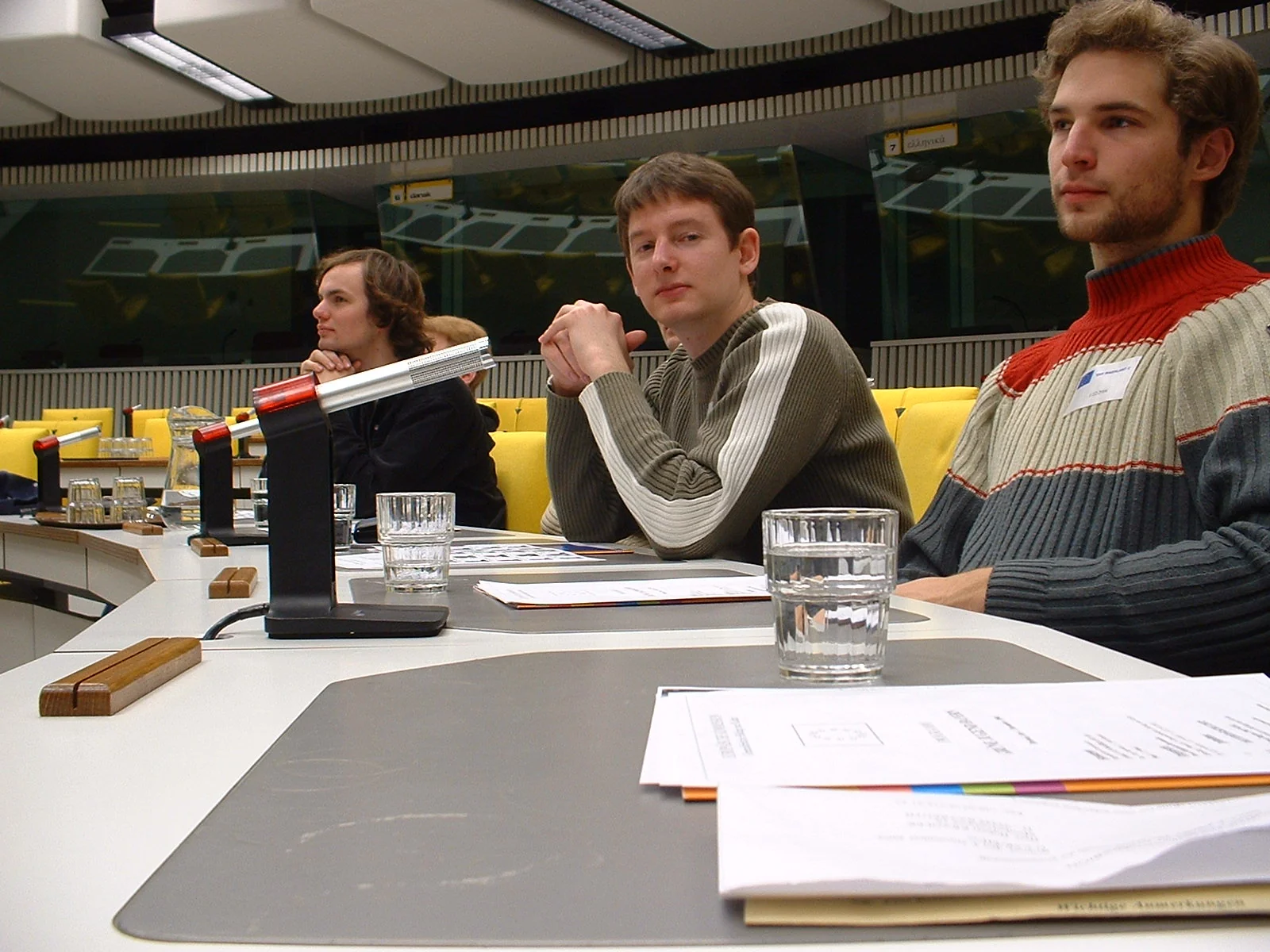
Cover image: Two anti-software-patent activists seated at a table during a meeting with the European Commission, December 2004 — photo by Björn Laczay, CC BY 2.0 — https://commons.wikimedia.org/wiki/File:Opponents_of_software_patents_meet_with_the_European_Commission.jpg