
A fab lab is a standardised group of computer-controlled machines — laser cutter, milling machine, sign cutter, microelectronics bench — costing around 20,000 dollars of equipment, which MIT has been replicating outside the campus in the same form since 2002. The term fab lab (from fabrication laboratory) denotes a specific configuration: a fixed shopping list, not a generically well-equipped workshop. The point is the standardisation: two nominally identical labs exchange a design file and obtain the same object.
Context
MIT’s Center for Bits and Atoms (CBA), directed by Neil Gershenfeld, was set up in 2001 with National Science Foundation (NSF) funding to study the boundary between digital representation and physical matter. From the CBA comes the course MAS.863, How to Make (Almost) Anything, where students with no engineering background learn to drive computer-controlled machines to produce working objects, sensors and actuators included.
The external fab labs answer a practical question: how to take part of the CBA’s capabilities to places where there is no MIT. The first field installations went out in 2002, in Costa Rica and in Pabal, India, at Vigyan Ashram. In 2003 the first lab meant for a community opened at the South End Technology Center in Boston, together with Mel King, and one opened in Norway, in Lyngen. As of mid-2004 the active sites are therefore a handful, each with roughly 20,000 dollars of equipment.
The kit
A fab lab as of mid-2004 is a small group of standard commercial machines, chosen for cost and replicability rather than top-end performance:
- a CO₂ laser cutter for cutting and engraving flat sheet (cardboard, acrylic, thin wood);
- a precision mill of the Roland Modela type for printed circuit boards and small-scale moulds;
- a larger mill for wood panels and structural materials;
- a sign cutter (vinyl cutter) for stickers, antennas and conductive masks;
- a microelectronics bench — soldering iron, measurement instruments, microcontroller programmers.
The common thread is fabrication, subtractive or additive, starting from a file: you draw on the computer, generate the tool path, run the job. The individual machines already exist and can be bought on the market; the new thing is bundling them into a fixed shopping list, so the workflow moves from one lab to another without re-adaptation.
The critical point
What weighs is replicability, more than computing power or the resolution of any individual machine. If the kit is the same everywhere and the software flow is documented, a project developed in Boston runs in Pabal without a redesign: what travels is the file, not the finished part. The constraint shifts from the availability of the machine to the availability of the description. In the cases documented by 2004 it is a local problem, solved on the spot: in Norway a radio system to follow grazing sheep and reindeer; in India instruments to measure fat content in milk and moulds for textile printing. In none of these does MIT design the solution: it supplies the machines and the method.
There follows a consequence for the notion of design ownership. When the useful object is the file — schematic, tool path, firmware — sharing it costs as much as making a copy. It is the same logic as open-source software: digital fabrication inherits the same marginal economics, with one added physical friction — materials, machine time, calibration — that software does not have.
Software and formats
The fab labs of 2004 work with a heterogeneous toolchain, partly open source and partly commercial. The open part carries weight: replicating requires formats and tools that anyone can obtain without expensive licences.
- 2D vector modelling for the laser cutter and the sign cutter, often in the
DXFandSVGformats; - tool-path generation, that is computer-aided manufacturing (CAM), for the mill and the cutter;
- a microelectronics chain to design and program microcontroller boards.
The weak point is the interchange formats: DXF has implementation variants that break portability, and SVG (a W3C recommendation since 2001) is still unevenly supported across the various editors. The hardware standardisation, as of 2004, finds no equally strict equivalent in the software chain.
Implications
The real friction weighs less on the cost of the machines, which is falling, and more on three fronts: calibration (the same machine gives different results depending on setup and material), project documentation (a file with no process notes is hard to reproduce), and training (the learning by making model of MAS.863 does not transfer with the shopping list). The 20,000 dollars of hardware is the measurable part, and the part bound to come down; the other three remain the hidden cost.
For anyone looking at the model from outside — universities, technical institutes, small manufacturers — replicability is the figure to weigh first. More than the price of the laser cutter, what weighs is an awkward question: does a project developed here produce the same object elsewhere without someone putting it right by hand? As of 2004 the answer depends more on documentation discipline than on the kit.
Limits
The model, as of mid-2004, is still small: a handful of installations, each with a few units of each machine. Achievable tolerances are far from industrial; a fab lab produces prototypes and one-offs, not runs. The network between labs is informal and held together by the CBA, with no autonomous governance structure. How stable the shopping list stays as machine prices fall — and how far the software chain standardises — are open questions that will only clear up with the labs opening over the next few years.
- https://www.edge.org/conversation/neil_gershenfeld-personal-fabrication
- https://cba.mit.edu/
- https://cba.mit.edu/docs/index.html
- https://www.w3.org/TR/SVG/
- https://www.noze.it/en/insights/fab-lab-mit-gershenfeld/
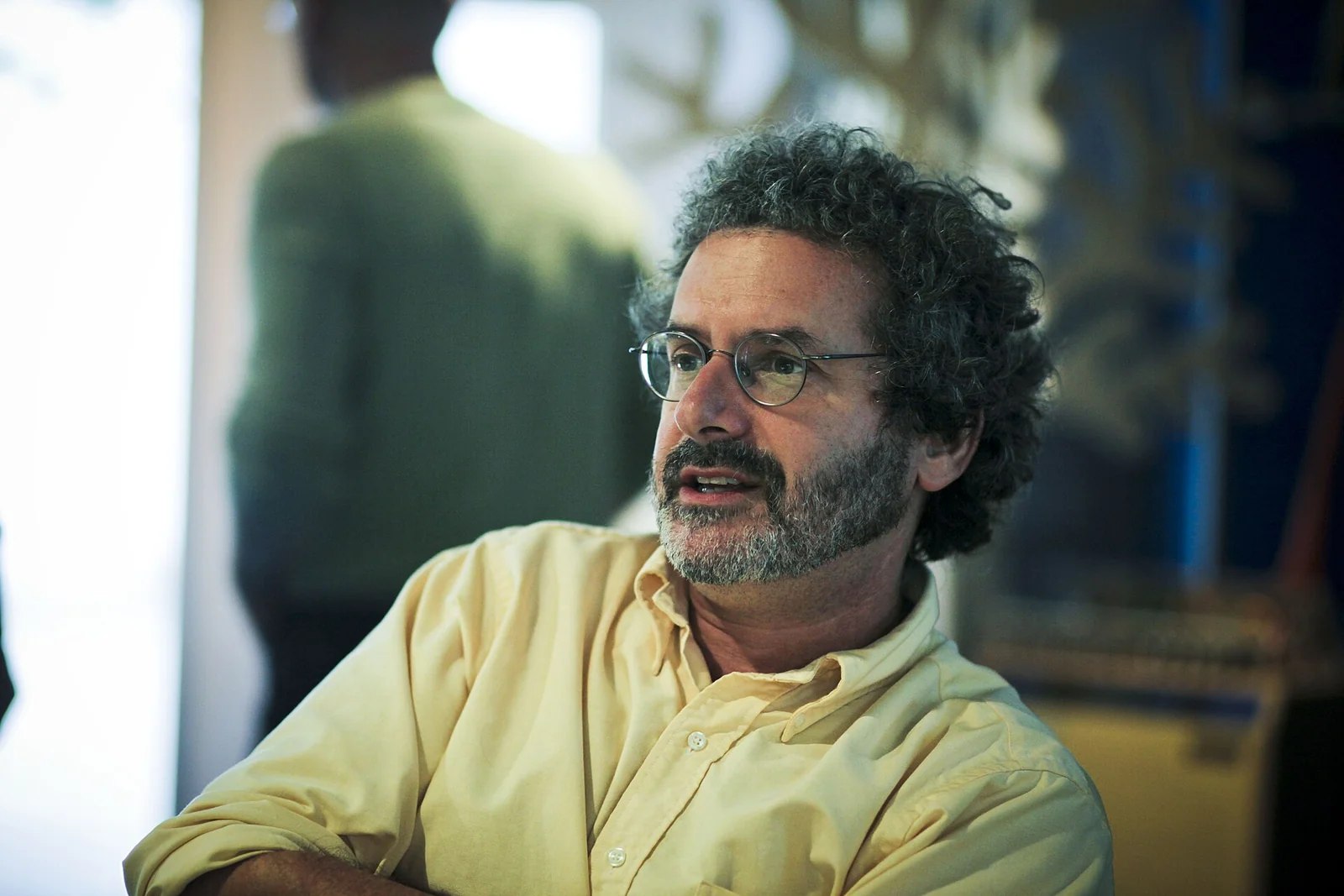
Cover image: Neil Gershenfeld, a bearded man with glasses, speaking at an event in front of a microphone — photo by jeanbaptisteparis, CC BY-SA 2.0 — https://commons.wikimedia.org/wiki/File:Neil_Gershenfeld_(4902288881).jpg