
The directive issued by the Minister for Innovation and Technologies on 19 December 2003 requires every public body to assess open source software when it acquires a system, and to prefer solutions that handle at least one open data format. For a Province portal the matter is decided in the project criteria, before any coding choice: the technical base must be documented, reusable and free of proprietary lock-in on the data it publishes.
Regulatory context
Three acts, all already in force or enacted, set the boundary.
The Stanca directive of 19 December 2003 (Development and use of IT programs by public administrations) ranks four acquisition options: bespoke development, reuse of programs already produced by other administrations, purchase of proprietary licences, acquisition of open source programs. It also introduces, for the first time, contractual clauses that favour reuse and the handling of at least one open format.
Law 4 of 9 January 2004 (Provisions to favour access to IT tools for disabled persons) and its implementing regulation, Presidential Decree 75 of 1 March 2005, impose accessibility requirements on public-body websites and provide for an accessibility officer in each central body, with verification entrusted to CNIPA (the National Centre for IT in Public Administration). The ministerial decree carrying the detailed technical requirements — Annex A — is not out yet at the date of these notes; the working reference therefore remains the W3C’s WCAG 1.0 (Web Content Accessibility Guidelines) of 1999.
The Digital Administration Code (Legislative Decree 82 of 7 March 2005) has been enacted but enters into force on 1 January 2006. Its articles 68 and 69 consolidate the directive’s principles: a comparative assessment weighing total cost and the degree of openness of formats and interfaces, and an obligation to make software developed for the public sector available to other administrations. It is worth designing the portal to fit that text from the start.
Reference architecture
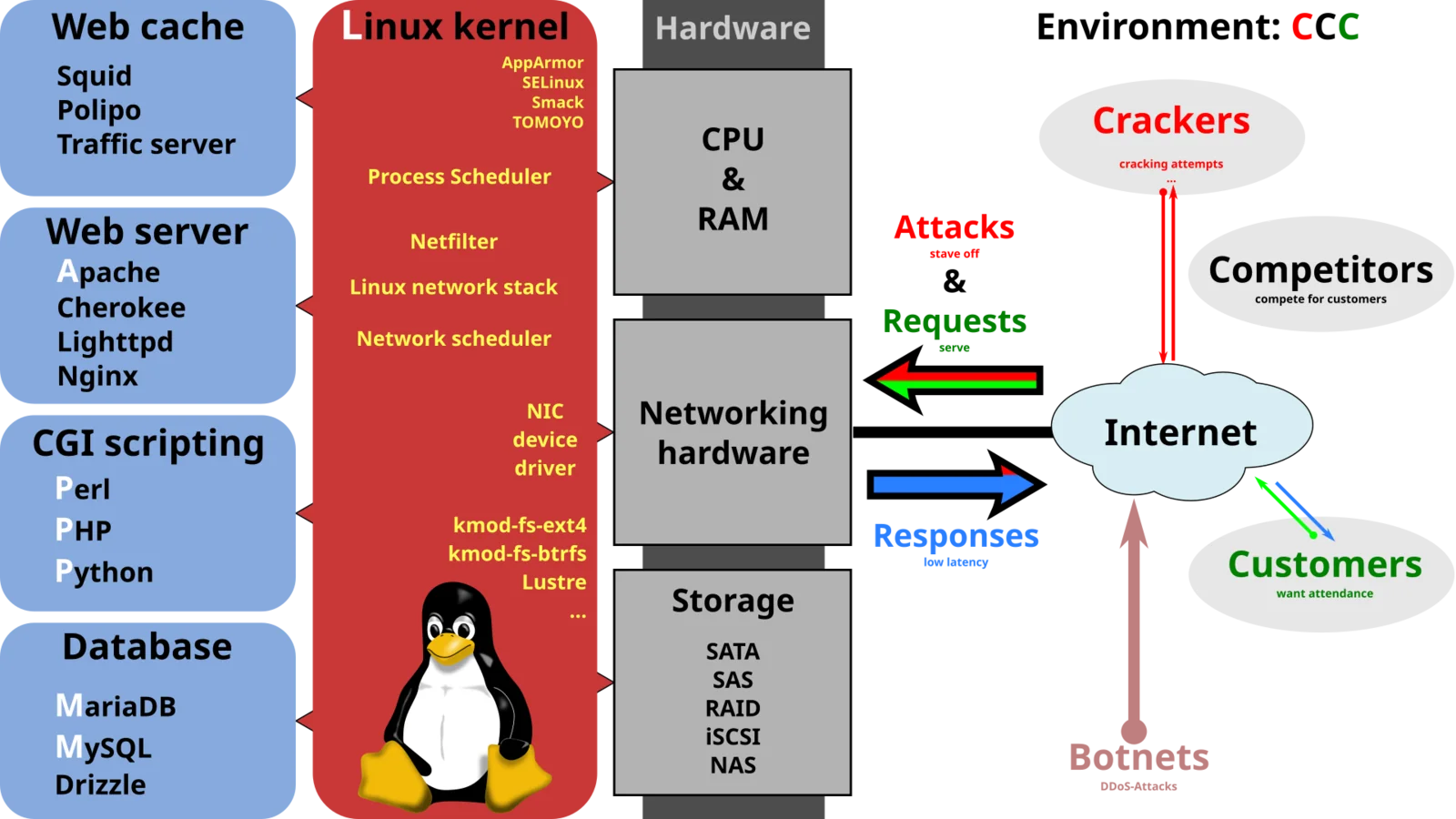
The typical stack for a portal of this kind is the one known as LAMP: GNU/Linux as operating system, Apache as HTTP server, a relational database (MySQL or PostgreSQL), a server-side application language (PHP, Perl or Python). Every component is distributed under a licence approved by the Open Source Initiative, each with source code available and no per-node licence fee.
Apache 2.0 holds the HTTP front, with mod_rewrite for readable URLs that stay stable over time — not a secondary requirement for a body that must guarantee the persistence of published acts. For the individual provincial offices to draft and update pages without going through the vendor each time, a content management system is needed: in the open source world, mature products by now include Plone (on Zope), Typo3, Mambo, Drupal and PHP-Nuke, with workflow and permission models suited to an editorial team spread across several departments.
The presentation layer should be kept separate from content. XHTML 1.0 markup served with CSS 2 stylesheets makes it possible to meet WCAG 1.0 checkpoints — text alternatives for images, heading structure, contrast, device independence — and to change the template without touching the data. Semantic separation is the technical condition for accessibility to be verifiable rather than bolted on afterwards.
The critical point: the data, not just the software
Attention often ends up on the software licence. The more durable constraint for a public body, though, is the format in which data is produced and stored. A portal can run on a free stack and still publish council resolutions in a proprietary format whose parser is held by a single vendor: the document stays readable only while that software exists, against the open-format obligation introduced by the 2003 directive.
The consistent technical choice is to produce acts in formats with a public specification: HTML for web content, PDF for documents meant for print and archiving, XML for structured flows (tenders, the public register, budget data). The OpenDocument Format was approved as an OASIS Standard on 1 May 2005 and is a viable route for office documents; ratification as an ISO/IEC standard is still pending, under way at the date of these notes. The test is verifiable: a format is adequate when at least one independent implementation can read it from the specification alone.
Consequences for the body
Adopting an open source stack for a provincial portal has measurable consequences on three fronts.
On cost, the absence of per-node licence fees shifts spending from licences to services — installation, customisation, maintenance — which stay local and can be renegotiated at each renewal, without the lock-in of a single platform vendor.
On technological independence, the available source code lets the body change service provider without rewriting the portal: the condition required by article 69 of the Code — source plus documentation, under an open licence — is also the condition that makes a procurement contestable.
On reuse, a portal released under an open licence can be reused by other Provinces with similar needs, consistent with the second option in the Stanca directive. Reuse only works when paired with installation and configuration documentation: without it the code is there but in practice it is not reused.
Limits
These notes describe project criteria, not guarantees of outcome. A free stack does not make a site accessible on its own: WCAG 1.0 accessibility depends on the markup the CMS produces and on editorial choices, and must be verified case by case, all the more so while the national technical-requirements decree is still missing. The regulatory frame is in motion: the Digital Administration Code only takes effect in January 2006, and the working reading of articles 68 and 69 will have to be observed in practice. Durability over time, finally, depends on maintenance: an abandoned open source portal ages like any other, and the available source does not replace a live maintenance contract.
A provincial portal built on these criteria — LAMP stack, a CMS for distributed editing across offices, open formats for the acts — is the one noze developed for the Provincia di Teramo, described in the insight: https://www.noze.it/en/insights/teramo-province-portal/.
https://www.funzionepubblica.gov.it/ — Minister for Innovation and Technologies, directive of 19 December 2003 https://www.gazzettaufficiale.it/eli/id/2004/01/17/004G0015/sg — Law 4 of 9 January 2004 https://www.gazzettaufficiale.it/eli/id/2005/05/03/005G0097/sg — Presidential Decree 75 of 1 March 2005 http://web.archive.org/web/2005/http://www.cnipa.gov.it/ — CNIPA, open source observatory (2005 archive) http://www.w3.org/TR/WAI-WEBCONTENT/ — W3C, Web Content Accessibility Guidelines 1.0 (1999) http://www.w3.org/TR/xhtml1/ — W3C, XHTML 1.0
Cover image: Diagram breaking down the LAMP stack into its four layers: Linux as the operating system, Apache as the web server, MySQL as the… — diagram by ScotXW, CC BY-SA 3.0 — https://commons.wikimedia.org/wiki/File:LAMP_software_bundle.svg