
The provisional agreement on the EU AI Act of 9 December 2023 classifies as high-risk any AI system used as a safety component in the management of critical infrastructure, power grids included (Council of the EU, 9 December 2023). Over the same months the grid-optimisation literature proposes replacing classical optimal power flow (OPF) solvers with learned surrogates — graph neural networks — and with QUBO reformulations run on quantum annealers. The two facts clash: the approximation that makes a surrogate attractive is the same property that complicates its regulatory classification.
Context
Optimal power flow is the problem of computing generator set-points that minimise a cost (losses, fuel) while respecting the physical constraints of the grid: power balance, voltage limits, line capacity. The AC version is non-convex and NP-hard; real systems solve it through linearisations (DC-OPF) or non-linear programming solvers within tight time windows. Unit commitment — the on/off scheduling of generators over a horizon — is a mixed-integer program under the same computational pressure.
Two strands of work from 2022–2023 set out to cut this cost. The first trains graph neural networks (GNNs) to predict the OPF solution directly from grid topology, treated as a graph of nodes (buses) and edges (lines). PowerFlowNet, released in November 2023, uses message passing to approximate power flow with a reported low error and inference times below a Newton-Raphson solver (Lin et al., arXiv:2311.03415). Parallel work adds topology awareness and physics-informed corrections to reduce the fraction of infeasible solutions. The second strand reformulates combinatorial OPF and unit commitment as QUBO (quadratic unconstrained binary optimisation) problems and maps them onto quantum annealers; in 2023 the approach was evaluated on combinatorial OPF instances in IEEE Transactions on Smart Grid.
Problem
A GNN surrogate does not solve OPF: it approximates it. And the difference weighs when the output drives safety components. A classical solver returns a solution with a certificate — optimality within a tolerance, constraints satisfied within a measurable residual. A GNN returns a vector of set-points whose feasibility is not guaranteed by construction: it depends on the training data distribution and degrades when the operating topology leaves that distribution (a line under maintenance, an N-1 contingency, an unusual load profile).
The metrics by which these models are evaluated in the literature — mean squared error on set-points, percentage of constraint violations on a test set — describe average behaviour on data close to the training set. They do not answer the question a grid operator has to ask: what does the model do on the case it has never seen, and how do I know before it happens. The NIST AI RMF 1.0, of 26 January 2023, keeps the MEASURE and MANAGE functions explicitly separate: measuring performance is one thing, managing residual risk another (NIST AI 100-1). A surrogate with low MSE and no guarantee on the out-of-distribution case passes the first test and fails the second.
Critical point
The missing property is not accuracy, it is runtime-verifiable feasibility. A power grid accepts a set-point only if that set-point respects the physical constraints for the current topology, not for an average one. From here two classes of architecture diverge.
In the first, the learned model is the final authority: its output goes straight to the actuators. Here the model’s opacity becomes the decision’s opacity, and the AI Act’s high-risk classification imposes human oversight and traceability on an object that by construction offers neither.
In the second, the learned model acts as a warm start: it produces an initial point that a classical solver refines and certifies within the time window. The GNN gives the speed, the solver the feasibility guarantee. The safety property does not rest on the neural network being correct. It is the same logic by which a quantum annealer, which returns samples from a distribution rather than a proven-optimal solution, serves as a candidate generator inside a hybrid decomposer, not as an autonomous decider. The 2023 quantum unit-commitment literature does in fact place the annealer inside hybrid classical-quantum pipelines, with the classical solver closing the constraint.
The difference between the two architectures does not emerge from accuracy metrics. It emerges only if one defines, separately from the model, a feasibility gate that every output must pass before it touches an actuator.
Implications
For a grid control system that uses learned components, high-risk compliance requires three properties the model alone does not give. Traceability: for each applied set-point, the record of which input produced it, which model version, which constraint residual the gate measured. Reversibility: a threshold beyond which the system rejects the learned output and falls back to the classical solver or to a known-safe operating point. Out-of-distribution measurement: an explicit indicator of how far the current topology departs from the training one, because a GNN’s error grows precisely where the data is missing and where the operator most needs a guarantee.
None of the three is a property of the model. They are properties of the architecture around it. They move the governance question from how accurate is the model to what happens when it is wrong, and who notices. On critical infrastructure the second question is the binding one, and the AI Act makes it explicit by assigning power-grid management the highest risk band among infrastructural applications.
Limits
The solver times cited in the literature for GNN surrogates are measured on standard benchmarks (IEEE cases) and exclude the cost of the feasibility gate and of the refinement solver: the warm-start architecture is slower than the bare GNN, and the net gain over a well-tuned classical solver remains to be quantified case by case. Quantum annealing on unit commitment is limited, as of January 2024, by the qubit count and the connectivity of available hardware, and reported results concern instances small relative to real transmission grids. Finally, the regulatory picture is a provisional agreement: the consolidated AI Act text and the harmonised technical standards that will translate the obligations into verifiable requirements were not published as of writing. The three properties above remain an engineering reading of a still high-level obligation, not a certification protocol.
The Dake research project takes exactly these techniques — Deep Learning and Graph Neural Networks for energy-grid optimisation — onto applied ground, as the insight published by noze recounts: https://www.noze.it/en/insights/dake-2-deep-tech-energy/.
- https://www.consilium.europa.eu/en/press/press-releases/2023/12/09/artificial-intelligence-act-council-and-parliament-strike-a-deal-on-the-first-worldwide-rules-for-ai/
- https://nvlpubs.nist.gov/nistpubs/ai/nist.ai.100-1.pdf
- https://arxiv.org/abs/2311.03415
- https://www.nist.gov/itl/ai-risk-management-framework
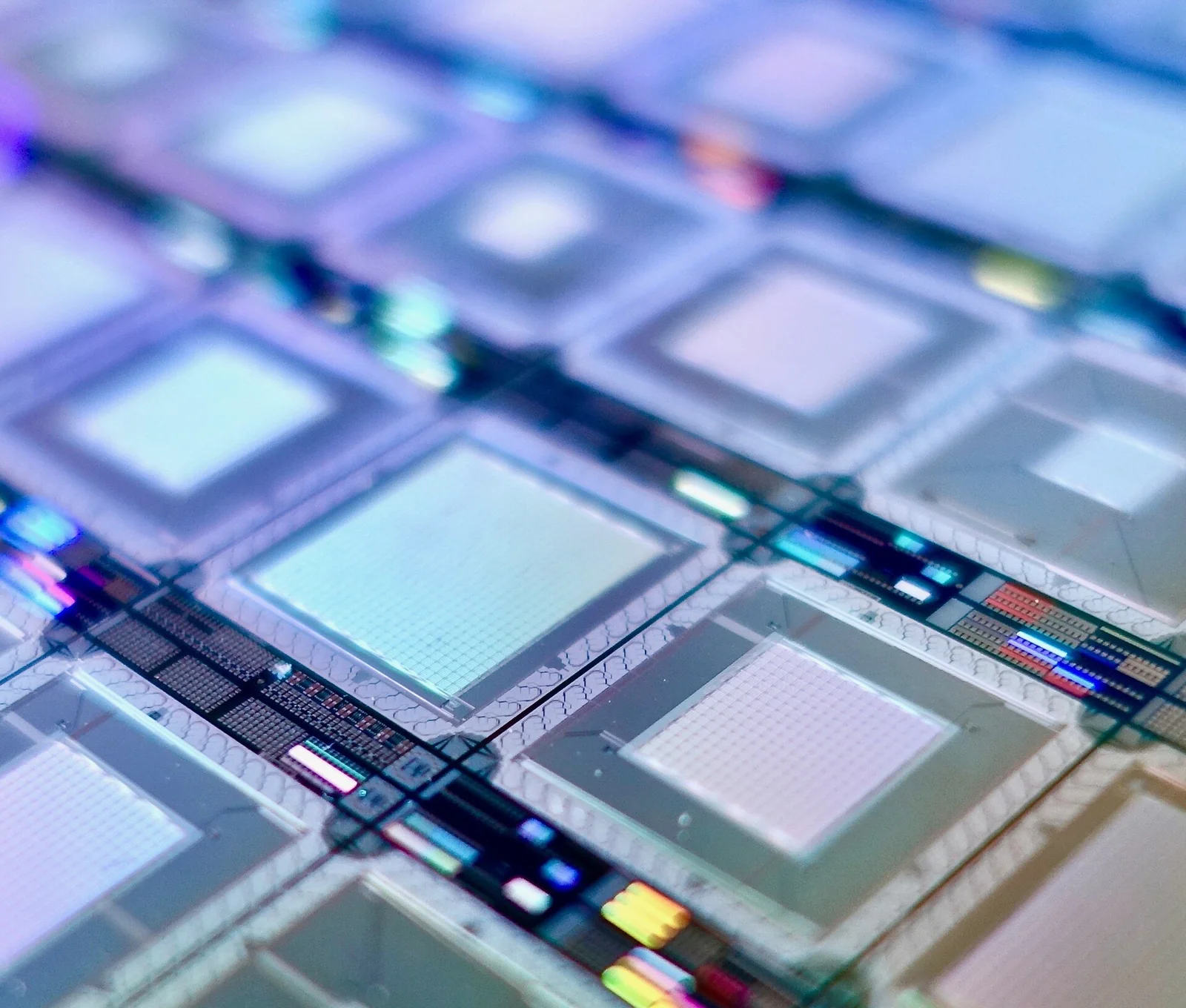
Cover image: Close-up of the D-Wave 2000Q quantum processor mounted on a square gold-plated board with metal connectors, the 2000-qubit annealer… — photo by Steve Jurvetson, CC BY 2.0 — https://commons.wikimedia.org/wiki/File:Latest_D-Wave_2000_Qubit_Processor_(25215169297).jpg