
Fab Academy 2009 is the first attempt to take MIT’s MAS.863 — How to Make (Almost) Anything outside MIT, delivering it as a synchronous programme across the Fab Lab network. Neil Gershenfeld runs it at the Center for Bits and Atoms (CBA) and it follows the original course week by week, with one difference: the workshop is no longer a single place, but any Fab Lab that joins, provides the machines and assigns a mentor.
Context
How to Make (Almost) Anything started at the CBA as a digital fabrication course and runs through CAD/CAM, laser cutting, CNC milling, printed-circuit production, microcontroller programming, sensors and actuators. For years you could only take it by being physically at MIT, with access to the lab’s machines.
The problem Fab Academy tackles is one of scale. The skills are in high demand, but the seats in the MIT room are few and fixed. The Fab Lab network — labs with a deliberately standardised machine inventory — offers a way out: if every lab has roughly the same machines, the same weekly exercise can be done anywhere with comparable results.
Programme architecture
The setup is hybrid. There is a weekly global lecture, given by the CBA and broadcast over videoconference to every node at the same time. Then there is the hands-on work on site: each student does the week’s exercise in their own Fab Lab, supervised by a mentor present in the room. The centralised part transfers the content and keeps the calendar aligned across nodes; the local part supplies the machines and direct supervision.
What makes the model workable is the shared inventory. The CBA’s Fab Charter describes Fab Labs as a network of local labs sharing “an evolving inventory of core capabilities to make (almost) anything”. In practice, in 2009 this comes down to a recurring kit: a precision mill for circuits and small parts (usually a Roland MDX/Modela), a vinyl cutter, a laser cutter, a bench for assembling and programming electronics. So when the week’s exercise is “make a board”, the instruction can take for granted that the student is sitting in front of a mill able to engrave copper traces, with the software modules to generate the toolpath.
CAD/CAM chain and electronics production
Electronics is the part where machine uniformity weighs most, and it is also the most instructive technically. The workflow from the original course, reused in the Academy, is this:
- design schematic and layout in
Eagle(the free Light edition), with the CBA’s component libraries (fab.lbrand relatives) that contain only parts that are genuinely sourceable and hand-solderable; - export the copper as an image;
- generate the toolpath with the CBA’s fab modules, which take the image and compute the milling trajectory to engrave the traces and then cut the board outline;
- mill the circuit on a copper-clad board, solder the surface-mount components, programme the microcontroller.
The microcontrollers are the Atmel AVR parts in the ATtiny family (usually tiny44 and tiny45): few pins, cheap, programmable in C with the avr-gcc/avrdude toolchain. The point is not the individual chip, but the fact that the same code and the same milling file give the same result in different labs. The board of someone taking part in Barcelona and that of someone in India start from the same files and the same procedure.
One practical detail says a lot about the bootstrap nature of do-it-yourself electronics in 2009: to load firmware onto a freshly soldered microcontroller you need an external in-system programmer. The board milled in the lab does not programme itself over USB; a second programmer has to act as a bridge. It is a constraint that weighs on every node’s bill of materials.
The critical point: documentation as the deliverable
The most interesting thing about Fab Academy, technically, is that what gets assessed is not the physical object but its documentation. Each week the student publishes the whole process on their own site: text, photos, video, CAD files, code, toolpaths. They must also describe the failures and how they fixed them, not just the finished result.
This shifts the centre of gravity of the course. In a single lab, learning stays oral and implicit — you watch your neighbour, you ask the technician. In a distributed network this does not scale: the only channel that passes from one node to another is what gets written down. Public documentation then becomes both the mechanism that holds the programme together and the reusable archive that grows year after year. The Fab Charter codifies the same logic on the licensing side: projects can be protected and sold, but “should remain available for individuals to use and learn from”.
Implications
The less obvious consequence is that you cannot standardise the teaching without standardising the machines. Without a shared inventory, a weekly exercise identical for everyone would be impracticable: each node would have to adapt it to its own machines, and comparative assessment would break down. The hardware constraint — which looks like a limitation — is the precondition of the distributed model.
The second implication concerns the comparison with academic technical training. Here the final credential, the Fab Diploma awarded after an original project, rests on a path made entirely of public, verifiable artefacts. The assessor does not have to trust a grade: they open the student’s site and read files, code and toolpaths.
Limits
The model depends on two fragile things. The first is how uniform the machines really are: Fab Labs share an “evolving” inventory, not an identical one, and already in 2009 the differences between one Roland mill and another, or between different laser-cutter models, can give results that are not perfectly comparable. The second is the availability of the local mentor: the global lecture transfers the content, but a botched solder joint or a wrong toolpath gets fixed in person, and the quality of that support changes from node to node.
Recognition is also an open question. As of now the Fab Diploma is a network credential, not an academic degree: its value will depend on how much weight the community — and then, perhaps, institutions — choose to give it over the years.
https://cba.mit.edu/about/ https://fab.cba.mit.edu/about/charter/ https://fab.cba.mit.edu/classes/863.08/ https://archive.fabacademy.org/ https://www.noze.it/en/insights/fab-academy-2009/
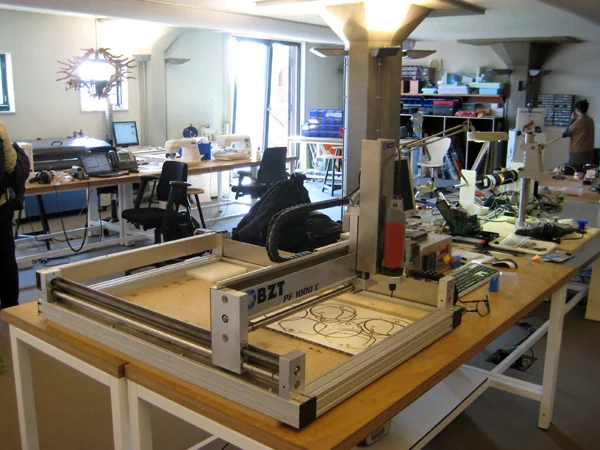
Cover image: Interior of a Fab Lab: workbenches with digital fabrication equipment and a person working in the background — photo by Rory Hyde, CC BY-SA 2.0 — https://commons.wikimedia.org/wiki/File:Amsterdam_Fab_Lab_at_The_Waag_Society.JPG