
Paediatric short bowel syndrome (SBS) is the leading cause of intestinal failure in children, and it produces clinical time series that are long but few: the modelling difficulty comes from that combination, not from the choice of algorithm. What follows are technical notes gathered while starting work with the Meyer Children’s Hospital in Florence on the use of quantitative methods in the management of these patients.
Clinical context
SBS is a malabsorptive state that follows a reduction of functioning intestinal surface, usually after surgical resection in the neonatal period (necrotising enterocolitis, atresias, gastroschisis, volvulus). The most common operational definition refers to a small intestinal length below 25% of that expected for gestational age, or to dependence on parenteral nutrition (PN) for more than six weeks after resection (Goulet et al., PGHN 2019).
The central clinical goal is enteral autonomy: weaning off PN as the residual bowel adapts. Management is multidisciplinary and rests on structured nutritional protocols — for paediatric PN the reference guidelines are the 2018 ESPGHAN/ESPEN/ESPR/CSPEN documents, spread across several papers (amino acids, lipids, iron and trace minerals, vitamins, home PN). Serial transverse enteroplasty (STEP) and, from 2019, the GLP-2 analogue teduglutide (approved by the FDA for children over one year) widen the therapeutic space, and with it the number of variables that describe an individual patient’s course.
The problem: the shape of the data
SBS clinical data has a recurring structure that constrains any model.
It is longitudinal and irregular. The relevant parameters — weight, length or height, fluid balance, electrolytes, cholestasis markers (direct bilirubin, GGT), PN access, catheter-related sepsis episodes — are sampled at different rates and change with clinical state: dense in the acute phase, sparse when the situation is stable. The sampling is informative: the decision to measure depends on the patient’s condition. Treating these points as a regular grid introduces bias.
It is high-dimensional per subject, low in subject count. Paediatric SBS is rare: a single intestinal rehabilitation unit follows tens of patients, not thousands. Each patient brings many measurements over time, but the number of independent trajectories a model can learn from stays small. It is the opposite of the regime where high-capacity methods do best.
It is heterogeneous in coding. Residual anatomy, presence or absence of the ileocaecal valve, length and segment of preserved colon, type of stoma: discrete descriptors that weigh heavily on prognosis and that often live in free text or unstructured fields rather than in ready-made variables.
Defining the target
The model comes after the decision on what is being predicted. Three formulations carry different clinical meaning.
- Time to PN weaning as a survival-analysis problem. The most natural question, but subject to censoring: patients still on PN at the end of observation, transfers and deaths compete as events. A regression that ignores censoring overestimates systematically.
- Binary classification between autonomy reached and not reached within a fixed horizon (12, 24 months). Simpler to evaluate, but it throws away the temporal information and depends on the chosen horizon.
- Prediction of an adverse event — intestinal-failure-associated cholestasis, catheter sepsis — over a moving window. Useful operationally, but with strongly imbalanced classes and an asymmetric cost between false positives and false negatives, to be fixed in advance.
The choice is not technical in the narrow sense: it changes which patients enter the cohort, how follow-up start is defined, and which decisions the output can inform.
The critical point: validating with few subjects
With a few dozen trajectories, error estimation is the dominant constraint. Standard cross-validation, if it mixes measurements from the same patient across training and test folds, leaks information and produces optimistic metrics. The minimum rule is to group by patient: all of a subject’s points sit in the same fold. Even so, with few groups the confidence intervals on the metrics stay wide, and it is honest to report them rather than the single number.
The distinction between internal and external validation weighs more than the choice of model. A model fitted on a single-centre cohort also captures that centre’s habits — weaning thresholds, PN choices — which do not transfer elsewhere. Without an external cohort, any estimate of the ability to generalise is a conjecture. For the same reason, at these counts a regularised linear model or a parametric survival model is often preferable to a high-capacity architecture: fewer parameters to estimate, more inspectable behaviour, lower variance.
Operational consequences
Three practical consequences.
The heaviest phase is cohort construction: harmonising the coding of residual anatomy, reconstructing PN start and end dates, telling the informative signal of the sampling apart from noise. It is this work that determines the result, more than the choice of algorithm.
The model worth building first is descriptive, not predictive. Stratifying patients by observed adaptation pattern, quantifying between-centre variability, mapping the missing data: it is a prerequisite for any defensible predictive model, and already carries clinical value on its own.
Any output should be presented as quantitative support for a decision that remains the clinician’s, with the uncertainty stated. On a rare condition with serious outcomes, a confident model never validated outside its centre of origin does more harm than good.
Limits
The above concerns the set-up phase, before results on real data. The small sample size is structural and is not worked around by choosing the method; in the medium term the practicable route is pooling data across centres, which opens questions of harmonisation and data governance not addressed here. The cited guidelines fix the standard of care, not the modelling methodology: the link between the two is exactly the work to be done.
The applied path of this work with Meyer is described in the insight published by noze: https://www.noze.it/en/insights/meyer-sbs-ai/.
- https://pghn.org/DOIx.php?id=10.5223%2Fpghn.2019.22.4.303
- https://www.espen.org/files/ESPEN-Guidelines/Pediatrics/ESPGHAN_ESPEN_ESPR-guidelines-on-pediatric-parenteral-nutrition-Organisational-aspects.pdf
- https://www.takeda.com/en-us/newsroom/news-releases/2019/us-fda-approves-gattex-teduglutide-for-children-1-year-of-age-and-older-with-short-bowel-syndrome-sbs/
- https://www.meyer.it
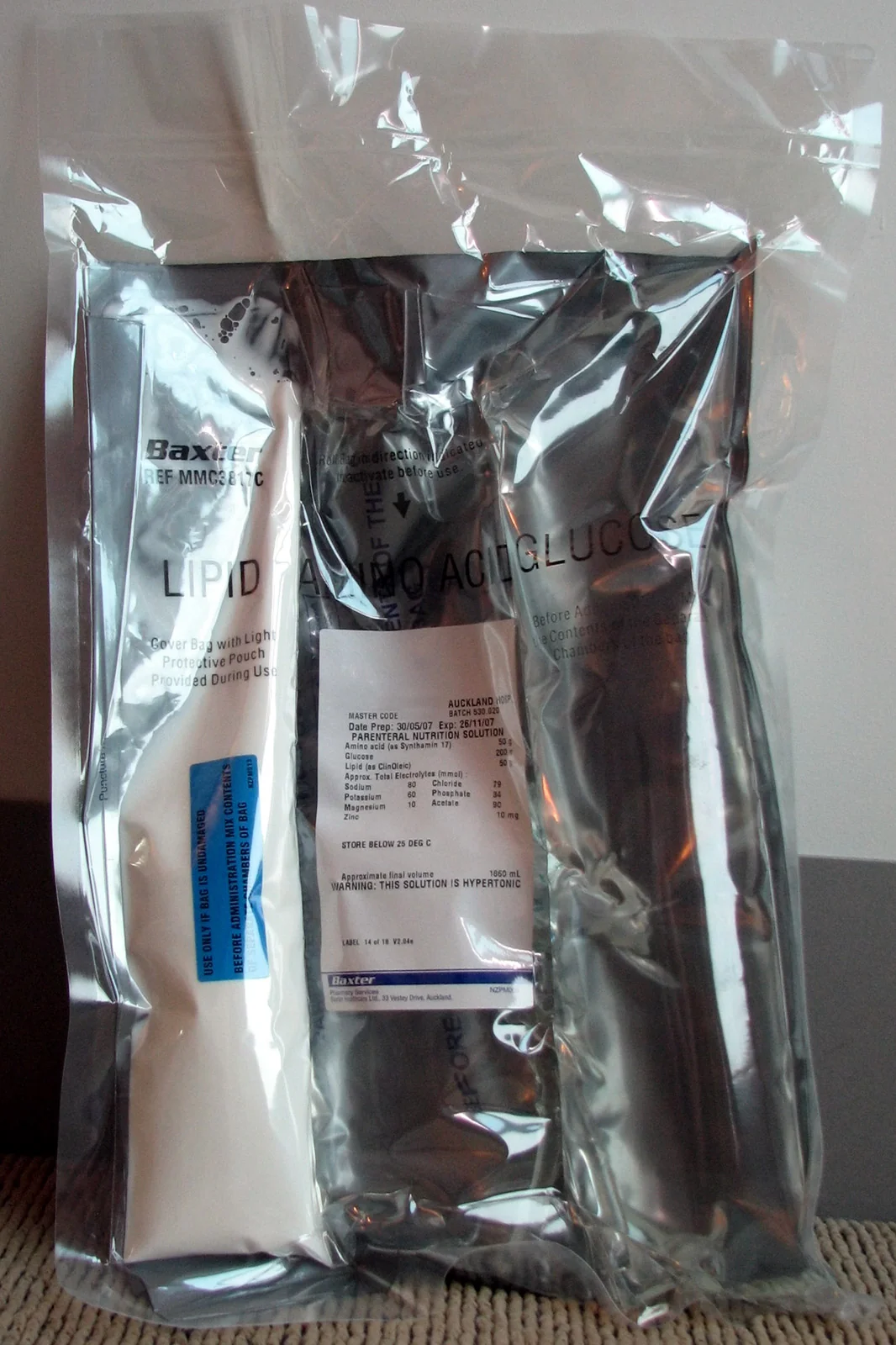
Cover image: Transparent total parenteral nutrition bag with three separate compartments holding glucose, amino acids and lipids — photo by Tristanb, CC BY-SA 3.0 — https://commons.wikimedia.org/wiki/File:Tpn_3bag.jpg