
All the lonely people / Where do they all come from?
All the lonely people / Where do they all belong?
Every time I listen to it, the same thing strikes me. McCartney, 1966, a chamber lied disguised as pop — no drums, no bass, no guitars, just a double string quartet that George Martin writes modelled on Bernard Herrmann. Martin used to cite Fahrenheit 451, but the film came out seven months after the recording, so the real model is Psycho, 1960 — that hard, staccato string gesture that sounds like scraping. And nothing here is decorative.
It enters before the voice. A staccato figure, hammered, almost mechanical — and you already know everything, before the story has even started. Then McCartney: picks up the rice in the church where a wedding has been. The strings land inside me, one by one. They are the gesture itself of Eleanor stooping, picking up, picking up again — small, repetitive, useless. The song has already said everything in the first four seconds, the rest is only confirmation.
I feel the oscillation — minor, major, minor again. E minor and C major, two poles that never resolve. C major arrives on the chorus (Ah, look at all the lonely people) and seems like a light, a promise, a door about to open; and it falls back into minor, always. Like a door left ajar that closes again. I stay there waiting and the door closes. And the loneliness reaches me before anyone has named it.
There’s a detail you don’t hear at first, and after that you can’t stop hearing. On the chorus Lennon and Harrison’s harmony comes in, and that held Ah is a kind of gentle cry, an oxymoron that’s somehow the only right word. Up to that point we’ve had the narrator, calm, almost detached, the third person observing. Two voices come in that aren’t telling anyone’s story. They’re doing grief directly. Without a character. It lasts a moment and then the chronicle resumes — Father McKenzie, writing the words of a sermon that no one will hear — and that’s the moment I’m waiting to reach.
The voice–instrument relationship is almost theatrical. The voices tell the story in a plain, almost clinical style, while the strings comment — dry pizzicatos on the concrete detail (darning his socks in the night, and you really hear the needle going in and out), long, aching bowed lines in the choruses. And this is the thing that has always moved me: the voices tell and the strings feel — they feel in place of the characters, who on their own can’t seem to feel. Or to be heard.
Where do they all belong? The question hangs because the music leaves it hanging: the strings fade out on the very same figure they entered with, hammered, staccato, unchanged. The circle closes without consolation.
Ever since I first heard it I keep ending up there, in a loneliness that’s breathed.
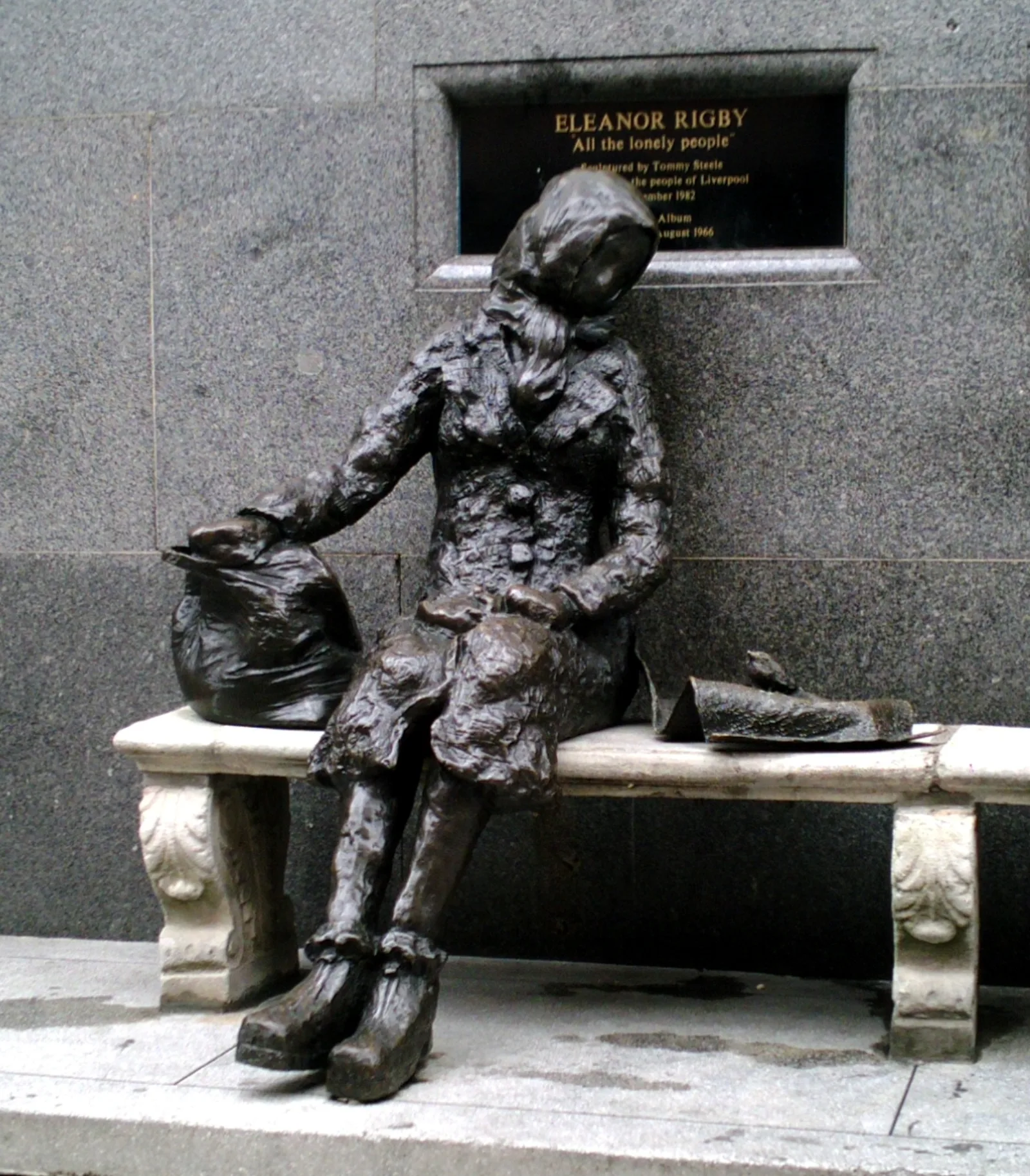
Cover image: Eleanor Rigby statue on Stanley Street, Liverpool — photo by Rodhullandemu, CC BY-SA 4.0 — https://commons.wikimedia.org/wiki/File:EleanorRigbyStatue.jpg