
Since September 2024 innovation management has had a certifiable standard: ISO 56001:2024, Innovation management system — Requirements. A practice common for twenty years finally has a shared grammar, and that helps keep it apart from the two disciplines it gets confused with every day: research and development (R&D) and the Industry 4.0/5.0 paradigms. Origins, documents and scopes differ for all three.
Context
The ISO 56000 family separates three layers that are often treated as one.
ISO 56000:2020 sets the vocabulary. ISO 56002:2019 (Innovation management system — Guidance) describes an innovation management system in non-prescriptive form: reading the context, the role of leadership, planning, innovation processes and objectives, improvement. ISO 56001:2024 translates that guidance into requirements that are verifiable and certifiable by a third party, using the same Harmonized Structure that ISO 9001 uses for quality and ISO 27001 for information security.
In practice innovation management does not say what gets innovated, but how an organisation structures the path that carries an idea through to adoption: technology scouting, impact assessment, planning, change management. It is a management system, with the same cyclical logic as other ISO systems — not a project with a beginning and an end.
R&D as a distinct function
R&D produces new technical knowledge; innovation management sets it within an organisational context. They are two distinct functions, and the distinction can be measured.
The operational reference is the OECD Frascati Manual (2015 edition), which defines R&D as activity satisfying five cumulative criteria: it must be novel, creative, uncertain, systematic and transferable/reproducible. This is the same definition tax authorities use to qualify R&D spending for incentives: an activity that fails any of the five is not R&D in the technical sense, whatever it is called inside the company.
To measure the maturity of what R&D produces, the most widely used instrument in Europe is the TRL scale (Technology Readiness Level), in the form codified by the European Commission in Annex G of the Horizon 2020 Work Programme (Decision C(2014)4995). Nine levels: TRL 1 for basic principles observed, TRL 9 for a system proven in a real operational environment; TRL 5–6 as the threshold for validation and demonstration in a relevant industrial environment. The scale offers a common language for establishing where a technology stands before deciding whether to adopt it — the typical decision of the innovation manager, not of the researcher.
Industry 4.0: a term with a date
The term Industrie 4.0 first appeared on 1 April 2011, in an article by Henning Kagermann (acatech), Wolfgang Wahlster (DFKI) and Wolf-Dieter Lukas (BMBF), published in VDI Nachrichten on the eve of the Hannover Messe, where it was presented to the public. It points not to a single technology but to the integration, inside production, of cyber-physical systems, the Internet of Things (IoT), cloud and analytics — the so-called fourth industrial revolution.
The components that recur in the later German documents (notably the 2013 acatech recommendations and the RAMI 4.0 reference architecture, DIN SPEC 91345:2016) are:
- Connectivity: sensors and IoT devices producing process data in real time.
- Digital twin: virtual models of physical processes for simulation and optimisation.
- Automation: advanced robotics, autonomous systems, edge computing.
- Data-driven decisions: analytics applied to production data.
Industry 4.0 describes a technological infrastructure. In its original formulation it sets no criteria on who operates that infrastructure, nor on its environmental impact.
Industry 5.0: a document, not a revolution
In European institutional usage the term Industry 5.0 comes from a specific document: the report Industry 5.0 — Towards a sustainable, human-centric and resilient European industry, published by the European Commission’s Directorate-General for Research and Innovation in January 2021 (authors Breque, De Nul, Petridis).
The report is explicit on one point: Industry 5.0 complements Industry 4.0, it does not replace it. It adds three criteria the 2011 formulation did not have:
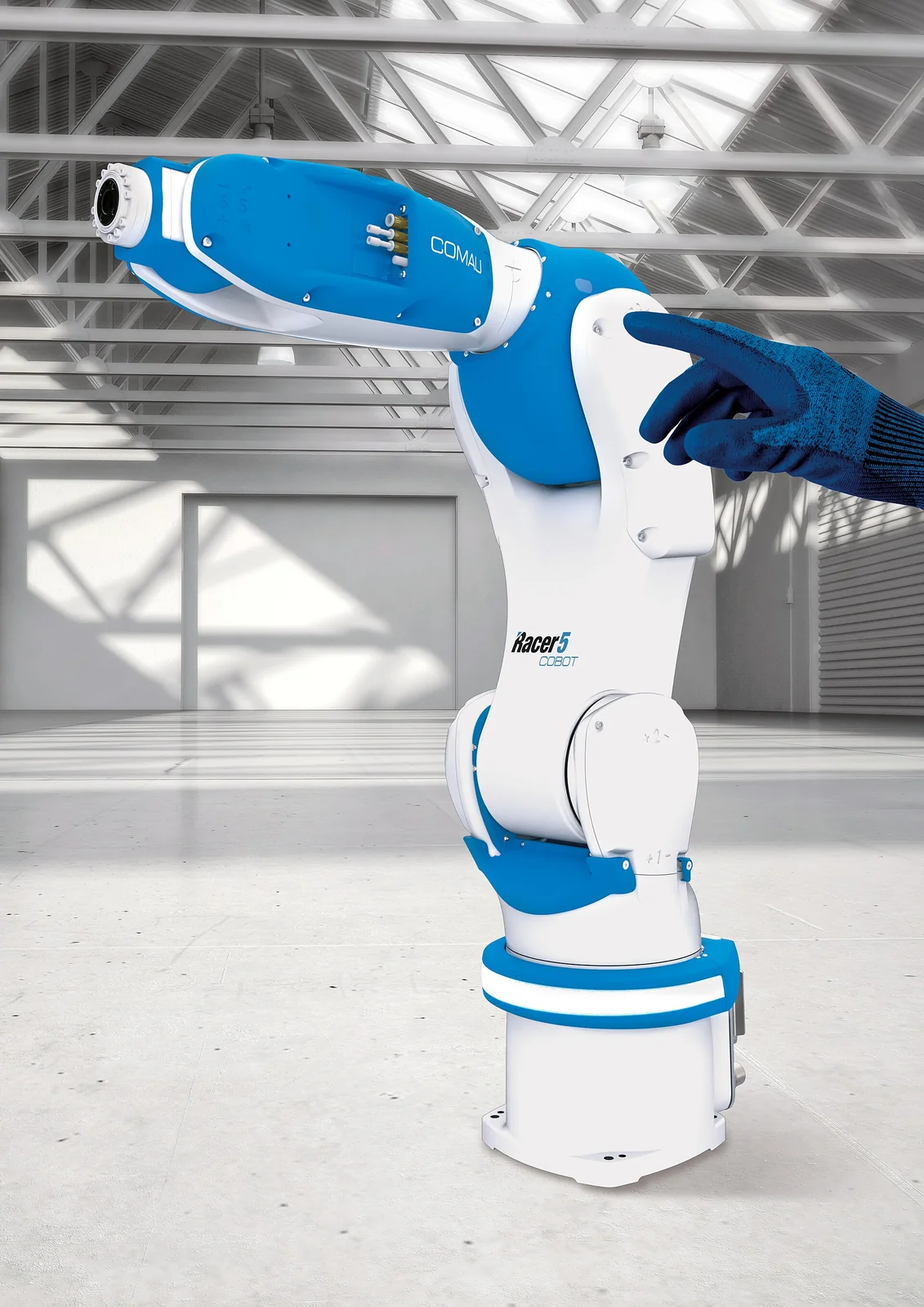
- Human-centricity: technology designed around the operator’s capabilities. Cobots — collaborative robots meant to share the workspace with people — are the typical example; the reference safety standard is
ISO/TS 15066:2016. - Sustainability: circular economy and energy efficiency as design criteria.
- Resilience: the capacity to absorb external shocks — supply-chain disruptions, energy events — without losing operational capability.
The report itself maps the relevant European research projects, and this is consistent with its nature: a steering document for research and innovation, not a technical specification. To date there is no ISO Industry 5.0 standard analogous to RAMI 4.0.
Critical point
The four references answer different questions, and conflating them produces recurring operational errors.
Innovation management (ISO 56001) says how the process is structured. R&D (Frascati Manual, TRL) says what is explored and at what maturity. Industry 4.0 (RAMI 4.0) says with what infrastructure it is implemented. Industry 5.0 (EC report 2021) says under what design constraints — people, sustainability, resilience.
The typical error is to call the purchase of a connected machine “innovation”: it is adoption of Industry 4.0 infrastructure, not necessarily R&D (the Frascati criteria are missing) nor innovation management (the structured process is missing). The second error is to treat Industry 5.0 as a later version that makes 4.0 obsolete — the 2021 document says the opposite.
Limits
The four maps cover different parts of the terrain, and none covers all of it.
ISO 56001 is recent: as of 2026 the empirical base on certifications and their measured effects is still narrow. The TRL scale measures technical maturity, but neither market value nor fitness for context — a TRL 9 technology may be unsuited to a specific organisation. Industry 5.0 remains, in its founding documents, a policy direction with metrics less settled than those of the 4.0 infrastructure; the composite indices for measuring its adoption are still the subject of open literature. Whoever plans the adoption of a technology therefore works with dated, traceable instruments, each with an explicit boundary. It is the traceability, more than the completeness, that makes them usable in a verifiable process. An applied composition of these four maps into a single working method — innovation management, R&D and the 4.0/5.0 paradigms held together — is described in an insight published by noze: https://www.noze.it/en/insights/innovation-management-r-and-d-industry-4-5/.
- https://www.iso.org/standard/79278.html
- https://www.iso.org/standard/68221.html
- https://research-and-innovation.ec.europa.eu/knowledge-publications-tools-and-data/publications/all-publications/industry-50-towards-sustainable-human-centric-and-resilient-european-industry_en
- https://www.cesaer.org/content/10-library/2021/technology-readiness-level/h2020-wp1415-annex-g-trl-en.pdf
- https://www.wolfgang-wahlster.de/wp-content/uploads/Ten_Years_of_Industrie_4_0.pdf
- https://www.oecd.org/en/publications/frascati-manual-2015_9789264239012-en.html
Cover image: Comau Racer-5 collaborative robotic arm, white and blue, touched by a blue-gloved hand in a bright industrial hall — photo by MarcoAlfa, CC BY-SA 4.0 — https://commons.wikimedia.org/wiki/File:Comau_Racer-5_COBOT.jpg