
The VALKYRIES project (Grant Agreement 101020676, Horizon 2020) closes on 30 September 2023 after two years of work on a precise problem: getting first-response services from different countries to cooperate when a mass-casualty disaster crosses a border. The question is not rhetorical. A forest fire on the Spain–Portugal border, an industrial accident on the Slovakia–Austria frontier, an earthquake between Bulgaria and Greece, a naval incident in international waters between Norway, the Netherlands and Denmark: these are the four demonstration scenarios the consortium worked on (CORDIS, 101020676).
Context
A mass-casualty incident (MCI, an event whose number of casualties exceeds local response capacity) stresses coordination above all else. When the event is cross-border, a structural strain adds to the operational one: each national service arrives with its own dispatch centre, its own triage protocols, its own nomenclature, often its own language. The disaster-medicine literature on reporting templates has recorded this for over ten years. The Utstein template for uniform data reporting of acute medical response in disasters, published in 2012 in PLOS Currents Disasters, exists precisely to give shared definitions and indicators to communities that would otherwise measure different things and call them by the same name.
The VALKYRIES consortium — coordinated by INDRA, with clinical and civil-protection partners including the Sant’Anna School of Advanced Studies and the Regional Emergency Agency in Italy — treated this gap as a pre-standardisation problem, not a software-development one.
Problem
In projects like this, the temptation is to build a platform that integrates everything. It is also the part easiest to fund and to show in a demo. The hard knot comes earlier: two dispatch centres can exchange messages only if they agree on the meaning of the fields.
Take triage. Colour coding (red, yellow, green, black) looks universal, yet the clinical thresholds that lead to a colour change from protocol to protocol — START, SALT, national variants. A patient one team classifies as immediate priority may end up in a different category in the other team’s system. If the two systems simply forward the colour without the underlying clinical data, the information crosses the border corrupted, and nobody notices until it is too late. The same holds for casualty identification, for location (different geographic reference systems), for hospital-resource status.
The problem, in short, is semantic before it is one of transport. An interoperable radio network and a well-documented API solve nothing if the two ends of the conversation do not share a minimum data set: the minimal set of fields, with agreed definitions, that must travel with every casualty and every resource.
Architecture
VALKYRIES’ harmonisation work, presented at ARES 2023 (Benevento, August 2023, DOI 10.1145/3600160.3605060), keeps three layers separate that are often conflated.
The first is transport: how messages travel between systems. Here the OASIS EDXL (Emergency Data Exchange Language) family offers already-ratified, vendor-independent building blocks. The EDXL Distribution Element 2.0 (OASIS, 2013) is a wrapper for routing any emergency payload to recipients and geographic areas; the Common Alerting Protocol 1.2 (OASIS, 2010) standardises alerts; EDXL-SitRep covers aggregated situation reports; EDXL-TEP tracks patients across multiple locations and custodians; EDXL-HAVE reports hospital-resource availability. None of these is new, and that is exactly the point: interoperability is built on stable, verifiable standards, not on formats invented for a single project.
The second layer is semantics: the shared vocabulary. This is where a project of this kind makes its original contribution, because transport standards deliberately leave many fields open. Agreeing a cross-border minimum data set — which fields on casualty, triage, location and resource, with which definitions and which codings — is a matter of clinical and organisational consensus, not engineering.
The third layer is procedure: who talks to whom, in what order, with what authority. Two technically interoperable systems remain unusable if their respective chains of command have not agreed in advance who coordinates when the incident straddles the border.
The critical point
A project like VALKYRIES is measured by how much semantic and procedural work outlives the funding, more than by the software delivered. A platform demonstrated in four exercises and then switched off leaves nothing behind. A minimum data set, a mapping of national triage protocols, a usage profile of the EDXL standards agreed across several countries still hold their worth after the code is archived, because others can pick them up, criticise them and adopt them.
Building a system is one thing; building the conditions under which many different systems can talk to each other is another. The second path is slower, gives little in a demo, and produces results that look more like documents than products. That is why it is routinely undervalued, and why it is the decisive part.
Implications
For anyone designing systems that must integrate with pre-existing infrastructure — not only in the emergency domain — the operational lesson is always the same: start from the semantic contract, not from the integration. Define the minimum data set and its codings before writing the adapter. Choose stable, vendor-independent standards (EDXL, CAP) over proprietary formats, even when the proprietary one is more convenient in the short term. Treat the mapping between different nomenclatures as a first-class artefact, versioned and tested, rather than a conversion table buried in one module’s code.
On the governance side, a cross-border project makes explicit a fact that national projects tend to mask: interoperability is not a property of the software, it is an agreement between organisations that the software merely enforces. When the agreement is missing, no amount of code stands in for it. On the implementation side, noze took part as a technical consultant for the Scuola Superiore Sant’Anna, developing two React single-page applications in wizard form — one for an operational checklist, one for the data management plan — as well as hosting the project website: the account of its contribution is in the insight published by noze (https://www.noze.it/en/insights/valkyries-conclusion/).
Limits
All of this concerns the technical and semantic dimension. It leaves out the factors that often weigh more in a real MCI: radio coverage in compromised areas, the decision latency of command chains, the physical availability of resources, joint training. A well-defined minimum data set is useless if the teams have never drilled together using it, under pressure.
There is also a methodological limit that applies to the whole family of time-bounded funded projects: a demonstration across four controlled scenarios is a proof of feasibility, not an operational validation. Real validation comes only from repeated use in actual events, which by definition cannot be planned. At VALKYRIES’ close, the open question is not whether the platform works in an exercise, but which parts of the semantic work the national civil-protection bodies will pick up and maintain over time.
- https://cordis.europa.eu/project/id/101020676
- https://dl.acm.org/doi/10.1145/3600160.3605060
- https://docs.oasis-open.org/emergency/edxl-de/v2.0/edxl-de-v2.0.html
- https://docs.oasis-open.org/emergency/cap/v1.2/CAP-v1.2-os.html
- https://docs.oasis-open.org/emergency/edxl-sitrep/v1.0/edxl-sitrep-v1.0.html
- https://docs.oasis-open.org/emergency/edxl-tep/v1.0/edxl-tep-v1.0.html
- https://pmc.ncbi.nlm.nih.gov/articles/PMC3461975/
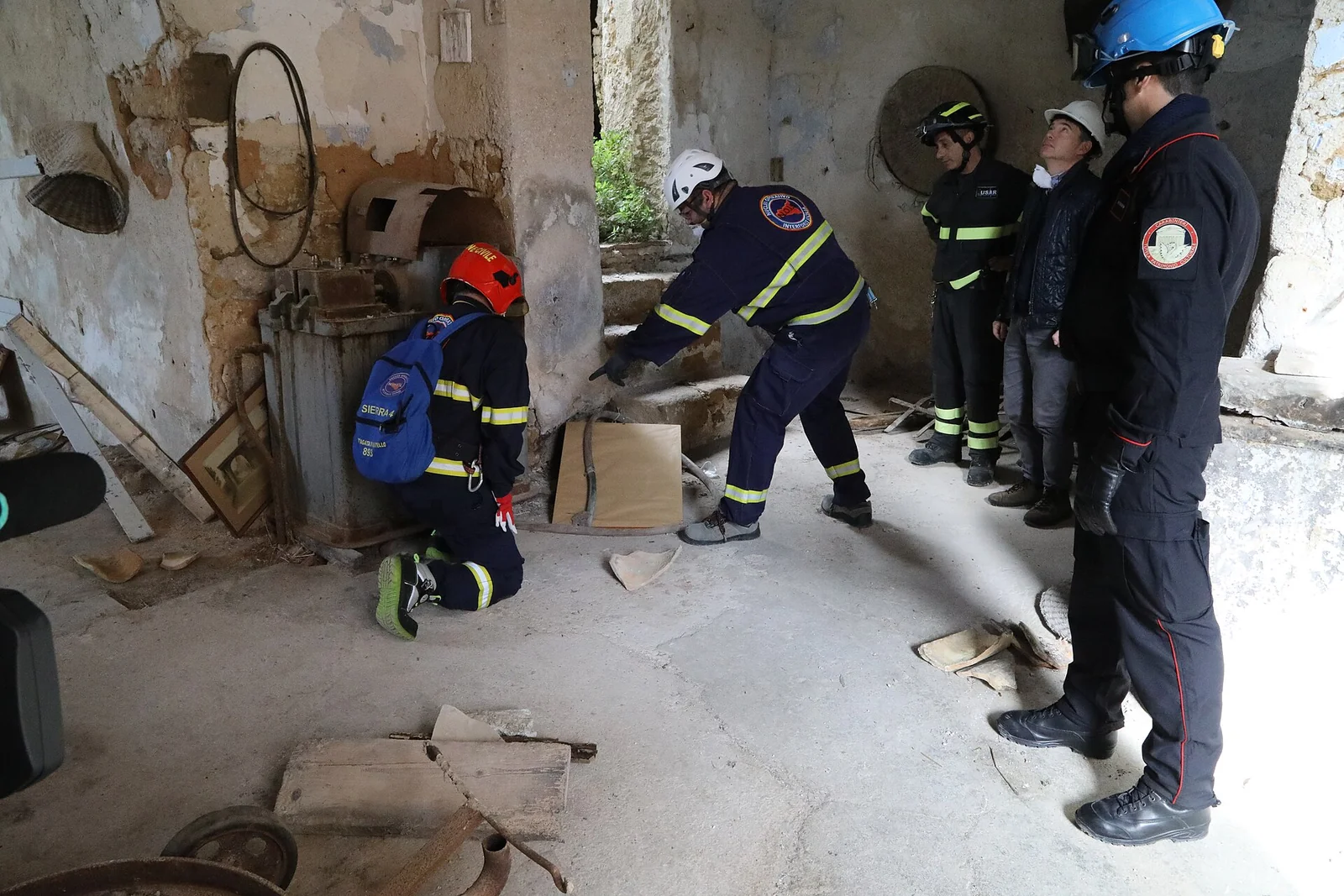
Cover image: A civil-protection rescue team in helmets and high-visibility uniforms searching inside a damaged building during a mass-emergency… — photo by Dipartimento della Protezione Civile, CC BY 2.0 — https://commons.wikimedia.org/wiki/File:Esercitazione_Belice_2018_(45566391211).jpg