
On 8 September 2026 OpenAI published On the Navier–Stokes Millennium Prize Problem, with a writeup of the proof and a Lean formalisation. The claim is that the Navier-Stokes equations, starting from a smooth fluid at rest, can develop a singularity in finite time.
The equations describe fluid motion by treating a fluid as a continuous medium rather than a collection of molecules, and they are the same ones underneath wing design, weather forecasting and the calculation of blood flow. The question left open for ninety years was whether that description holds forever.
The announcement arrives in the middle of a credit dispute with Tristan Buckmaster and Levent Alpöge, who published three proofs on neighbouring equations in the same days. I am not going into the dispute. The sources are at the bottom, including Giorgio Gilestro’s reconstruction.
Let me take some weight off the title: it will take time to work out how to use this discovery in designing real things. For the physics of sails, in the immediate term, very little changes. The result does not say that wind around a sail can reach infinite speeds, nor that simulation software becomes unreliable. Lift, drag, boundary-layer separation and tip vortices go on being computed with Navier-Stokes, with turbulence models and with experiment, exactly as yesterday.
The configuration in the proof is built for the purpose:
- a three-dimensional continuous fluid
- a smooth external force chosen in a particular way
- a vortex concentrating indefinitely
- finite total energy and diverging velocity
A real sail brings in walls, cloth deformation, compressibility and molecular scales, and long before any infinite velocity the approximation of the fluid as a continuous medium would stop holding. That is what OpenAI itself describes as a limit of the continuum model.
The consequences are therefore mostly theoretical. Viscosity does not guarantee regularity in every situation the statement admits. How a vortex concentrates and stretches is better understood, and from there could come criteria for spotting the problematic zones of a simulation and adaptive-grid strategies. What remains is that the universal reliability of simulators cannot rest on a global regularity theorem, because there is no such theorem. To design a sail today the equations, the software and the test procedures are what they were, and the construction does not describe the wall-bounded flow that a sail actually is. Quanta stresses that no immediate practical consequences are expected.
What was proved
The result goes in the direction of breakdown. The system produced an analytical proof, and its formalisation, that a fluid initially smooth and at rest reaches unbounded velocity in finite time, with energy staying finite throughout the dynamics.
The object is a vortex spiralling inward and stretching, its central region shrinking as it speeds up. The technical difficulty is that the breakdown has to arise from the motion of the fluid itself: acceleration, pressure gradients, momentum transport and viscosity all have to grow large and cancel precisely, so that velocity grows without bound while the external force stays smooth.
OpenAI states the physical meaning itself. A real fluid cannot move infinitely fast, so the point where the mathematics blows up is the point where the model stops describing the fluid, and from there on you would have to track the molecules one by one.
Charles Fefferman, who wrote the official statement, tells Quanta Magazine that he was thrilled the problem was solved and also says where the credit belongs: “the heroes of the story […] are Córdoba and Martínez-Zoroa”, the two mathematicians the technique underneath these constructions comes from.
Why the external force is not a shortcut
The official statement is worth reading, because this is where it is easy to go wrong. In Fefferman’s formulation for the Clay Mathematics Institute there are four statements. (A) and (B) ask for existence and smoothness on R³ and on the torus R³/Z³, meaning space with periodic boundary conditions, with the force identically zero. (C) and (D) ask for breakdown on the same two domains, and there the text explicitly allows a smooth force f(x,t) alongside the initial data.
OpenAI states that it has established statement C and also D. The forcing therefore does not weaken the result with respect to the Millennium Problem: it sits inside the statement the problem itself provides.
The Euler case has to be kept separate. It is the same question with zero viscosity, and Fefferman’s document calls it open and important while noting it is not one of the seven. There OpenAI’s agents resolved the unforced version, while Tristan Buckmaster and Levent Alpöge published the forced version alongside two further blowup results. These are different things, which is why the two efforts do not overlap.
How it was produced
The figures here are the ones OpenAI states, and they are worth lining up, because this is the part that concerns anyone working with these systems.
The internal model has been in training since 28 August and training is still under way. On 1 September, after hearing rumours that two Millennium Problems had been resolved, they launched an attempt on all the open ones, using coordinated groups of agents with the ability to read from a cached copy of the internet and to run code.
- The group that resolved Navier-Stokes: on the order of 10,000 concurrent agents
- Solution reached on Saturday 5 September, about 88 hours after launch
- Lean formalisation and verification, a further 17 hours, via GPT-6 Astra
- On Navier-Stokes alone: 2.7 million messages and roughly 130 billion output tokens
- Across all problems attempted: 4.9 million messages and roughly 300 billion output tokens
The unforced Euler regularity disproof came first, from around a hundred agents in some fifty hours, and it served as the trigger: they moved resources onto Navier-Stokes and handed the agents the Euler resolution as starting material, then used Codex to consolidate the insights of the different groups.
On where what the model knows comes from, OpenAI puts a sentence in writing that counts. It states that neither the researchers nor the agents saw the other work by any means before it was released publicly and that no specific user data was accessed in order to solve the problem, and then writes: “While unlikely, we cannot rule out that de-identified data derived from their usage of our products helped improve our models”. So it cannot be ruled out that the use of their products by the people working on the same problem ended up, de-identified, inside the models that then closed it. To anyone working on these systems that “while unlikely” reads differently. De-identification removes who wrote something, not what was written, and in a mathematical argument all the value sits in the second. Nor is that risk measurable, because there is no way to trace a capability of a model back to the training example that produced it. Anyone working on an open problem using a competitor’s tool has no way of checking what remains, and the estimate of improbability stays a statement by the party holding both the data and the model.
What actually changes
My sense is that propellers, planes, sails, missiles, weather forecasts and even fans will change. It is worth saying by which route, because it is not the obvious one.
It is not the theorem itself. People doing computational fluid dynamics have been solving these equations numerically for decades without knowing whether smooth solutions survive, and they will carry on tomorrow morning exactly as they did yesterday. No engineering office redesigns a propeller because a pathological initial condition leading to infinite velocity exists.
What the theorem does say, and what was conjecture before, is that the continuum model has an edge of its own, and that the edge is reachable from smooth conditions. The mechanism that gets you there is the stretching of a vortex that spirals and accelerates, and it is the same mechanism governing the small scales where cavitation on a blade, separation on a foil and the noise of a fan all live. Knowing where the model ends is the premise for knowing how far to trust a calculation near that edge.
The real route, though, is the method. What decides whether a simulation predicts a sail’s drive correctly is not the equations, which have been known since the nineteenth century, but the turbulence closure models, meaning what you put in place of the scales you cannot resolve. That is an analysis problem of the same family as the one just closed, and it is the same bottleneck in weather forecasting, where how far ahead you can see depends on how convection and boundary-layer turbulence below the grid scale get parameterised. If a system of coordinated agents brings home in 88 hours a question open for ninety years, the closure problems come within range, and those do show up on the propeller, on the sail and in the forecast.
The wind you read by hand
Anyone who teaches sailing reads turbulence without equations. The telltales on the windward side of the main starting to dance, the leech beginning to flutter, the lift dying as the flow separates and the boat sitting down: all of it is felt through the helm before it is seen anywhere.
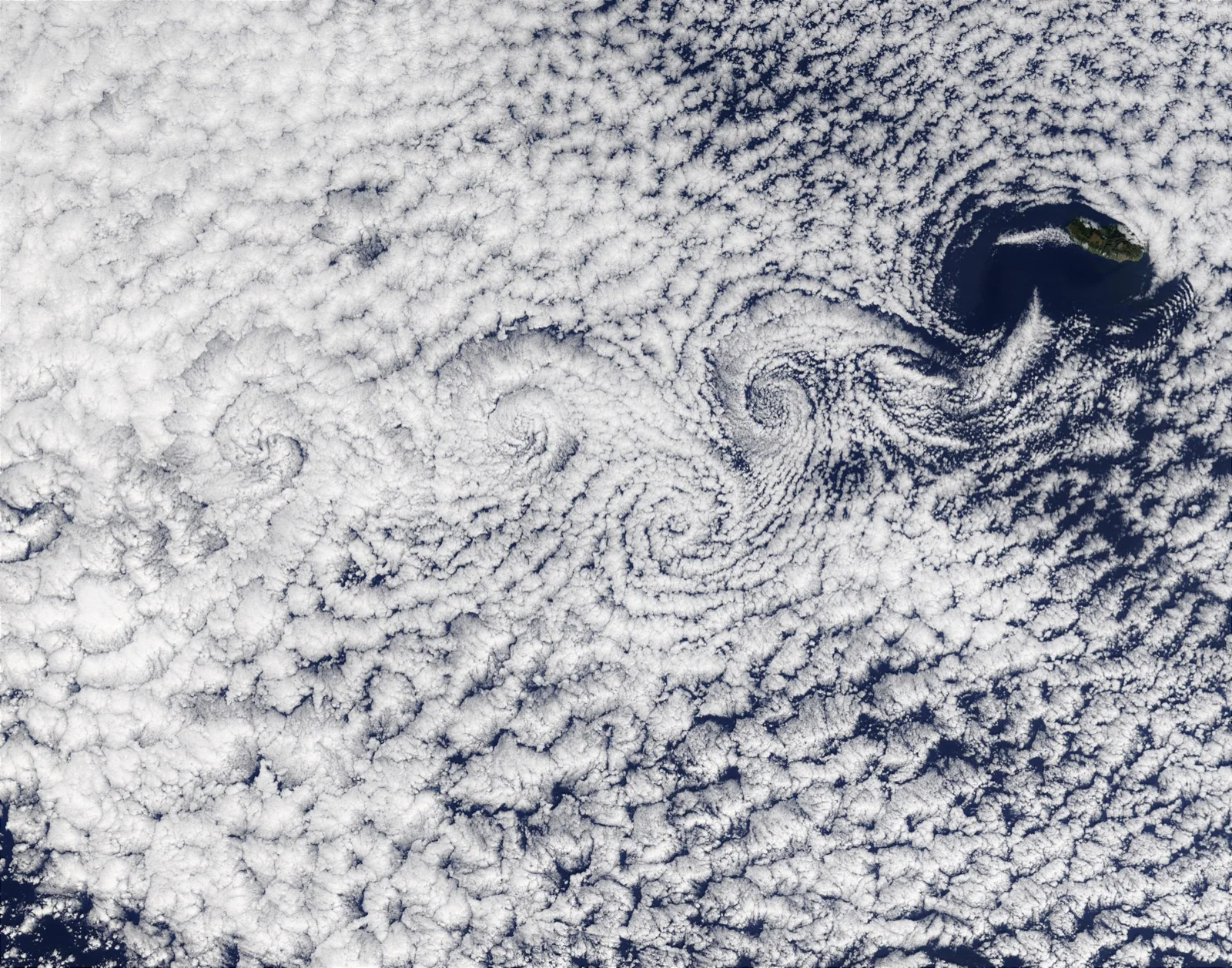
The cover image is the same physics at ocean scale, a trail of alternating vortices downwind of Madeira. Now someone has proved that the model behind those vortices, pushed in the right place, reaches a point where it describes nothing at all.
In Bertrand Chéret’s Les Voiles the boat is a biplane. One lifting surface works in air and is the sail, the other works in water and is the hull below the waterline. They have to give each other equal and opposite side forces, and since water is about eight hundred times denser than air the one underwater can be far smaller. Same equations, different density and viscosity.
The forecast and the pressure charts from the evening before tell me what wind I will find, the sails will turn it into drive and the hull below the waterline will cut water for miles. Three curves of the same equations, whose edges we now know a little better. And you go out anyway, and you trim the sails.
- OpenAI’s announcement of 8 September 2026 — https://openai.com/index/navier-stokes-solution/
- The Lean formalisation in OpenAI’s repository — https://github.com/openai/NavierStokesAndEuler
- Fefferman, the official problem statement — https://www.claymath.org/wp-content/uploads/2022/06/navierstokes.pdf
- Clay Mathematics Institute, the problem page — https://www.claymath.org/millennium/navier-stokes-equation/
- Tristan Buckmaster’s post — https://mastodon.social/@tristanbuckmaster/117233413705701198
- OpenAI’s post on X, 8 September 2026 — https://x.com/OpenAI/status/2097375276384567642
- Quanta Magazine, the technical coverage — https://www.quantamagazine.org/ai-has-solved-one-of-maths-1-million-millennium-prize-problems-20260908
- MaddMaths, the Italian mathematics community’s summary, in Italian — https://maddmaths.simai.eu/news-2/sembra-che-openai-abbia-risolto-il-problema-del-millennio-delle-equazioni-di-navier-stokes/
- TechCrunch’s account — https://techcrunch.com/2026/09/08/openai-fought-dirty-on-career-making-math-problem-says-nyu-mathematician/
- Scientific American on the affair — https://www.scientificamerican.com/article/openai-claims-blockbuster-math-breakthrough-amid-swirl-of-controversy/
- Giorgio Gilestro’s reconstruction — https://www.facebook.com/giorgio.gilestro/posts/pfbid0o2ATX4SyGVcnn9tXB6jbH6w1EmBZfHehpGXSQLzP4rsvWic6dHnfTs2sKXXPHhWol
- Bertrand Chéret, Les Voiles, Gallimard — https://www.gallimard.fr/catalogue/les-voiles/9782742407675
Cover image: von Kármán vortex street downwind of Madeira, Terra MODIS, 1 December 2002 — Jeff Schmaltz, MODIS Rapid Response Team, NASA/GSFC — public domain — https://commons.wikimedia.org/wiki/File:Vortex_street_near_Madeira_Island,_Dec_1,_2002.jpg