
Building one large “model of the world” or many local ones is, beneath the technical surface, an eighty-year-old question: where the knowledge you need to act actually lives. An essay published on 10 July 2026 by Thinking Machines Lab puts it back at the centre and takes AI’s side toward the distributed. It is worth taking seriously, because the argument is not one of taste but of information theory.
What Thinking Machines argues
The essay — The future worth building is human — starts from a sharp thesis: AI should extend human will and judgment, not take their place. The supporting argument is epistemic and comes from two economists. Michael Polanyi and Friedrich Hayek: productive knowledge is largely tacit, local, fleeting, held by those who acquired it through their work — “we know more than we can tell.” A model trained at the centre cannot reach that dispersed knowledge; hence, they argue, the need for distributed systems, customized by those who use them, with organizations encoding their own values directly into the weights. Two bottlenecks stand in the way today: a communication channel that is too narrow — “a small text box and a long wait” — and inadequate evaluation metrics. With a scaling that holds: interactivity scales with intelligence, because the same training that makes the model more capable makes it a better collaborator. The line that sums up the piece: the industry has made enormous progress in teaching machines to think; what they should think about must remain with us.
What a world model promises
On the other side stands the technical ambition of the world model. In its clean form the idea goes back to the 2018 work of David Ha and Jürgen Schmidhuber: give an agent an internal, predictive model of the world’s dynamics, on which to imagine the consequences of its actions and plan “in its head” before acting in reality. Yann LeCun placed it at the centre of his programme for autonomous intelligence in 2022, with latent-space predictive architectures (JEPA): not predicting every pixel, but the regularities that matter. In many of its recent incarnations the direction is the same — a single general model that captures “how the world works,” on which planning can rest.
Hayek’s problem
Here the two sides meet, and not peacefully. A universal world model is, by definition, an attempt to centralize the world’s knowledge in a single model. It is exactly the move that Hayek, in 1945, declared impossible. The Use of Knowledge in Society is not a political pamphlet: it is an argument about information. The knowledge relevant to decisions — the particular circumstances of time and place — is never given to a single mind in complete form; it is dispersed among many, often not articulable, and changes faster than any centre can gather it. This is the “knowledge problem”: the reason central planning fails not out of ill will but because of an informational limit. Polanyi adds the tacit dimension: much know-how does not let itself be written down, and so enters no dataset. The narrow channel Thinking Machines complains about — the text box — is exactly the bottleneck through which that local knowledge would have to pass to enter the central model. It does not pass through, or it passes through impoverished.
Implications
A design fork follows. On one side, ever-larger world models that aim to include everything: they capture generalizing regularities well — naive physics, recurring patterns — but their map stays thinner than the territory precisely where the territory is made of tacit, local detail. On the other, the distributed AI that Thinking Machines proposes: models brought close to where the knowledge lives, specialized in their weights by those who hold it, with interaction channels wider than a text box. It is also the practical logic of on-premise AI — keeping the model next to the data and the domain instead of shipping everything to a centre — the approach on which noze bases its own work: https://www.noze.it/en/insights/open-intelligence-secure-governance/. The choice between the two poles is not only technical: it decides who owns the knowledge encoded in the weights, and how much power concentrates in whoever trains the single model.
Limits
Three honesties. The first: the opposition is less clean than it is told. A world model really does capture regularities that generalize, and not all knowledge is tacit; there is a layer of the world that lets itself be modelled at the centre. The dispute concerns the local, tacit layer, not everything. The second: “distributed” has its costs. Coordinating many models that disagree is harder than querying one, and Thinking Machines makes a virtue of it — an ecosystem that competes and learns — but alignment among the parts remains an open problem. The third: “the future worth building is human” is a value choice, not a theorem. Hayek’s argument says where knowledge can sit, not where it must sit; that one wants to leave “what to think about” to human beings is a preference, strong and defensible, but to be defended as such.
- https://thinkingmachines.ai/blog/the-future-worth-building-is-human/
- https://www.econlib.org/library/Essays/hykKnw.html
- https://arxiv.org/abs/1803.10122
- https://worldmodels.github.io/
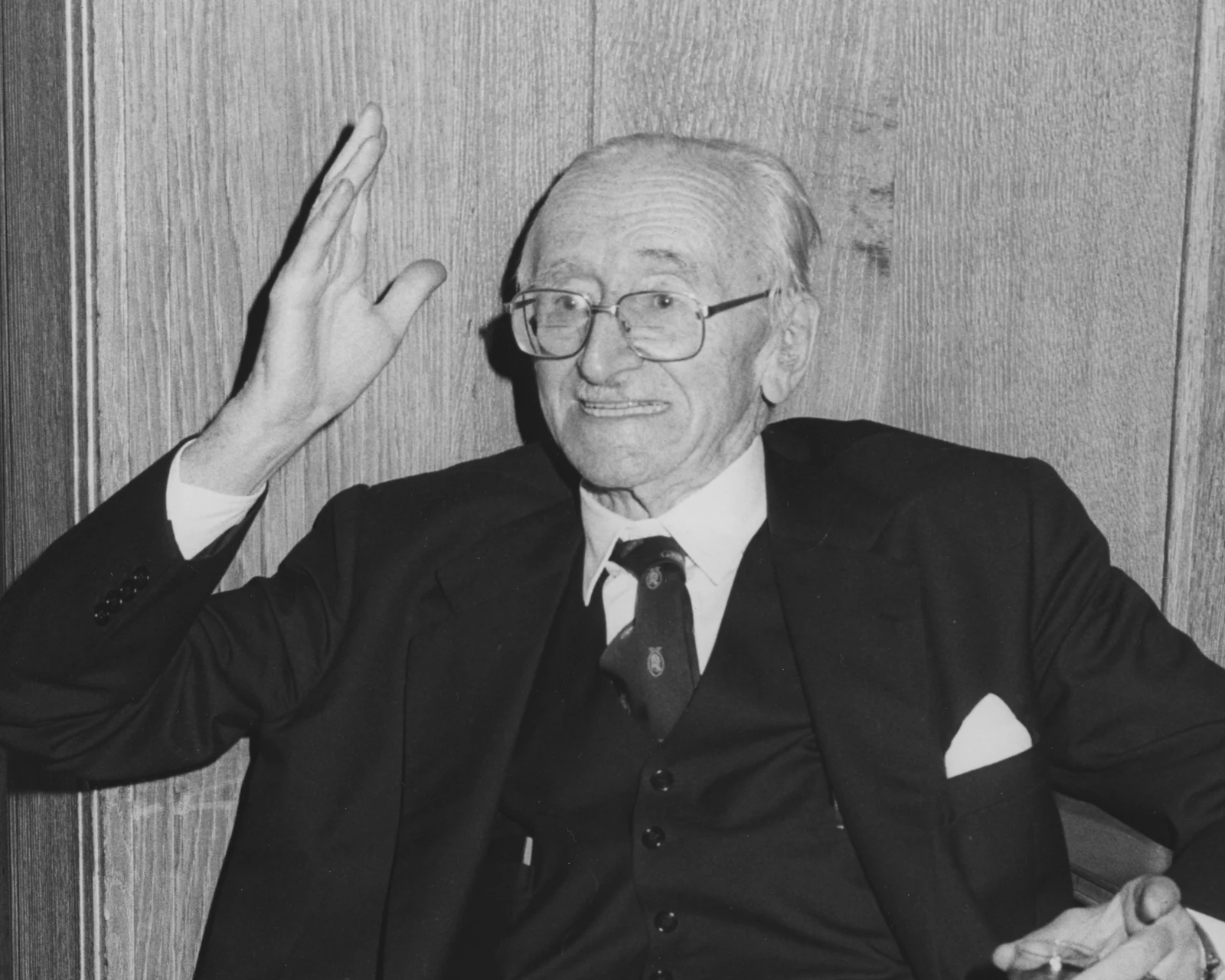
Cover image: Friedrich Hayek in 1981 — LSE Library, no known copyright restrictions — https://commons.wikimedia.org/wiki/File:Friedrich_August_von_Hayek_1981.jpg