
Yesterday I wrote about Levent Alpöge’s announcement: working with Claude, he says he has proved the Riemann hypothesis. Reading the news, though, I went back many years.
Before falling asleep
As a child I did not want to sleep. Or rather, I wanted to wake up straight away, because I was too curious to see what I would meet or learn the next day. I had got it into my head that if I managed to dream while knowing I was dreaming, I could keep thinking and learning during sleep too. Sometimes it worked. Much later I found out that lucid dreaming is studied for real, including in a sleep laboratory in clinical physiology in Pisa.
From those years I have images more than memories. Numbers, which sometimes let themselves be divided and sometimes do not. The spirals of shells and sunflowers. The night sky, big enough to seem made for sending us messages. The first sounds at the piano.
Between Fermat and Riemann
As a young man I slept little, partly because I stayed out late having fun. Fermat’s marvellous proof, the one that would not fit in the margin, had stuck in my head, and so had Riemann’s function with its zeros all on one line, perhaps.
I spent the nights first with pen and paper, then at the computer, writing code that searched for primes and ran numerical checks. I read the books that told these stories. I followed Wiles’s proof as it happened, between 1993 and 1994.
At the piano
Those nights also had a soundtrack. At the piano I played small parts, never a whole piece. Above all Beethoven’s Moonlight, then Schubert’s Unfinished, Schumann’s Rhenish and Schubert’s Trio Op. 100. I played to switch off, to clear my mind or to throw it into the dark abyss of my thoughts. I thought less about the immensity of the hypothesis than about that of nature itself, a nature that had had to create something so elusive to keep the castle of reality from collapsing into absurdity.
The name Moonlight is not Beethoven’s: he had called it Sonata quasi una fantasia. It comes from an image by the poet Ludwig Rellstab, who saw a lake under the moon in that first movement. Who knows whether Beethoven would have liked it. He told his pupil Carl Czerny that he had written better things.
Later came Leonard Bernstein’s Mass. In its two orchestral Meditations I heard an echo of quantum mechanics. The second is built on eleven notes from Beethoven’s Ninth. So I came back to him.
Dialogues that never happened
I imagined dialogues between Riemann and Einstein, who never met. Einstein was born thirteen years after Riemann died. He used Riemann’s geometry to build general relativity. Maxwell was in my dialogues too, with his perfect equations, almost too perfect.
I kept going back to the double slit, with many attempts and many thoughts. To the philosophy of nature. To game theory. Then the delirium of the absurd in complex numbers, where Riemann’s function lives. From there I arrived at linear algebra, which I would later use for machine learning.
Between the young man, the man and the researcher there is no clear border. These discoveries belong to all three.
Marvellous things
Riemann had written “very likely”. A hundred and sixty-seven years later there may be a proof, written in a language that for now only a machine reads in full. I am waiting for the version one can follow with pen and paper, at night.
It is the same curiosity that, as a child, made me want to wake up early.
- Trinity College Dublin, Riemann’s 1859 paper with the English translation — https://www.maths.tcd.ie/pub/HistMath/People/Riemann/Zeta/
- MacTutor, the history of Fermat’s last theorem — https://mathshistory.st-andrews.ac.uk/HistTopics/Fermat%27s_last_theorem/
- Wikipedia, Beethoven’s Piano Sonata No. 14 and the origin of its nickname — https://en.wikipedia.org/wiki/Piano_Sonata_No._14_(Beethoven)
- Leonard Bernstein Office, the Meditations from Mass — https://leonardbernstein.com/works/view/76/meditations-from-mass
- Norbert Straumann, Einstein, Grossmann and Riemann’s geometry, arXiv — https://arxiv.org/abs/1106.0900
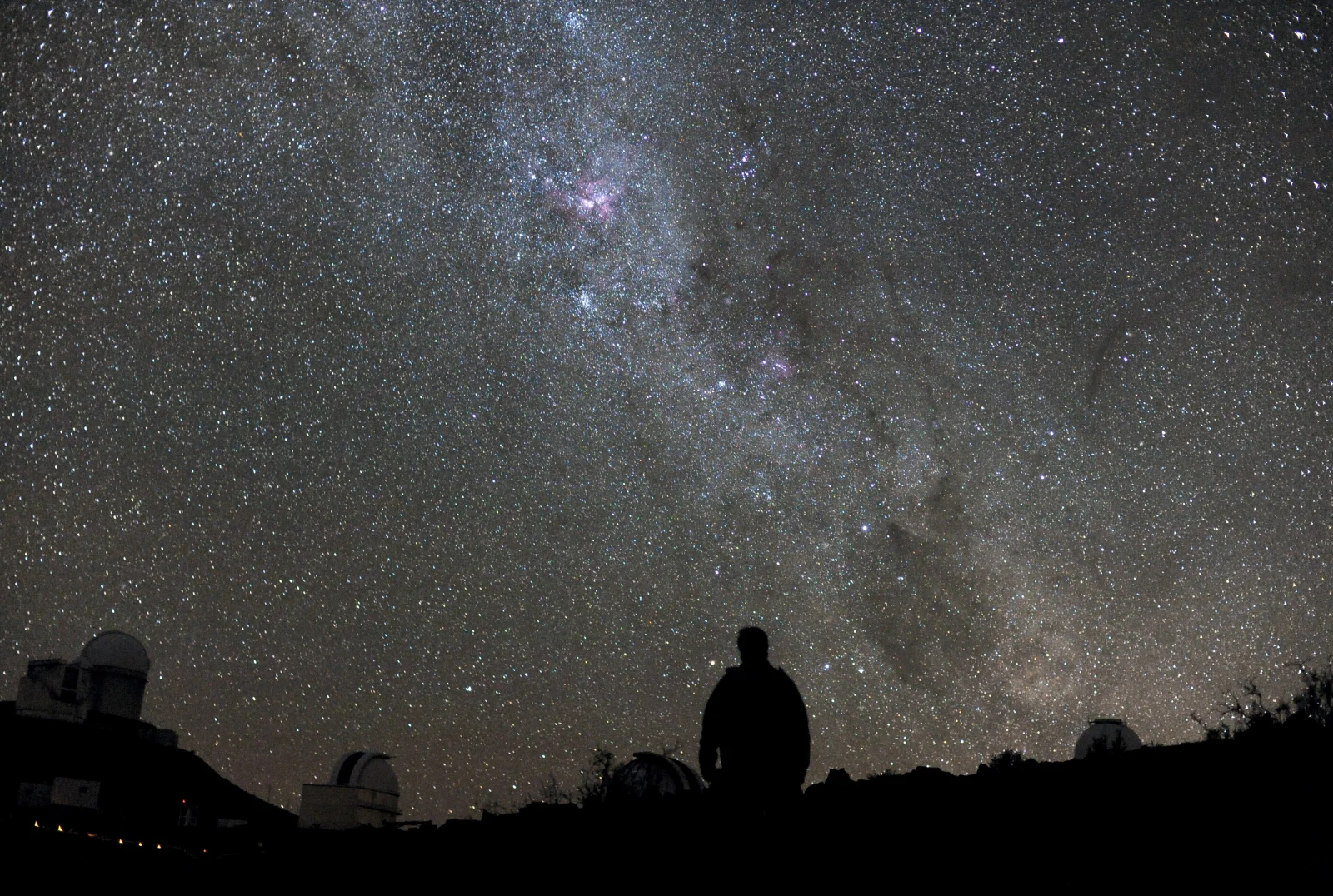
Cover image: Håkon Dahle, “Starry Night at La Silla”, the Milky Way above ESO’s La Silla Observatory in Chile. ESO/H. Dahle, CC BY 4.0 — https://commons.wikimedia.org/wiki/File:Starry_Night_at_La_Silla.jpg