
On 20 November Levent Alpöge, a mathematician at Anthropic, posted a four-page note on his website in which he writes that, working with Claude, he has found a proof of the Riemann hypothesis. According to the note the method also settles the generalised Riemann hypothesis. Of the proof itself Alpöge has released only the Lean formalisation, the language in which a computer checks every step of an argument. The formalisation is split across fourteen archives. Alpöge writes that a written-out version generated with Claude ran to more than 250,000 pages.
Andrew Sutherland, of MIT, recompiled it independently and reports that the Lean kernel accepts it using only the three standard axioms. The Comparator check is still outstanding: it verifies that the theorem proved matches a reference statement of the Riemann hypothesis and that the code does not redefine the meaning of any symbol. In the evening Kevin Buzzard, of Imperial College London, wrote that its result was still awaited. Nobody has yet read the whole argument. Alpöge himself writes that he has not mastered all the mathematics it contains. Brian Conrey, one of the leading specialists on the problem, told AFP that in his view it is the biggest thing that has ever happened in mathematics.
The announcement came the day after Anthropic’s stock market debut. Alpöge does not mention the listing but comments on the timing. He writes that he asked Dario Amodei whether he could make the announcement, that there was a constraint to respect and that the cynical reading of the timing is false.
What the hypothesis says
Prime numbers are the integers greater than 1 divisible only by 1 and by themselves: 2, 3, 5, 7, 11, 13 and so on. There are infinitely many of them, as Euclid already knew, but they thin out. Up to a hundred there are 25, up to a thousand 168, up to a million 78,498. Gauss estimated that near a number x their density was about 1/ln x.
In November 1859 Bernhard Riemann presented a paper of a few pages to the Berlin Academy, On the number of primes less than a given magnitude. He linked the count of primes to a function of a complex variable, the zeta function, ζ(s) = 1 + 1/2ˢ + 1/3ˢ + …, extended to the whole complex plane except the point s = 1. Besides the trivial zeros, at the negative even numbers, zeta has infinitely many zeros called non-trivial, which lie in a strip between real part 0 and 1. Riemann wrote that it is “very likely” that they all lie on the line with real part 1/2. He added that he had set aside the search for a proof after a few fleeting, vain attempts.
The Riemann hypothesis is this: all non-trivial zeros of the zeta function have real part 1/2. Translated into the language of primes, it says that the error in Gauss’s estimate of how many primes there are up to x grows no faster than the square root of x, up to a logarithmic factor. That is close to the best one could hope for.
In the formula that rebuilds the distribution of primes from the zeros, each zero contributes a wave whose amplitude grows like x raised to the zero’s real part. If the zeros all lie on the line, every wave grows at the same rate, like √x. None drowns out the others. It is one of the reasons people speak of the music of the primes.
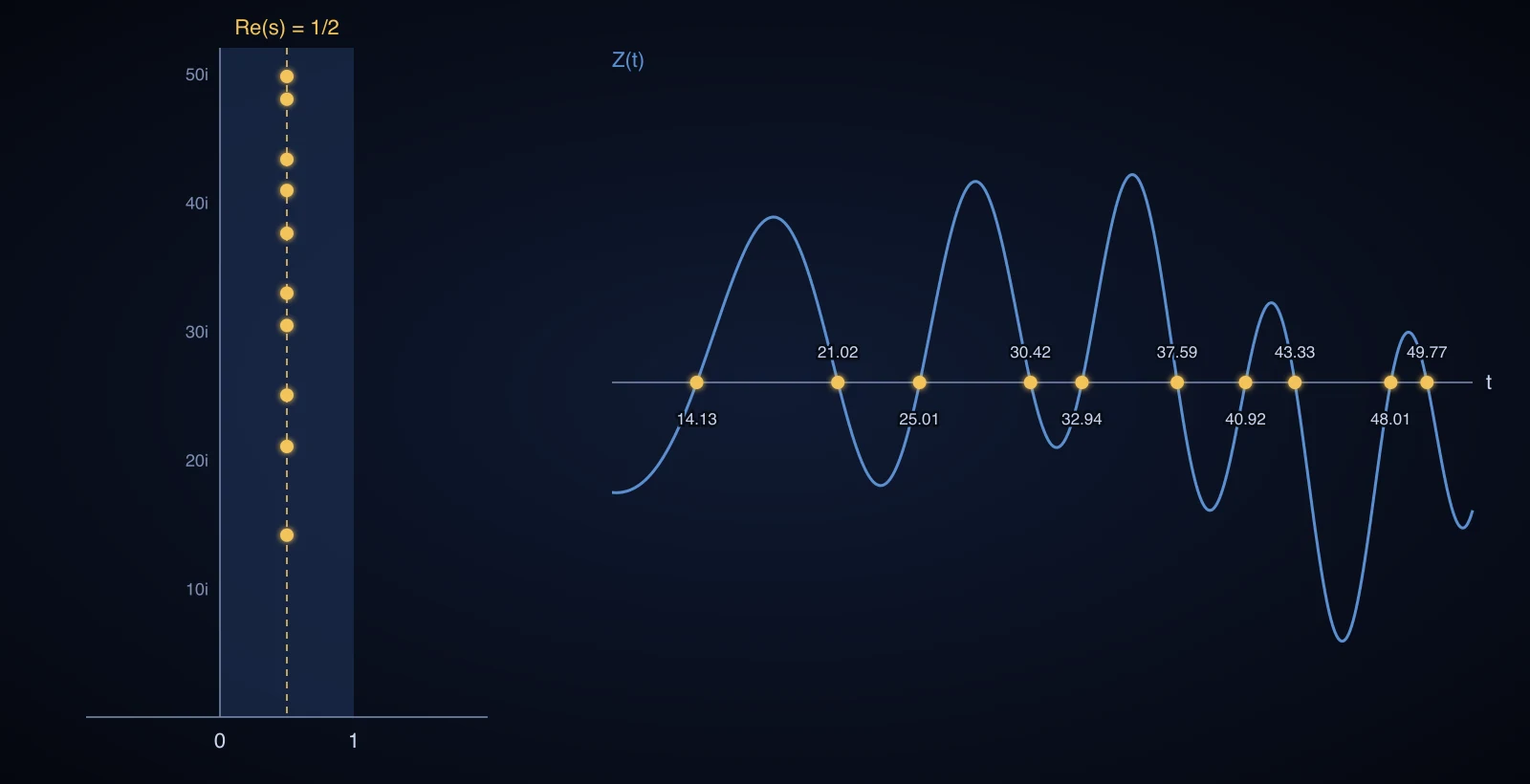
In 1900 David Hilbert included the hypothesis among the twenty-three problems for the new century. In 2000 the Clay Mathematics Institute made it one of the seven Millennium Prize Problems, with a prize of one million dollars. Meanwhile computation has checked an enormous number of zeros. In a paper published in 2021 Dave Platt and Tim Trudgian verified that the first 12,363,153,437,138 zeros lie on the line. None of these checks, however, is enough to prove that all of them do.
Who tried before
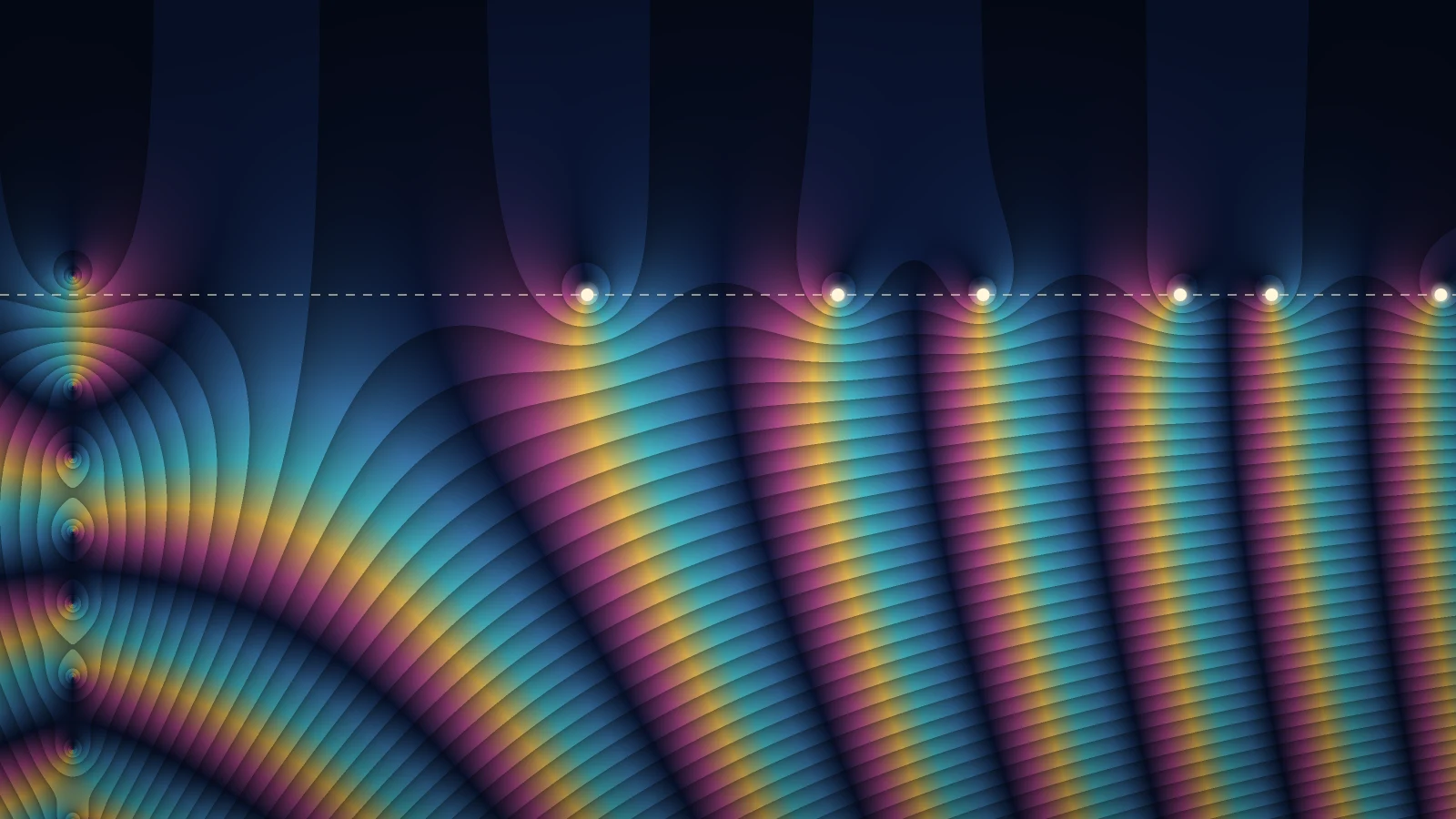
In 1863 Enrico Betti offered Riemann the chair of geodesy at the University of Pisa. Riemann, ill with tuberculosis, had to decline. He died in 1866 at Selasca, on Lake Maggiore, aged 39. In 1932 Carl Ludwig Siegel published the method Riemann used to compute the zeros, which he had found among Riemann’s papers in Göttingen. It is the formula that bears both their names, the same one used for the figure above.
In 1914 Godfrey Harold Hardy proved that infinitely many zeros lie on the line. In 1950 Alan Turing had one of the first computers, in Manchester, compute zeros. In 1972, over tea at the Institute for Advanced Study in Princeton, Hugh Montgomery described to Freeman Dyson the formula he had found for the spacing between nearby zeros. Dyson recognised it: it is the same one that describes the eigenvalues of the random matrices used in physics for the energy levels of heavy nuclei. Alpöge, in the first paragraph of his note, recalls that the hypothesis has echoes in physics too. Montgomery and Dyson’s is the best known.
John Nash also worked on the hypothesis. In the late 1950s he discussed it with Atle Selberg and the number theorists in Princeton. In Sylvia Nasar’s account, early in 1959 he presented his own approach at a meeting of the American Mathematical Society at Columbia University. Those in the room realised something was wrong. In the spring he was hospitalised with a diagnosis of schizophrenia. John Milnor recalls that Nash later blamed his collapse on his efforts to resolve the contradictions of quantum mechanics. He began to recover in the 1990s and in 1994 received the Nobel prize in economics.
In September 2018 Michael Atiyah, Fields medallist and Abel laureate, presented a proof a few pages long at the Heidelberg Laureate Forum, at the age of 89. The mathematical community did not accept it.
The precedent of Fermat
Around 1637 Pierre de Fermat wrote in the margin of his copy of Diophantus’s Arithmetica that the equation xⁿ + yⁿ = zⁿ has no positive integer solutions for n greater than 2. He wrote that he had found a marvellous proof which the margin was too narrow to contain. Andrew Wiles announced the proof on 23 June 1993 in Cambridge, at the Isaac Newton Institute. In the following months a gap emerged, which Wiles closed in September 1994 with Richard Taylor. The paper appeared in the Annals of Mathematics in May 1995, 358 years after the margin note.
Fibonacci, the golden ratio and spirals
In the Liber abaci of 1202 Leonardo Pisano, known as Fibonacci, posed the problem of the pairs of rabbits. Each pair produces a new pair every month from its second month of life. Month after month the pairs number 1, 1, 2, 3, 5, 8, 13, 21, 34, 55. Each term is the sum of the two before it. The ratio between consecutive terms approaches the golden ratio, φ = (1 + √5)/2, about 1.618.
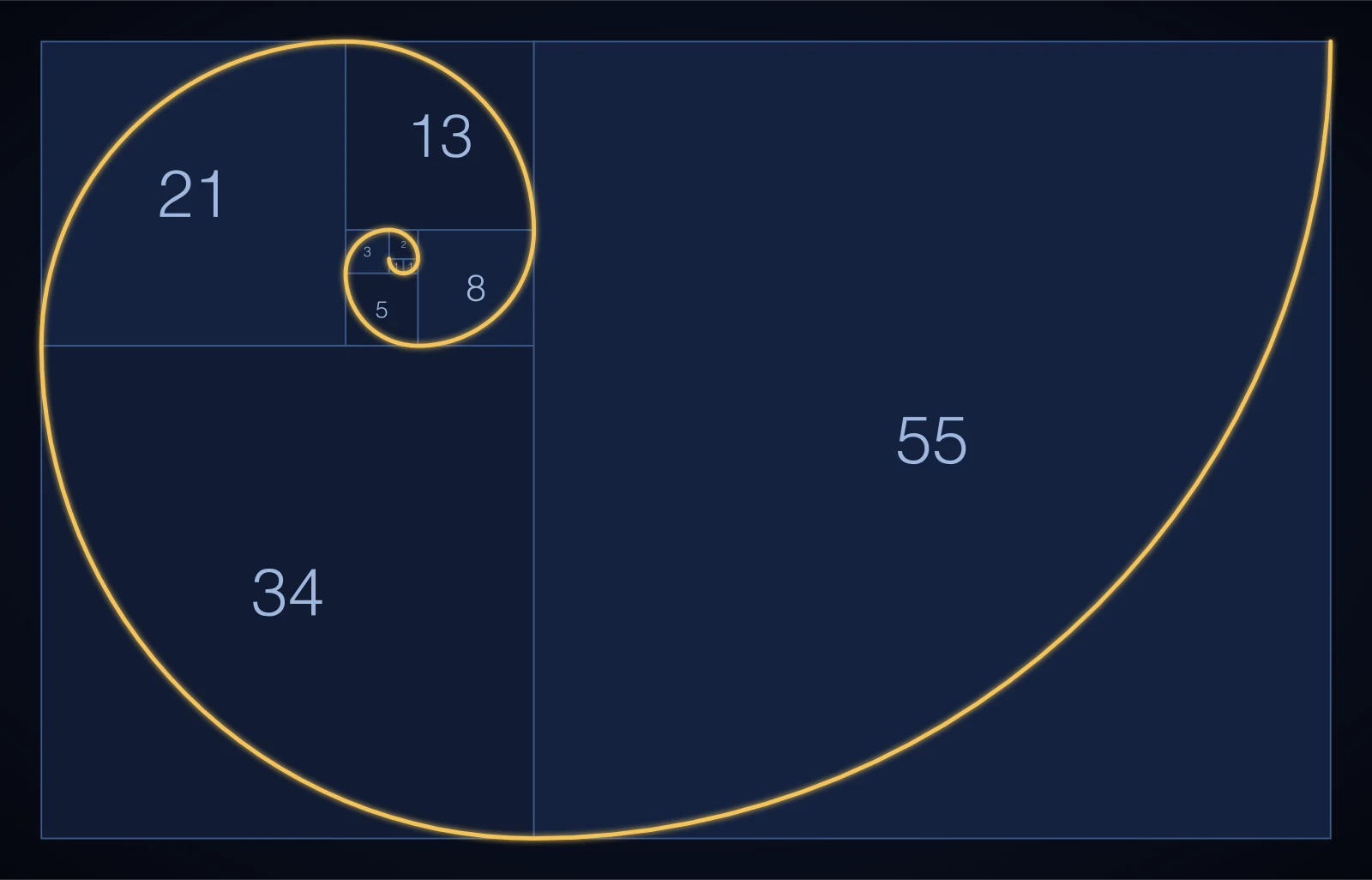
The sequence has a precise link with the primes. Apart from F₄ = 3, a Fibonacci number can be prime only if its index is prime. The converse does not hold, since F₁₉ = 4181 = 37 × 113. Whether there are infinitely many Fibonacci primes is unknown.
The golden angle, 360° divided by φ², about 137.5°, is the angle at which many plants arrange their leaves and seeds. In 1979 Helmut Vogel used it in a model of the sunflower head: seed n sits at an angle of n times 137.5° and at a distance from the centre proportional to √n. That is the figure below, where I coloured gold the seeds whose index is prime.

In 1963 Stanisław Ulam, during a boring talk, wrote the integers on a square spiral and marked the primes. Diagonals far denser than expected appeared. The figure ended up on the cover of the March 1964 Scientific American, the issue in which Martin Gardner’s column was devoted to the primes. The diagonals correspond to quadratic polynomials rich in primes, such as Euler’s n² + n + 41, which gives primes for every n from 0 to 39. That any quadratic polynomial yields infinitely many primes has never been proved, not even for n² + 1.
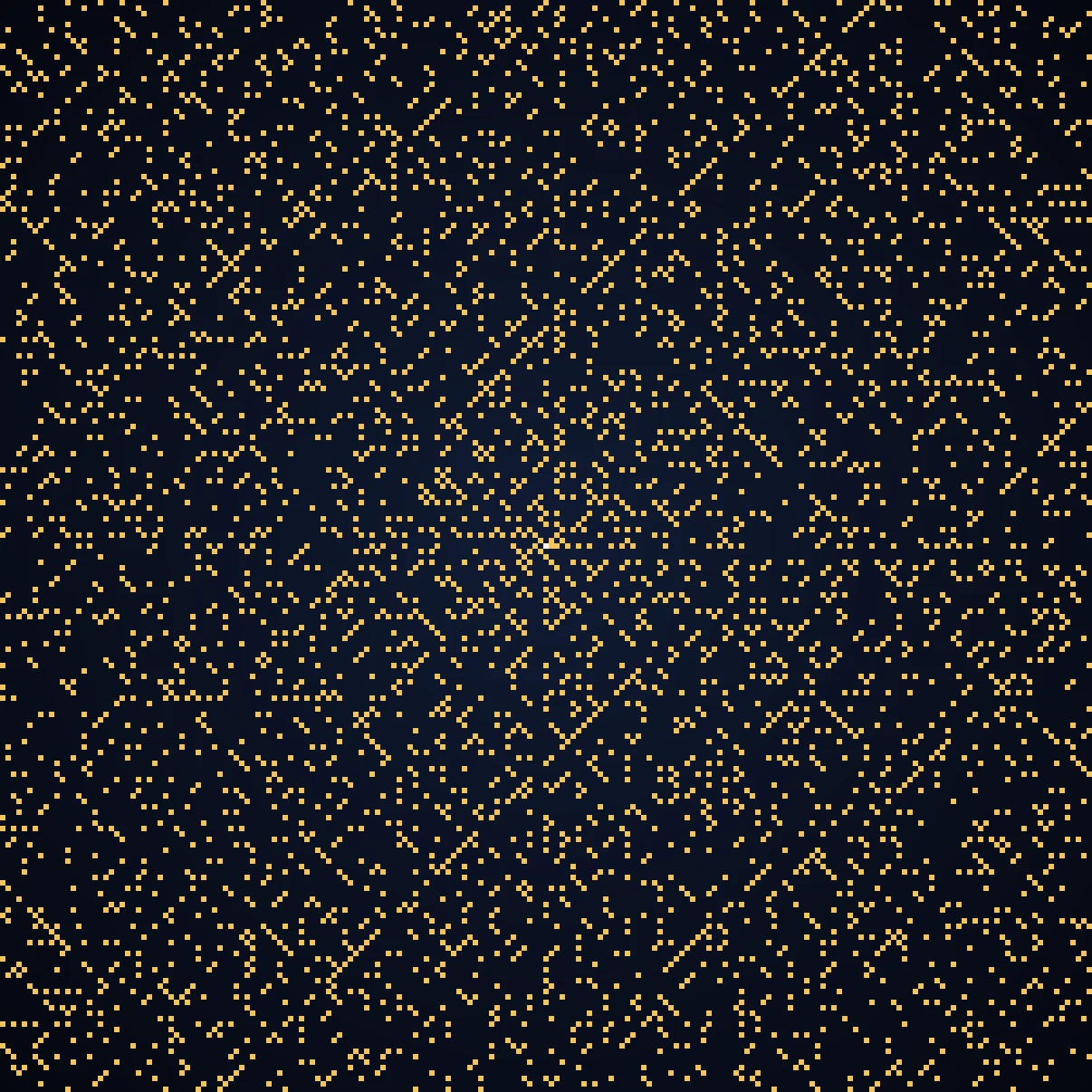
Primes as a language
On 16 November 1974 the Arecibo radio telescope sent a 1,679-bit message towards the globular cluster M13. The number 1,679 was chosen because it is the product of two primes, 23 and 73. Whoever receives it has only one sensible way to arrange the bits, a grid of 73 rows by 23 columns. The result is a drawing with the numbers from 1 to 10, the elements and nucleotides of DNA, a human figure, the solar system and the telescope. In his 1985 novel Contact, Carl Sagan, who had contributed to that message, has a signal made of prime numbers arrive from Vega.
The Voyager Golden Record of 1977, often mentioned in this context, does not use primes. Its cover explains in binary code how to play the record and where the Sun is, with a map of fourteen pulsars and a unit of time taken from a transition of the hydrogen atom.
Why mathematics is accelerating
Laid out in order, 2026 went like this.
- 1 August. OpenAI publishes ten results with proofs in Lean.
- 10 August. Anthropic announces that a research version of Claude raised from 41.6% to 67.2% the minimum share of zeta zeros known to lie on the line.
- 8 September. OpenAI says it has solved the Navier-Stokes problem, another of the Millennium Problems.
- 6 October. Among OpenAI’s 722 manuscripts is the quasi-Riemann hypothesis: no zero with real part greater than 7/8.
- 26 October. OpenAI announces an algorithm that, if confirmed, refutes the Exponential Time Hypothesis, as I described in The exponentials we cannot see.
- 20 November. Alpöge announces a proof of the Riemann hypothesis, that is, of the 1/2 bound.
In the timeline in the note, the first step is dated 6 October and the generalised hypothesis 16 November, about six weeks later.
My thesis is that we are seeing acceleration where it is easiest to measure. Mathematics has a formal verifier: if the Lean kernel accepts a proof and the statement is the right one, the result is true even before anyone has understood it. That is why it is one of the first fields in which the speed of the models turns into recognisable results. In biology or physics the verifier is still the experiment, which takes months. The Cambridge paper on the intelligence explosion starts from the same premise applied to AI research, with models speeding up the work of building the next models.
The scarce resource changes too. The bottleneck used to be finding the proof. Now the scarce things are checking the formal statement, understanding why the theorem is true and simplifying it. Alpöge expects rapid simplifications. Precisely because models are closing problems one after another, Atoosa Kasirzadeh has proposed a different way to measure progress in mathematics. I wrote about it in The dawn of a new mathematics?
The Clay rules require publication in a refereed journal and two years of scrutiny by the community. A proof available only in Lean, which nobody has yet read, is an object those rules did not foresee. Within hours Ravi Vakil, at Stanford, said that a postdoc in his department had independently submitted another proof, about which nothing more is known for now.
The same questions apply to software written by agents: code that nobody reads in full, accepted because it passes automated checks. One has to know what the check guarantees and what it leaves out. That is the subject I work on with OISG.
It has been 167 years since Riemann’s paper. What is needed now is the Comparator check and human reading. Alpöge writes that he intends to understand the argument, simplify it and write it up properly.
- Levent Alpöge, the note of 20 November 2026 on the proof — https://alpo.ge/remark.pdf
- Lean Zulip, the discussion on verifying the proof — https://leanprover.zulipchat.com/#narrow/channel/113488-general/topic/Discussion.3A.20Alp.C3.B6ge.20Proves.20the.20Riemann.20Hypothesis/near/642270043
- Scientific American, the article on the first independent checks, 20 November 2026 — https://www.yahoo.com/news/science/articles/ai-riemann-hypothesis-proof-almost-210000837.html
- AFP on Phys.org, the announcement and the reactions of Conrey and Vakil, 20 November 2026 — https://phys.org/news/2026-11-anthropic-claude-math-greatest-riddle.html
- Anthropic, the result on the share of zeros on the critical line, 10 August 2026 — https://www.anthropic.com/research/riemann-zeta
- OpenAI, the announcement on the Navier-Stokes problem, 8 September 2026 — https://openai.com/index/navier-stokes-solution/
- Clay Mathematics Institute, the Millennium Problem page — https://www.claymath.org/millennium/riemann-hypothesis/
- Clay Mathematics Institute, Riemann’s 1859 manuscript — https://www.claymath.org/collections/riemanns-1859-manuscript/
- Trinity College Dublin, the text of Riemann’s paper and the English translation — https://www.maths.tcd.ie/pub/HistMath/People/Riemann/Zeta/
- Dave Platt and Tim Trudgian, The Riemann hypothesis is true up to 3·10¹², arXiv — https://arxiv.org/abs/2004.09765
- MathWorld, the Riemann hypothesis and Hardy’s results — https://mathworld.wolfram.com/RiemannHypothesis.html
- MathWorld, the prime number theorem and Gauss’s estimate — https://mathworld.wolfram.com/PrimeNumberTheorem.html
- MathWorld, the Riemann-Siegel formula found by Siegel among Riemann’s papers — https://mathworld.wolfram.com/Riemann-SiegelFormula.html
- Alan Turing, Some calculations of the Riemann zeta-function, Proceedings of the London Mathematical Society, 1953 — https://doi.org/10.1112/plms/s3-3.1.99
- MacTutor, biography of Bernhard Riemann — https://mathshistory.st-andrews.ac.uk/Biographies/Riemann/
- Scuola Normale Superiore, the panels of the exhibition on Enrico Betti with his 1863 letter to Riemann (PDF) — https://www.sns.it/sites/default/files/2023-10/pannellipistoiamostrabetti_compressed.pdf
- Quanta Magazine, Montgomery, Dyson and the zeros of zeta — https://www.quantamagazine.org/in-mysterious-pattern-math-and-nature-converge-20130205/
- John Milnor, John Nash, Mathematician (PDF) — https://www.math.stonybrook.edu/~jack/Nash-print.pdf
- Wikipedia, Sylvia Nasar’s book A Beautiful Mind — https://en.wikipedia.org/wiki/A_Beautiful_Mind_(book)
- AMS Blog on Math Blogs, Atiyah’s 2018 proof — https://blogs.ams.org/blogonmathblogs/2018/10/01/on-michael-atiyah-and-the-riemann-hypothesis/
- MacTutor, the history of Fermat’s last theorem — https://mathshistory.st-andrews.ac.uk/HistTopics/Fermat%27s_last_theorem/
- Andrew Wiles, Modular elliptic curves and Fermat’s Last Theorem, Annals of Mathematics, 1995 — https://doi.org/10.2307/2118559
- MacTutor, biography of Leonardo Fibonacci — https://mathshistory.st-andrews.ac.uk/Biographies/Fibonacci/
- MathWorld, Fibonacci primes — https://mathworld.wolfram.com/FibonacciPrime.html
- Helmut Vogel, A better way to construct the sunflower head, Mathematical Biosciences, 1979 — https://doi.org/10.1016/0025-5564(79)90080-4
- MathWorld, the Ulam spiral — https://mathworld.wolfram.com/PrimeSpiral.html
- Wikipedia, the Arecibo message — https://en.wikipedia.org/wiki/Arecibo_message
- Wikipedia, Carl Sagan’s novel Contact — https://en.wikipedia.org/wiki/Contact_(novel)
- NASA, the contents of the Voyager Golden Record — https://science.nasa.gov/mission/voyager/golden-record-contents/
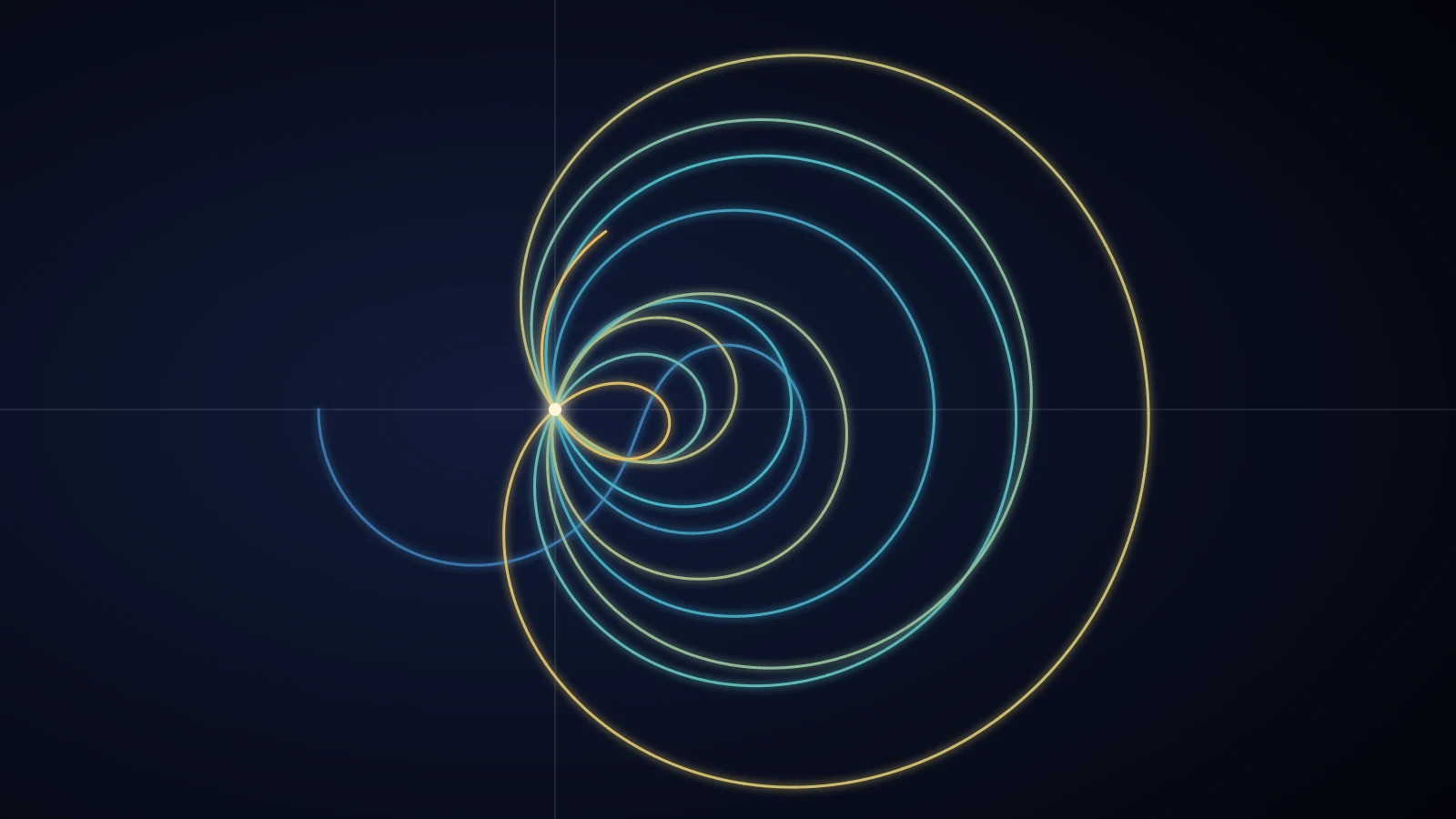
Images: generated for this post. On the cover the values of zeta on the critical line, ζ(1/2 + it) for t from 0 to 50: the curve passes back through the origin at every zero, ten times in this range. The zeta figures are computed with the Euler-Maclaurin and Riemann-Siegel formulas and the functional equation.