
On 6 October 2026 Paul Krugman published AI Versus Everything Else, arguing that data-centre spending is already crowding out investment in the rest of the US economy. Most of the debate on the economic effects of AI is about the future: jobs, a bubble, extreme risks. Krugman looks instead at an effect that can be measured today in the national accounts.
Crowding out is the mechanism by which a very large demand for capital, in an economy close to full employment, pushes up interest rates and draws resources away from other investment. It is usually discussed in relation to public deficits. With relatively low unemployment and elevated inflation, Krugman argues, a surge in private spending can produce it too, and today that is the case with spending on AI.
The figures in the national accounts
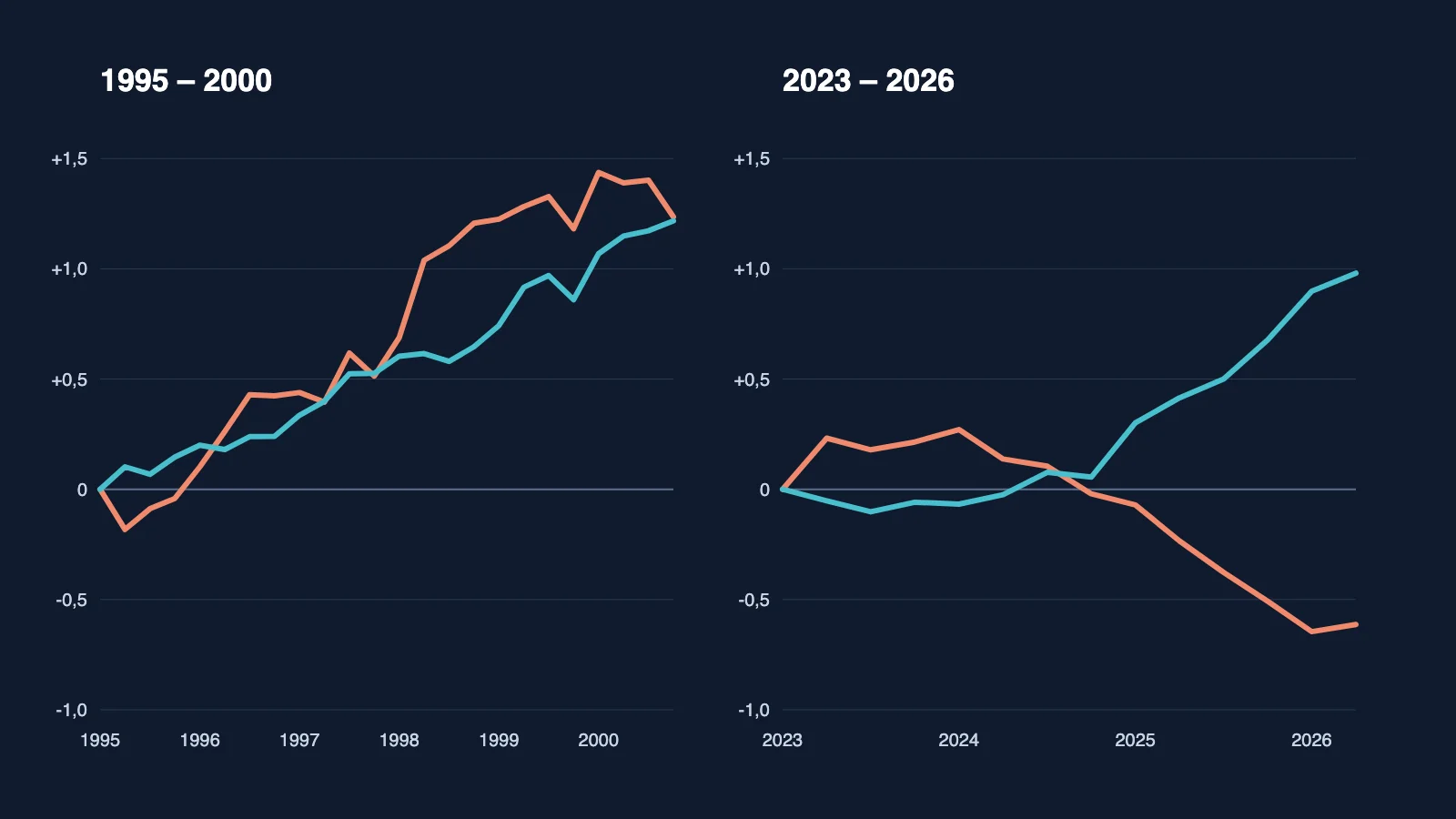
Krugman compares the change in technology investment, meaning information processing equipment and software, as a share of GDP, with the change in all other investment. I redid the calculation on the Bureau of Economic Analysis series in FRED, and the result is on the cover.
- From the first quarter of 2023 to the second quarter of 2026, private investment in hardware and software rose from 4.07% to 5.05% of GDP, +0.98 points.
- Over the same period all other private fixed investment, housing included, fell from 13.7% to 13.1%, about −0.6 points.
- From the first quarter of 1995 to the fourth of 2000, during the internet boom, the same measure gives +1.22 points for technology and +1.24 points for everything else. The two aggregates grew together.
Krugman explains the difference with the large foreign capital inflows that financed the boom in the 1990s. Today, he writes, there is no sign of them in the balance of payments.
Construction is the most visible part. According to Census Bureau data released on 1 October, in August spending on data-centre construction reached an annual rate of about $85 billion, up 73% in a year. The building, however, is a fraction of the spending: most of it goes on GPUs, servers and software, which the Census does not count.
The weight on growth has been estimated in different ways. The Federal Reserve Bank of St. Louis calculates that in the first nine months of 2025 hardware, software, research and data centres accounted for 39% of US GDP growth, against 28% in 2000. ING, after subtracting imports of computers and semiconductors, puts it at 36% of annual growth in the second quarter of 2026. The BEA does not publish an “AI” line, so these shares are built by analysts and also include ordinary computing.
The interest-rate channel
According to Asia Today, in the 5 October session the ten-year Treasury yield touched 5.347% intraday, its highest since April 2002, and the thirty-year 5.702%. In a post on 4 October Krugman names the demand for funds created by the AI boom as the likely main cause of the rise, alongside the reset of expectations about the Fed after the Iran war. The thirty-year fixed mortgage rate has gone from about 6% on the eve of the war to almost 7.3%. On a $500,000 mortgage, Krugman calculates, that is $431 more per month.
AI spending is less sensitive to rates. Most of it goes on equipment, and GPUs depreciate within a few years, so the cost of money matters less than for a building meant to last decades. Andrew Sheets of Morgan Stanley observed that a company expecting double-digit returns on invested capital is unlikely to change plans if it borrows at 6% instead of 5.5%. Rates weigh more on housing, offices, factories and commercial property, where according to the Wall Street Journal the rise is blowing up a number of deals.
Debt is playing a growing part too. According to the Financial Times, Bank of America, Citigroup and Morgan Stanley have started syndicating part of a $60 billion package to finance Anthropic’s leasing of Google chips, the largest semiconductor financing ever arranged. Krugman notes that the fallout for private credit and other less regulated parts of finance may be wider than it appears today.
Electricity
On the PJM grid, which serves thirteen US states and Washington, the total cost of wholesale power in the first quarter of 2026 was $136.53 per megawatt-hour, against $77.78 a year earlier, up almost 76%, according to Monitoring Analytics, the independent market monitor. E&E News reports that data-centre load included in the last two capacity auctions added about $13 billion to the costs of customers on the grid, households included.
Memory and devices
Memory makers are shifting capacity towards high-bandwidth memory for accelerators and towards servers, leaving less for PCs and phones. In February Gartner expected a combined 130% rise in DRAM and SSD prices by the end of 2026, with PCs 17% and smartphones 13% more expensive than in 2025, and shipments down 10.4% and 8.4% respectively. According to data reported by Asia Today, in the United States business computer prices rose 11.4% year on year in the second quarter, and consumer computer prices 8.4% in August.
Here the competition for resources works through prices rather than rates. Production capacity goes to whoever pays most, and according to Gartner the increase falls hardest on entry-level smartphones, where margins are thinnest.
Work and skills
In August 2026 the Stanford Digital Economy Lab updated Canaries in the Coal Mine? by Erik Brynjolfsson, Bharat Chandar and Ruyu Chen, based on ADP payroll data. Between November 2022 and June 2026 employment of workers aged 22 to 25 in the two quintiles of occupations most exposed to AI fell by about 11%, while in the other three it grew by about 10%. Relative to peers in less exposed occupations the gap has risen to 19%, from 15% in the July 2025 data, and no comparable effect shows up for experienced workers.
Skilled labour is contested too. According to Asia Today, in August average hourly pay for electricians in US construction rose 7.1% year on year, and data centres draw on the same workforce as the rest of construction.
Outside the United States
AMRO, the ASEAN+3 macroeconomic research office, calculates that the region accounts for about two thirds of the increase in global AI-related trade, with Southeast Asia, South Korea, China and Japan among the most exposed economies. A fall in AI-related demand could take up to 1.5 points off the region’s growth in 2027, currently forecast at 4.1%.
What I think
The economic impact of AI is unprecedented in its strength and reach, and it extends to every area of human activity. It shows in mortgage rates, in power bills, in the price of a phone, in the hiring of young workers and in the growth of economies far from Silicon Valley. The cover chart is consistent with Krugman’s reading that this time technology grows by taking room from other investment. Who bears the cost, from households with a mortgage to customers on the power grid to people buying a phone, is also a governance question.
As with earlier technological shifts, a great deal of new work opens up alongside the costs. There are harnesses to build, the layers that let models work inside real systems, with tools, permissions and controls. Above all there is the governance and cybersecurity of a whole generation of new systems to design and implement: operating systems built for agents, software partly written by models, dedicated hardware and the whole of physical AI, from robots to drones, up to the convergence with quantum computing.
In the coming years my students today will find themselves doing risk assessments of prostheses and brain-computer interfaces, of human-machine interaction systems, of drones, cars and autonomous machines. Some of this work does not yet have a defined professional profile, and it calls for technical, regulatory and clinical skills together. There will be many new things to learn and understand, to study and to try, new businesses, new ideas and new horizons. This is not the end and there is no need to be afraid, but a phenomenon this large has to be governed with clarity, starting now.
- Paul Krugman, AI Versus Everything Else, 6 October 2026 — https://paulkrugman.substack.com/p/ai-versus-everything-else
- Paul Krugman, Who Dropped the Bonds?, on long-term rates, 4 October 2026 — https://paulkrugman.substack.com/p/who-dropped-the-bonds-interest-rates
- FRED, private investment in information processing equipment and software (A679RC1Q027SBEA) — https://fred.stlouisfed.org/series/A679RC1Q027SBEA
- FRED, total private fixed investment (FPI) — https://fred.stlouisfed.org/series/FPI
- FRED, nominal gross domestic product (GDP) — https://fred.stlouisfed.org/series/GDP
- Census Bureau, construction spending, August 2026 data — https://www.census.gov/construction/c30/current/index.html
- Federal Reserve Bank of St. Louis, tracking AI’s contribution to GDP growth — https://www.stlouisfed.org/on-the-economy/2026/jan/tracking-ai-contribution-gdp-growth
- ING, how much AI is contributing to US growth — https://think.ing.com/opinions/how-much-is-ai-contributing-to-us-economic-growth/
- UPI and Asia Today, the AI boom, Treasury yields and the AMRO report, 6 October 2026 — https://www.upi.com/Top_News/World-News/2026/10/06/us-ai-spending-amro-asean3/3611791319636/
- E&E News, data centres and the 76% rise in PJM power prices — https://www.eenews.net/articles/data-centers-drive-76-surge-in-pjm-power-prices/
- Gartner, the effect of memory costs on PCs and smartphones in 2026 — https://www.gartner.com/en/newsroom/press-releases/2026-02-26-gartner-says-surging-memory-costs-will-reduce-global-pc-and-smartphone-shipments-in-2026
- Tom’s Hardware, memory prices in the third quarter of 2026 — https://www.tomshardware.com/pc-components/ram/memory-price-surge-begins-to-cool-as-consumers-hit-affordability-limit-ai-demand-still-keeps-dram-and-nand-prices-climbing-through-q3-2026
- Stanford Digital Economy Lab, the August 2026 update of Canaries in the Coal Mine? — https://digitaleconomy.stanford.edu/news/canariesaug26/
- Wall Street Journal, rates and commercial real-estate deals — https://www.wsj.com/real-estate/commercial-real-estate-interest-rates-22d04b1b
Cover image: chart generated for this article from the Bureau of Economic Analysis series in FRED. It shows the change, in percentage points of GDP, of private investment in hardware and software (light blue) and of all other private fixed investment (coral), from the first quarter of 1995 to the fourth of 2000 and from the first quarter of 2023 to the second of 2026. It reconstructs Paul Krugman’s calculation in AI Versus Everything Else*.*