
On 23 September 2026 Anthropic published a preprint describing ART, a previously undescribed family of reverse transcriptases, surfaced by an autonomous agent campaign that examined 1.9 billion protein clusters over twenty-one and a half hours of wall-clock time. The authors are Peter H. Yoon, Januka S. Athukoralage, Emmanuel Ameisen, Eric Kauderer-Abrams, Nicholas T. Perry and Matthew G. Durrant, and it is among the first results from the research programmes of the life sciences group the company set up in the spring of 2026.
The structure around that enzyme had never been described, and the way it was noticed concerns anyone building agentic pipelines over primary data. An agent loaded the raw sequence into its own context and recognised a regularity nobody had asked it to look for.
What ART is
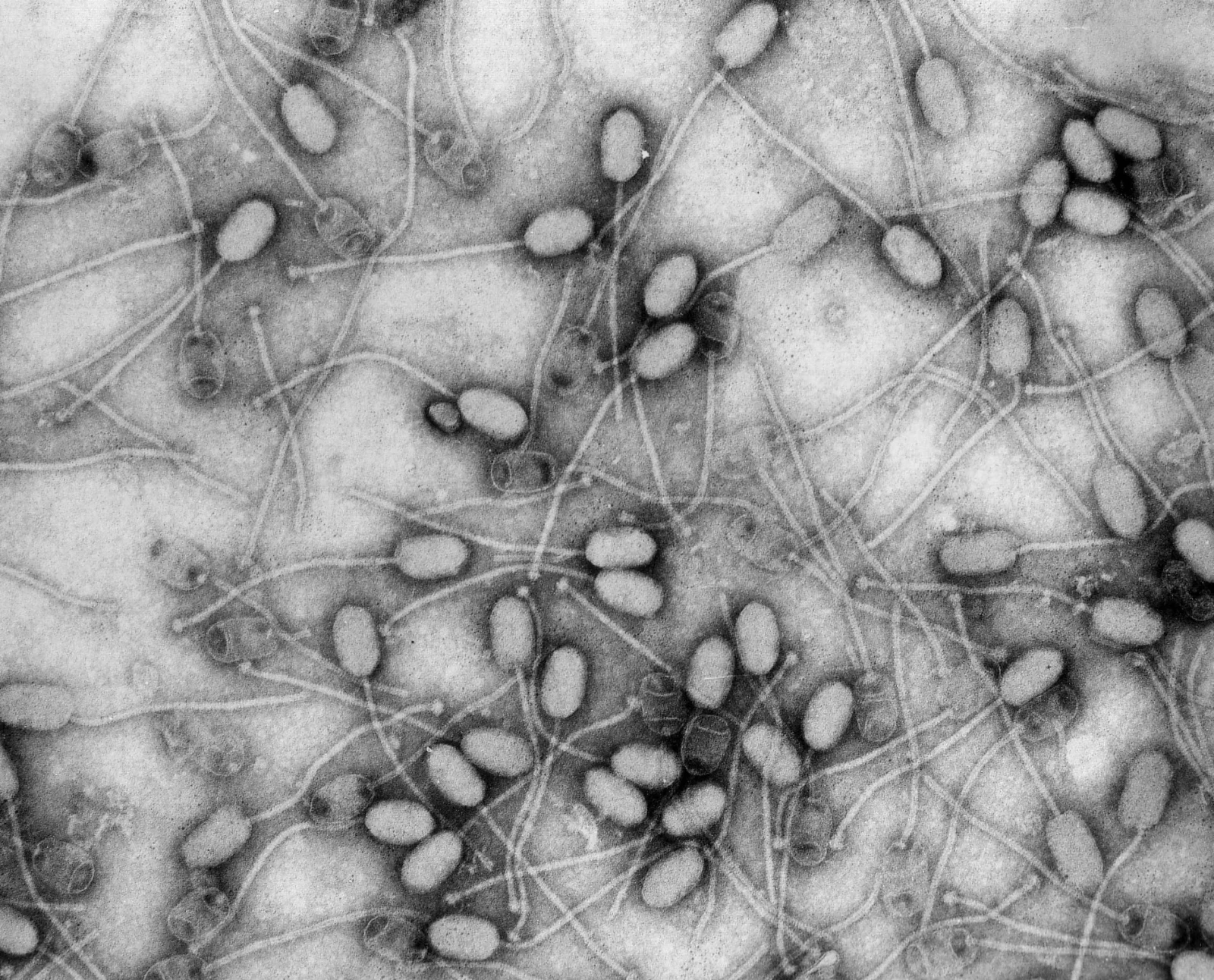
ART stands for array-associated reverse transcriptases. The locus has three parts: a run of non-coding DNA repeats, the reverse transcriptase, and a partner gene immediately downstream. It is found almost exclusively in jumbo phages, the viruses that infect bacteria, and in the authors’ reconstruction it counts 95 members, 28 of which carry a detectable array upstream of the enzyme.
The arrays hold 3 to 21 copies of a short repeat, separated by spacers of 120 to 220 nucleotides. The resemblance to a CRISPR array is architectural and stops there: no cas gene appears near any ART locus, the spacers are far longer than CRISPR spacers, and they stay conserved between related phages instead of turning over from strain to strain.
On the experimental side the authors show one thing, by two independent routes. Re-analysing public infection data for phage SA1 on Staphylococcus lentus, the array turns out to be among the most abundant phage transcripts — up to 8% of phage RNA fifteen minutes after infection — and it resolves into short RNAs whose boundaries are reproducible across replicates. The same behaviour shows up when the system is expressed in E. coli. The hypothesis they draw from it is a system related to retrons but working with a repertoire of distinct RNAs rather than a single one. It remains a hypothesis.
The enzyme itself was already in the databases, and the precedent that makes the story readable dates to 2021: the comparative genomics work describing phage MarsHill had already annotated the reverse transcriptase and proposed a non-coding RNA upstream, without describing either the repeats or the partner gene.
How the campaign is built
The campaign runs on a harness, the software that coordinates the agents, with every agent instantiated as Claude Code on the Mythos 5 model. A research brief is decomposed into five sequential stages, and each stage into individual tasks. Every task has a pair of agents: a worker that proposes a plan and executes it, and a supervisor that reviews plan and results and can open new tasks based on what it has read. A curator records findings in a shared knowledge base, and an editor reviews the reports.
The declared numbers:
- 119 tasks, 98 of them opened by the agents themselves from observations made along the way
- 949 agent sessions, for 76.9 agent-hours and 215.6 million tokens
- 21.5 hours of wall-clock time, up to 58 concurrent sessions, and a sandbox with 60 cores, 192 GiB of memory and no GPU, with structure predictions dispatched to an external queue (19 jobs)
- 49 of 119 tasks sent back by the supervisor at least once
- 19 final reports, ordered by a tournament of pairwise comparisons judged by the model
The census produced 3,564 protein families recurring in the neighbourhood of reverse transcriptases, narrowed to 17 promoted candidates. Of those 17, three were confirmed as new associations and fourteen were set aside as annotation artefacts, parts of already described systems, or ordinary residents of the genomic neighbourhood. The ART report came third in the tournament.
Reading DNA into context
The decisive step comes from a task opened outside the planned route. A worker had rejected the association that promoted the candidate in the first place, and the supervisor opened a follow-up task on a different hypothesis. The next worker loaded the non-coding sequence upstream of the enzyme into its own context and recognised the tandem repeat by eye, which neither the research brief nor the task brief had asked it to look for. From there came the novelty check against the literature and the databases.
The authors tried to measure that capability with a fixed-input benchmark: seven Claude models, five levels of information, one hundred attempts per combination, 3,500 in total. With the loci sitting as text in the prompt, the four most capable models describe the array in at least 90% of attempts. With the loci supplied as files in an environment with analysis tools, the figure falls as low as 32%, and 39% of those attempts never read two hundred contiguous nucleotides. More tools and more data make that particular observation worse. The authors’ hypothesis, which they then check against the session transcripts, is that those models never read the attached sequences into their context.
Two checks on the mechanism come with it. Two language models trained only on biological sequences, Evo 2 and gLM2, flag the same repeats on the same fragment. And passing the session transcript back through a copy of the same Mythos 5 checkpoint, two internal signals respond to the repeat copies and go silent when the copies are shuffled in place, the second on all fourteen copies and the first on twelve of fourteen. Neither is specific to DNA: both also respond to repeats in strings of letters and digits.
How reproducible it is
The preprint also reports the count of the replicates. The campaign was relaunched ten more times with the same harness and the same brief. Nearly every replicate that completed the census sampled ART loci, and in two cases a worker followed the family up. In no replicate did an agent read the DNA upstream of the enzyme, and the array was missed every time.
One campaign out of eleven. The authors put it down to the breadth of the search space and the non-deterministic behaviour of the harness, and they write it without hedging: harness configuration and model capability can dramatically affect research outcomes and successful discovery.
What other groups say
Feng Zhang, of MIT and the Broad Institute, calls the result “genuinely intriguing” and worth further investigation. It is worth saying where that view comes from: Zhang read the preprint at Anthropic’s request and appears in the paper’s acknowledgments, so it is not a view gathered from outside.
Dimitri Perrin, of Queensland University of Technology, sets two limits. The first on the system: “we can say that ART is CRISPR-like in its architecture, but there is no evidence that it is CRISPR-like in its function”. The second on the method: we do not know how many of the thousands of candidate families, or of the twenty selected cases, represented genuinely new biology, and finding one intriguing result after exploring thousands is not the same as showing the system recognises discoveries reliably.
Kevin Blake, a microbiologist at Washington University, adds that there is nothing to indicate a rival to CRISPR as a technology, and points out that countless CRISPR-like sequences remain unidentified because most bacterial species have never been studied.
The record of the campaign
The part I find most interesting is the record. Plans, results, reviews and scripts were written to a version-controlled archive readable by every agent, and the sessions are kept as complete traces. That is why the preprint can attribute recognition of the array to one specific task, show that the brief never contained the word “repeat”, and state that no tool call at all came between reading the sequence and recognising the pattern.
That record turns the result into a chain someone who was not there can verify, which is the same property I ask of an agentic system in production when its actions carry consequences. Here it establishes scientific credit; in a clinical or enterprise system it establishes accountability, and the structure required is the same.
It is worth noting that part of the chain cannot be reproduced from outside. The model behind the campaign, Mythos 5, is a limited release available only to approved organisations through a dedicated programme. Anyone wanting to repeat the campaign with the same parameters has no way to do so.
Limits
The function of ART is unknown. The authors state that they have not shown the reverse transcriptase to be active, nor that the RNAs produced by the array are its substrates, nor that the enzyme and the partner gene actually interact. The interaction between the two rests on predicted co-folds with an interface confidence score of about 0.6, a value the authors themselves describe as moderate.
The preprint has not been peer reviewed. Some of the fractions reported in the analyses the agents ran are taken from the agents’ own report and were not recomputed by the authors. The cost of the campaign is declared neither in the announcement nor in the preprint.
Finally, the announcement’s headline says Claude discovered the system. The autonomous part is the recognition of the anomaly and the chain of checks that held it up; defining the family, the phylogeny and the experimental measurements came afterwards, from people directing the analysis.
- Anthropic, the announcement of 23 September 2026 — https://www.anthropic.com/news/claude-discovers-novel-enzyme-system
- The preprint, with methods and figures — https://www-cdn.anthropic.com/22573675ada52a8ca8a97a1a4b4326b2f208a071.pdf
- Dimitri Perrin in The Conversation, the objections on method — https://theconversation.com/an-ai-model-has-found-a-new-crispr-like-biological-system-heres-what-it-means-for-science-292777
- Gizmodo, reactions from outside researchers — https://gizmodo.com/claude-found-a-mysterious-crispr-like-system-but-anthropic-cant-say-what-its-capable-of-2000816906
- Al Jazeera, the news report on the announcement — https://www.aljazeera.com/economy/2026/9/24/ai-model-claude-discovers-crispr-like-enzyme-system-anthropic-says
- Korn and colleagues, the 2021 comparative genomics of S. aureus jumbo phages — https://pmc.ncbi.nlm.nih.gov/articles/PMC8428398/
- Millman and colleagues, retrons as anti-phage defence systems — https://doi.org/10.1016/j.cell.2020.09.065
- Brixi and colleagues, Evo 2 in Nature — https://doi.org/10.1038/s41586-026-10176-5
- Chikhi and colleagues, Logan, the planetary-scale assembly behind the database — https://doi.org/10.1101/2024.07.30.605881
- Anthropic documentation on access to Mythos 5 — https://platform.claude.com/docs/en/about-claude/models/introducing-claude-fable-5-and-claude-mythos-5
Cover image: bacteriophage 3A of Staphylococcus aureus — Bacter, courtesy of H.-W. Ackermann — CC BY-SA 3.0 — https://commons.wikimedia.org/wiki/File:Phage_de_S_aureus_3A.jpg