
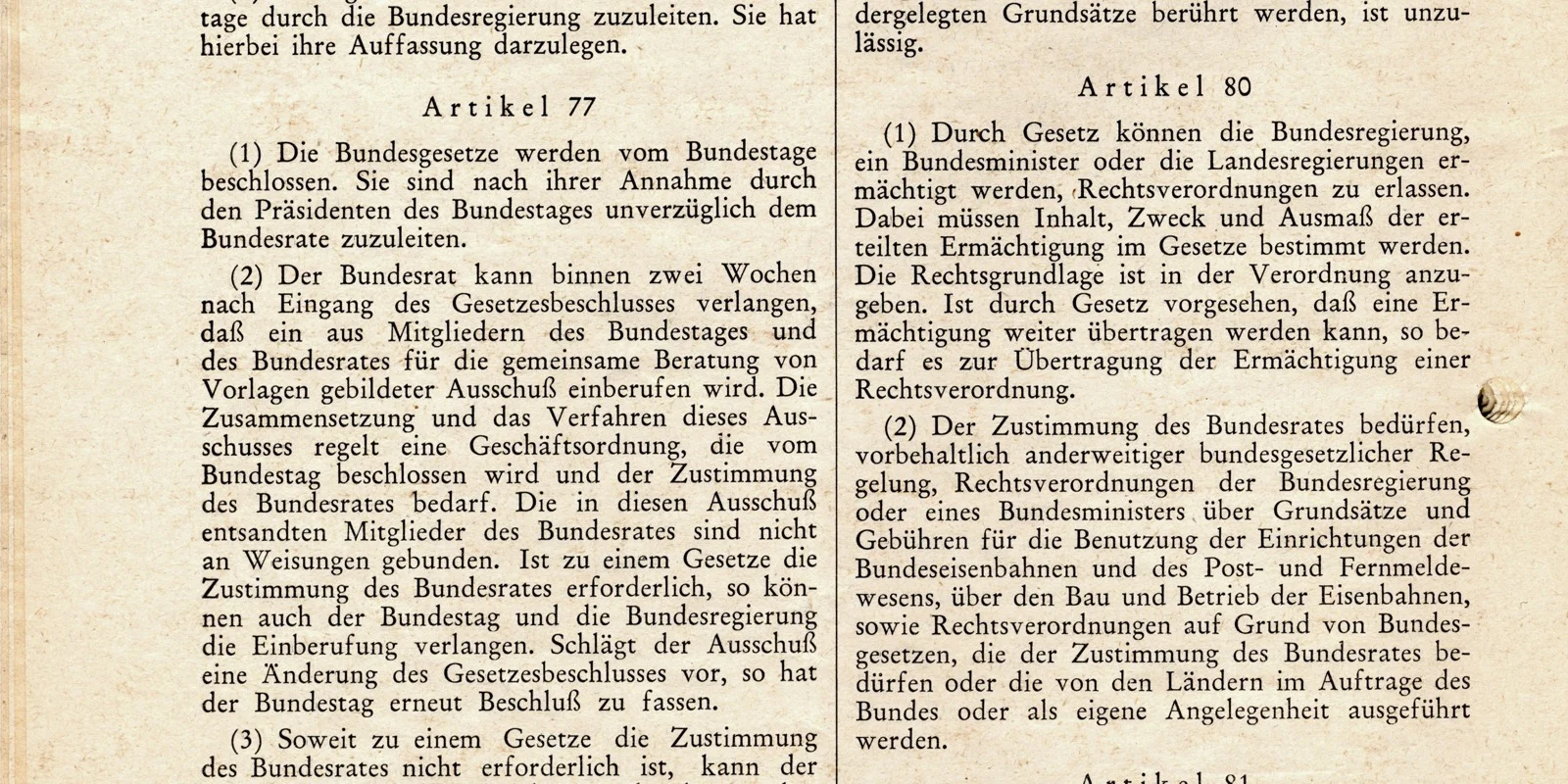
On 28 October 2026 Felix Ringe, a visiting fellow at Stanford Law School’s liftlab, and an anonymous co-author published Legal exploits may emerge at scale. Their thesis is that laws, written in natural language, can contain vulnerabilities just as software does. Today courts absorb most of them through interpretation, and few come to light. With AI systems able to search for them at scale, that balance could change. The authors state that they used language models to find a substantial number of vulnerabilities in the German legal system, none previously recorded to their knowledge. They publish three, chosen among those whose exploitation would not cause serious harm.
The duty to cite the legal basis
In Germany parliament can delegate the details of a matter to the government: a statute authorises the executive to issue regulations (Rechtsverordnungen). Article 80 of the Basic Law requires every regulation to state its legal basis, that is, the statutory provision that authorises it. Under the settled case law of the Federal Constitutional Court, provisions not covered by the cited basis are void. The duty also applies to regulations that amend other regulations, which are very common in German law.
The check has an almost mechanical structure. You read what a provision does, identify the statutory power needed to do it and compare it with the list of provisions cited in the preamble. It is a check a model can repeat across thousands of texts.
Three cases
- Confidential documents on occupational diseases. On 16 July 2026 the Occupational Diseases Regulation (BKV) was amended to make the materials of the scientific council that assesses new occupational diseases confidential even after deliberations end, including statements submitted from outside. According to the authors the required basis is § 9(1a) of Book VII of the Social Code, while the preamble cites only § 9(1). The scenario, a hypothetical one, is a journalist who requests, under the Freedom of Information Act, an employers’ association statement cited in the report on certain cancers linked to night work.
- Airport transit visa. In December 2015 Mali was added to the countries whose nationals need a visa even just to stay in the international area of a German airport during a stopover. The power to set that list lies in § 99(3a) of the Residence Act, which the amending regulation does not cite. The amendments of 2023 and 2026 do not cure the defect because they do not re-enact the entry. EU law does not impose the visa on its own, because Mali is not on the common list of the Visa Code.
- Time off for soldiers’ overtime. On 6 March 2025 NATO’s JSEC command in Germany was added to the multinational commands whose German soldiers are excluded from working-time protections, including the right to time off for overtime beyond five hours a month. The power to exclude them lies in § 30c(6) of the Soldiers Act, which the regulation does not cite. The scenario, again hypothetical, is a captain who asks for time off for ten hours of overtime.
For each case the authors discuss the foreseeable objections and consider them weak. That the provisions are void remains their legal reading.
From software bugs to legal bugs
The analogy with computer security had been proposed before. In August 2025 Greg Sadler and Nathan Sherburn introduced Legal Zero-Days, undiscovered vulnerabilities in a legal framework that have immediate effects without going through litigation, with the 2017 Australian dual citizenship crisis as their case study. They concluded that the models of the time did not reliably find impactful vulnerabilities and that future systems might. Fourteen months later Ringe and his co-author report an empirical result in that direction. The way they publish it, only the least harmful cases, also recalls the responsible disclosure practices of computer security.
What I think
Anyone who works in security recognises the pattern. When finding a vulnerability is cheap, the advantage goes to whoever finds it first, and defence has to use the same tools. The authors say this for the law: lawmakers will need to make the process more robust, including by using AI.
For the defect described here the defence has a familiar shape. An automatic check before publication, comparing every provision with the cited basis, works like the static analysis that runs before every software release. What is missing is what comes after: a channel to report a defect, a public register like CVE for software vulnerabilities, set deadlines for the fix. Today a vulnerability in a regulation surfaces when someone invokes it before a judge, and it is fixed by a new legal act. These are the timescales of the two-speed world: discovery follows the pace of models, correction that of institutions.
The cases are German, but I believe the problem concerns any legal system with many regulations that amend one another. Bringing to lawmaking the practices software has used for decades, namely checks before release, coordinated disclosure and tracked fixes, seems to me the most concrete way to prepare.
- Felix Ringe and anonymous co-author, Legal exploits may emerge at scale, 28 October 2026 — https://www.felixringe.com/legal-exploits/
- Felix Ringe, personal page — https://www.felixringe.com/
- German Basic Law, Article 80 — https://www.gesetze-im-internet.de/gg/art_80.html
- Federal Constitutional Court, judgment 2 BvF 3/90 of 6 July 1999 — https://www.bundesverfassungsgericht.de/SharedDocs/Entscheidungen/DE/1999/07/fs19990706_2bvf000390.html
- Occupational Diseases Regulation (BKV), § 9 — https://www.gesetze-im-internet.de/bkv/__9.html
- Book VII of the Social Code (SGB VII), § 9 — https://www.gesetze-im-internet.de/sgb_7/__9.html
- Residence Regulation (AufenthV), Annex C — https://www.gesetze-im-internet.de/aufenthv/anlage_c.html
- Residence Act (AufenthG), § 99 — https://www.gesetze-im-internet.de/aufenthg_2004/__99.html
- EU Visa Code, Regulation (EC) No 810/2009 — https://eur-lex.europa.eu/legal-content/EN/TXT/?uri=CELEX%3A02009R0810-20240628
- Soldiers’ Working Time Regulation (SAZV), annex — https://www.gesetze-im-internet.de/sazv/anlage.html
- Soldiers Act (SG), § 30c — https://www.gesetze-im-internet.de/sg/__30c.html
- Sadler and Sherburn, Legal Zero-Days: A Novel Risk Vector for Advanced AI Systems, arXiv, 2025 — https://arxiv.org/abs/2508.10050
Cover image: page 10 of the first issue of the Bundesgesetzblatt, 23 May 1949, with the original text of the Basic Law. On the right Article 80, which requires every regulation to state its legal basis. Parlamentarischer Rat, Bundesgesetzblatt I — public domain — https://commons.wikimedia.org/wiki/File:Bundesgesetzblatt_Nr_1_von_1949-05-23_Grundgesetz-012.jpg