
On 19 August 2026 Merck and Moderna announced that the phase 3 INTerpath-001 trial met its primary endpoint of recurrence-free survival and its secondary endpoint of distant metastasis-free survival, in patients with completely resected stage IIB-IV cutaneous melanoma. The drug is intismeran autogene, previously known as mRNA-4157 and V940, combined with pembrolizumab.
The release carries no efficacy figure from the trial. No hazard ratio, no confidence interval, no p value, no event count, no follow-up duration. The data “will be presented at an upcoming international medical meeting”, with no indication of which or when.
What was announced
INTerpath-001 is registered as NCT05933577: phase 3, randomised, double-blind, placebo- and active-comparator-controlled, started on 19 July 2023, with 165 sites across 26 countries and estimated primary completion in October 2029. The release states 1,137 patients randomised 2:1, while the registry still lists 1,089 as estimated enrolment.
The schedule is intismeran 1 mg intramuscularly every three weeks for up to nine doses, plus pembrolizumab 400 mg intravenously every six weeks for up to nine cycles, over a total duration of up to roughly 56 weeks. The control arm is pembrolizumab monotherapy, an already effective adjuvant standard rather than a placebo. RFS is investigator-assessed, not adjudicated by a blinded central committee. Overall survival remains secondary and has not been analysed.
The only hazard ratios in the release belong to a different trial, the phase 2b KEYNOTE-942 in 157 patients with stage IIIB-IV disease: at a planned median follow-up of 60.3 months, RFS 0.510 (95% CI 0.294-0.887), DMFS 0.411 (95% CI 0.200-0.843), overall survival 0.471 (95% CI 0.165-1.345) on fourteen deaths in total. These are two different trials, with different populations and different sizes.
How the therapy is built
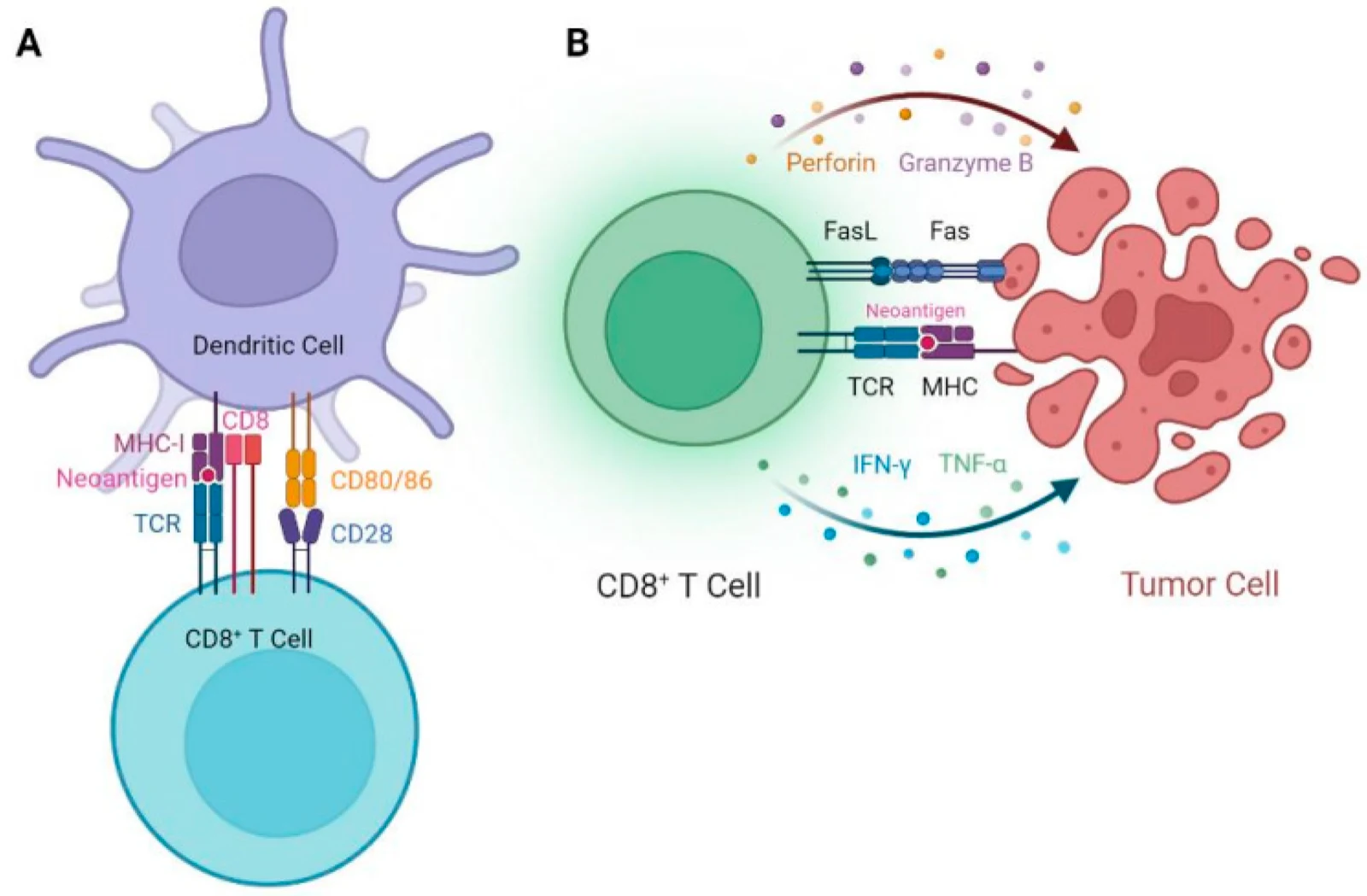
The declared workflow starts from four inputs: tumour DNA sequencing, normal DNA sequencing from blood, tumour RNA-seq and HLA typing. A selection algorithm then annotates mutations, peptides and HLA allele, ranks the candidates and picks up to 34. The chosen neoantigens are concatenated into a single mRNA strand, formulated in lipid nanoparticles and injected intramuscularly. The ribosome translates the concatemer into one chain, the proteasome processes it, and the epitopes end up on MHC.
“Up to 34” is a ceiling, and in the phase 2b it was almost always reached: median 34, range 9 to 34, with 91% of patients in the combination arm receiving 34 neoantigens. Moderna’s patent describes an embodiment with 29 class I epitopes and 5 class II.
The algorithm is not published. The most explicit public document is patent application WO2020097291A1, which lists the factors considered — gene expression, transcript abundance, allele frequency, conservation, predicted binding affinity for the patient’s HLA allele, clonality — and then states that they feed “a statistical model (e.g., a regression model […] a random forest regression model, a neural network, a support vector machine, a Gaussian mixture model, a hierarchical Bayesian model, and/or any other suitable statistical model)”. That is patent drafting, written to cover the space of possibilities rather than to describe the system in production.
How accurate the selection step is
There is a split here that the phrase “neoantigen prediction” conceals, and it decides everything. Predicting that a peptide will be presented on MHC is close to solved. Predicting that the peptide is immunogenic, that a T cell will actually recognise it, is not.
On the first problem NetMHCpan-4.1 is trained on 13.2 million data points covering 250 class I molecules, with a median PPV of 0.829 on the eluted-ligand benchmark. BigMHC reaches AUROC 0.973 on presentation. On the same model, the neoepitope immunogenicity metric is a mean PPV of 0.438, against 0.264 for the previous method.
Independent benchmarks land lower. On the ITSNdb database, which compares immunogenic and non-immunogenic neoantigens all already selected as MHC-I binders, seven methods score AUC between 0.52 and 0.60. A December 2025 benchmark of eight state-of-the-art tools, with data-leakage prevention, reports a best AUROC of 0.568 on the neoantigen discovery set. The same models, on the same benchmark, reach 0.784 on pathogen-derived epitopes. The gap has a biological explanation: a neoantigen comes from a self protein mutated at a single position and has to escape central tolerance, whereas a viral epitope is foreign throughout.
The field measurement comes from the Tumor nEoantigen SeLection Alliance. Twenty-five independent groups worked on the same sequencing data from six patients; 608 peptides were synthesised from their rankings and tested with multimer assays on those same patients’ samples. Thirty-seven, that is 6%, proved immunogenic. The median overlap between any two groups’ top hundred peptides is 13%.
Moderna has published a measurement of its own algorithm. Across 29 patients with metastatic colorectal cancer for whom the National Cancer Institute had already experimentally identified the neoantigens recognised by tumour-infiltrating lymphocytes, the mRNA-4157 algorithm included 41% of those targets in the vaccine design, 26 out of 64. For 61% of patients it included at least one, for 28% all of them. That is a sensitivity measure, not a precision one: it says how many true targets the algorithm catches, not what fraction of the 34 it picks is immunogenic.
The clinical result of INTerpath-001, whatever its size turns out to be when released, is therefore produced by a selection step that leaves out more than half of the known targets, and that for two patients in five catches none. The headroom sits in that step, not in the mRNA chemistry or the nanoparticle. It is also the step that can be improved without touching manufacturing: the model changes, the plant does not. The question is the one that matters for any clinical software, namely what has been validated and in which population.
What the endpoints predict
RFS and DMFS are surrogates, and their relationship to survival has been measured, with results that have shifted. A 2017 meta-analysis of 13 adjuvant trials and 6,815 patients reported a trial-level correlation with R² of 0.91 and a surrogate threshold of HR 0.77. A re-analysis of 30 randomised trials and 16,252 patients between 1978 and 2022 reports R² of 0.46 and a correlation of 0.68 (95% CI 0.45-0.82), classified as moderate. In both evidence bases, interferon trials make up more than half.
For DMFS no formal validation as a survival surrogate in adjuvant melanoma appears to have been published.
Two references quantify the gap. In AVAST-M, 1,343 patients, adjuvant bevacizumab improved disease-free interval with HR 0.85 (p=0.03) while leaving five-year survival at 64% in both arms, HR 0.98 (p=0.78). In the opposite direction, sipuleucel-T moved median survival from 21.7 to 25.8 months without moving time to progression.
Then there is the direct comparator. KEYNOTE-054, the trial that brought pembrolizumab into the adjuvant setting, started in July 2015; at seven years of follow-up it reports RFS with HR 0.63 and DMFS with HR 0.64, and no overall survival data has been published. Eleven years after that reference trial opened, the question INTerpath-001 raises is still open for the drug sitting in its control arm.
The constraint downstream
A therapy designed for one patient moves the bottleneck from discovery to logistics, and SEC filings are where this is written without promotional margin.
Moderna manufactures intismeran in Marlborough, Massachusetts: a site acquired in 2023, expanded by roughly 5,600 square metres, operational since August 2025 and shipping patient batches since September 2025. In the 2025 10-K Moderna states the capacity of Laval, up to 100 million doses a year, and of Harwell, the same. For Marlborough no capacity figure appears. Production time is given as “a typical turnaround time of a few weeks”, with no number and no statement of which event starts the count.
In the risk factors, where statements carry SEC liability, Moderna writes that maintaining the chain of identity between sample, sequence data and finished product “is difficult and complex, and failure to do so has resulted and may in the future result in product mix up, adverse patient outcomes, loss of product or regulatory action”. The verb is past tense. The document does not quantify the episodes.
The economic order of magnitude: Moderna recorded $407 million in collaboration expenses in 2025 net of Merck’s reimbursements, $198 million in the first half of 2026; Merck attributed $375 million of research and development to the collaboration in 2025 and capitalised $226 million of shared facility costs as of 30 June 2026. Cost per patient has never been released.
One regulatory detail for anyone working on clinical software: the selection algorithm is not a medical device. It is a step inside the manufacture of a biological drug, assessed within the product dossier, so it does not travel the path that separates a machine-learning device from its updates. If the model changes, the drug changes.
The rest of the field
As of 20 August 2026, four randomised trials of individualised neoantigen therapies have reported a between-arm efficacy comparison. KEYNOTE-942 in phase 2b, positive and published. INTerpath-001, declared positive with no numbers. IMCODE001, a phase 2 of autogene cevumeran plus pembrolizumab in first-line advanced melanoma, 125 patients, median PFS 8.3 against 7.9 months, HR 0.78, p=0.3061: primary endpoint missed. The phase 2 of GRANITE, which missed its primary endpoint of molecular response.
The INTerpath programme comprises nine phase 2 and phase 3 trials across melanoma, lung, bladder and kidney, with four phase 3 trials and estimated primary completions between 2029 and 2034. On the BioNTech side, the adjuvant colorectal trial has completed enrolment with final readout expected in 2027, the pancreatic one reads out in 2031, and two phase 2 trials have been stopped.
The direction is legible: the same pipeline, sequencing plus selection plus mRNA, is being applied to tumours whose mutational burdens and microenvironments differ sharply from melanoma’s. Melanoma is the favourable case, both for mutation load and for checkpoint inhibitor sensitivity. The readouts arriving from 2027 onwards will measure how well the computational part holds when the mutanome is poorer.
Limits
Nothing written here describes the size of the INTerpath-001 effect, because it has not been released. The difference between the 1,137 patients in the release and the 1,089 in the registry is not explained by the sources. Protocol and statistical analysis plan are not public, so the alpha spending rule at the interim analysis cannot be verified from outside, and RFS is investigator-assessed.
On the benchmarks: the TESLA data is from 2019-2020, on six patients, with the predictors of that period, and multimer assays detect pre-existing T cell responses, so the 6% is a lower bound. Moderna’s 41% comes from a 350-word conference abstract from 2020, retrospective and in silico across 29 patients, with no verifiable methods. Several benchmarks cited are published by the authors of the winning tools.
Some primary sources I did not open directly, because the servers answer 403 or require authentication: the Journal of Clinical Oncology paper with the five-year data, the ESMO abstract for IMCODE001, the Nature paper on the pancreatic phase 1, the FDA pages. The related figures come from reports and indexed extracts, and should be rechecked against the full text. The EMA PRIME designation and the FDA breakthrough therapy designation are stated by the companies in their own SEC filings, not publicly confirmed by the regulators, who do not publish timely named lists.
- https://news.modernatx.com/merck-and-moderna-announce-phase-3-interpath-001-trial-of-intismeran-plus-keytruda-met-endpoints-of-rfs-and-dmfs-in-melanoma
- https://clinicaltrials.gov/study/NCT05933577
- https://www.sec.gov/Archives/edgar/data/1682852/000168285226000033/mrna-20251231.htm
- https://patents.google.com/patent/WO2020097291A1/en
- https://pmc.ncbi.nlm.nih.gov/articles/PMC7652061/
- https://pmc.ncbi.nlm.nih.gov/articles/PMC10411733/
- https://pmc.ncbi.nlm.nih.gov/articles/PMC12680054/
- https://pmc.ncbi.nlm.nih.gov/articles/PMC10569228/
- https://pmc.ncbi.nlm.nih.gov/articles/PMC7319546/
- https://doi.org/10.1158/1538-7445.AM2020-6539
- https://doi.org/10.1093/jnci/djx133
- https://pmc.ncbi.nlm.nih.gov/articles/PMC11908549/
- https://www.ncbi.nlm.nih.gov/pmc/articles/PMC6096737/
- https://doi.org/10.1016/j.ejca.2024.114327
Cover image: Li, F.; Wu, H.; Du, X.; Sun, Y.; Rausseo, B.N.; Talukder, A.; et al., “Epidermal Growth Factor Receptor-Targeted Neoantigen Peptide Vaccination for the Treatment of Non-Small Cell Lung Cancer and Glioblastoma”, Vaccines 2023, 11(9), 1460, figure 3 — CC BY 4.0 — https://commons.wikimedia.org/wiki/File:Mechanism_of_neoantigen-induced_CD8%2B_T_cell-mediated_antitumor_immunity.png