
In mid-October 2026 OccupySaaS was born, describing itself as a protest movement written in code. It is driven by laid-off developers who use AI agents and public documentation to rebuild the SaaS services of the big platforms as open source, starting with Auth0 and Salesforce. The slogan is “They laid us off. We’re rebuilding their SaaS.”
From the square to the repository
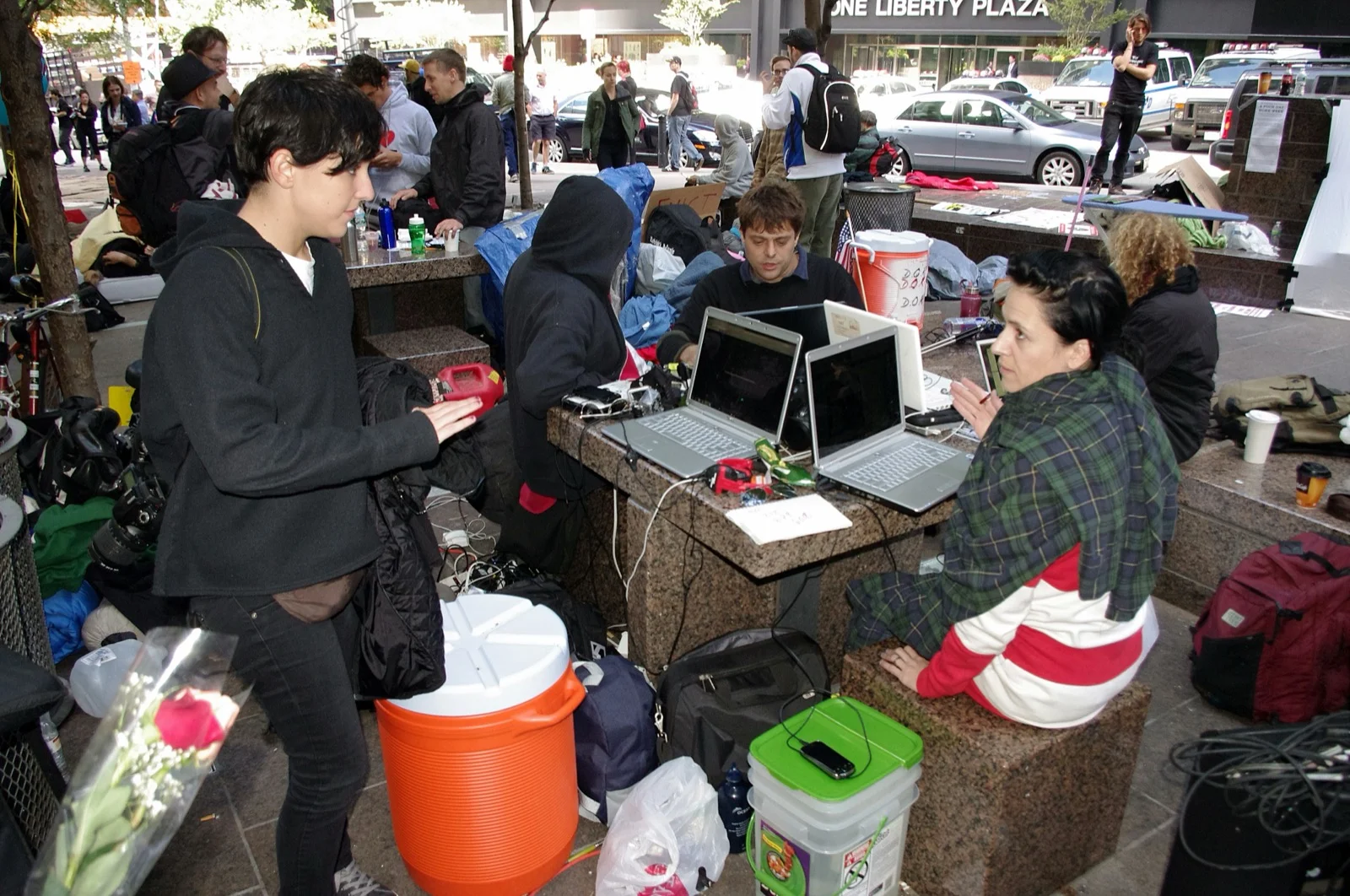
The name and the language come from Occupy Wall Street, the movement that began on 17 September 2011 in Zuccotti Park, New York: the 1% against the 99%, no leaders, decisions taken in open assemblies. The site turns that experience into a formula, tents swapped for terminals. The assemblies become GitHub issues and a Discord channel, where anyone can propose the next service to “occupy”. The public map of targets marks identity and CRM as occupied. Among the proposals are wikis, issue tracking, feature flags, observability and customer support.
The grievances are economic. Per-seat pricing is described as a tax on growth, lock-in as a mix of proprietary APIs, export limits and price rises. Then there are the layoffs, which the site puts at a million engineers, while the platforms kept growing.
A protest carried out through work
The classic forms of labour protest, the strike and the boycott, withdraw work or purchases. OccupySaaS adds an alternative. People who lost their jobs use the skills they had put at the industry’s service to build competing products, free and open. The lever that makes this possible is AI. The site says so explicitly: the big companies had thousands of engineers, the movement has agents that let a small group quickly turn a precise specification into working code. The numbers confirm it on a small scale. In under three weeks ZeroAuthy, the Auth0 replacement, passed 700 commits, almost all from a single developer, some of them signed by Claude.
To stay within the law the movement uses the clean-room method. Specifications are written only from public documentation and open standards, those who write them stay separate from those who implement them, and compatibility is tested with the vendors’ own public SDKs. Rebuilding compatible software from public information has well-known precedents, from the IBM-compatible BIOS Phoenix Technologies sold from 1984 to the 2021 Google v. Oracle ruling on the Java APIs. Both projects, ZeroAuthy and SalesCompel, say they are at an early stage.
A lineage in free software
Free software was born as a political project. In 1985 Richard Stallman wrote the GNU Manifesto, which presented sharing software as a matter of users’ freedom. In 1998 the Open Source Initiative reframed the same practices in terms of quality and convenience, which opened the way to adoption by companies. OccupySaaS brings the political framing back to the foreground and gives it a precise target: specific companies and their most widely used products, in the name of the workers the industry has let go.
What I think
I look at it as someone who has worked with open source since the early 2000s, and what interests me most is the social and political side. It is a new form of protest because AI makes it practicable: a small group, sometimes a single person, can build in a few weeks an alternative to a product that took years and many people. If the model spreads, layoffs of developers could also produce competition.
Its success, however, remains to be seen. Code is the part AI makes cheapest, while the success of a system also depends (and in some cases mainly) on what surrounds it: services, support, certifications, continuity, brand, an ecosystem of partners and trained people. The history of open source shows it. The companies that built a stable business on it, such as Red Hat, sell subscriptions, support and guarantees around software anyone can download. LibreOffice has read and written Microsoft Office formats for years, yet in companies Office remains the standard. Compatibility and a zero price alone do not move customers.
For an identity server this holds even more. Whoever adopts one entrusts it with the security of all their systems and asks the provider for guarantees, audits and someone accountable when an incident happens. A protest movement, however effective at producing code, will have to offer this too, or let others do it on top of its work. The Apache-2.0 licence allows that, and the site says so plainly: anyone can sell services around the projects. That may be the path by which a protest becomes an ecosystem.
- OccupySaaS, the project website — https://occupysaas.com/
- OccupySaaS, the ZeroAuthy repository — https://github.com/occupysaas/zeroauthy
- OccupySaaS, ZeroAuthy’s clean-room policy — https://github.com/occupysaas/zeroauthy/blob/main/CLEAN_ROOM.md
- OccupySaaS, the SalesCompel repository — https://github.com/occupysaas/salescompel
- Wikipedia, Occupy Wall Street — https://en.wikipedia.org/wiki/Occupy_Wall_Street
- GNU, Richard Stallman’s GNU Manifesto, 1985 — https://www.gnu.org/gnu/manifesto.html
- Open Source Initiative, the history of the initiative since 1998 — https://opensource.org/about/history-of-the-open-source-initiative
- Wikipedia, clean-room design and the IBM BIOS case — https://en.wikipedia.org/wiki/Clean-room_design
- Wikipedia, Google LLC v. Oracle America, Inc., 2021 — https://en.wikipedia.org/wiki/Google_LLC_v._Oracle_America,_Inc.
Cover image: the third day of Occupy Wall Street in Zuccotti Park, New York, September 2011. Photo by David Shankbone on Wikimedia Commons — CC BY 3.0 — https://commons.wikimedia.org/wiki/File:Day_3_Occupy_Wall_Street_2011_Shankbone_19.JPG — licence: https://creativecommons.org/licenses/by/3.0/