
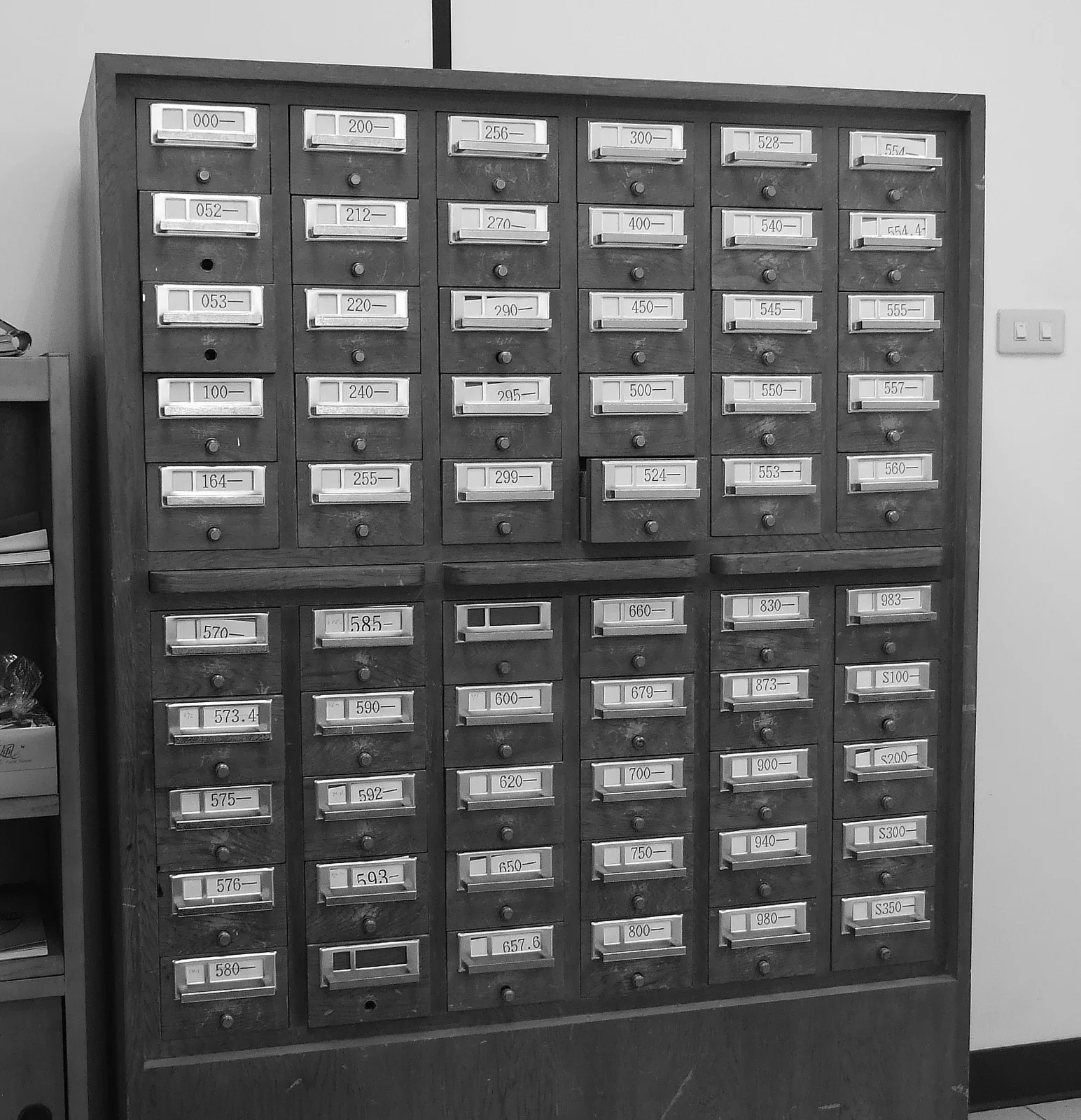
Niklas Luhmann’s slips number around ninety thousand, and they sit in two boxes. The figure circulates as proof that a well-kept personal archive produces original thought on its own. The detail of the archive cuts that reading down: a substantial share of the slips is bibliography and keyword index.
Luhmann’s archive, in figures
Universität Bielefeld has held the estate since 2011. There are two boxes. Zettelkasten I holds roughly 24,000 slips in seven drawers, compiled roughly between 1952 and 1962, administrative and political-science in character; Zettelkasten II holds roughly 66,000 in twenty-one drawers, roughly between 1963 and 1996, sociological in character.
A substantial share of the total is apparatus. ZK I includes a bibliography of about 1,800 entries and a keyword index of about 1,250; ZK II reaches roughly 16,000 bibliography entries and 3,200 index entries. The defensible phrasing is “around ninety thousand slips, bibliography and index included”. The reference reconstruction of how the archive worked is that of J.F.K. Schmidt, Niklas Luhmann’s Card Index: The Fabrication of Serendipity, in Sociologica 12(1), 2018, open access.
An edition project on the estate runs from 2015 to 2030 — sixteen years, €5,050,000 — at the North Rhine-Westphalian Academy of Sciences, Humanities and the Arts, under the direction of André Kieserling. Bielefeld records close to 600 publications for Luhmann, more than 40 of them monographs.
The recent popularisation, by contrast, has a precise date: PARA appeared as a Medium post on 8 February 2017, five years before the book that spread it.
Criticism of the method
Criticism from inside the method is older than its popularity. Christian Tietze published the formulation of the collector’s fallacy on zettelkasten.de on 20 January 2014, three years before PARA and eight before the book: “‘to know about something’ isn’t the same as ‘knowing something’”.
Sasha Chapin, in Notes Against Note-Taking Systems (31 January 2022), goes after the culture that grew around the practice without ever naming Forte, Luhmann or the phrase “second brain”.
Casey Newton wrote it in public on Platformer on 24 August 2023: “the original promise of Roam — that it would improve my thinking by helping me to build a knowledge base and discover new ideas — fizzled completely”. He then tried Obsidian and Mem, with the same outcome.
Andy Matuschak identifies the structural flaw of the genre: “people who write extensively about note-writing rarely have a serious context of use” — for many of these authors the primary creative work is writing about productivity. The criterion he offers is “the goal is not to take notes — the goal is to think effectively”. He points to Luhmann as the counterexample: he wrote very little about his own Zettelkasten.
Two corrections
Two anecdotes circulating in the same literature need correcting. The productivity book announced and then abandoned is Merlin Mann’s, not David Allen’s: Mann announced it on 18 August 2009 on the back of Inbox Zero and gave it up in 2011. And “the pen is mightier than the keyboard” from Mueller and Oppenheimer (2014), cited to justify handwritten notes, failed direct replication: Morehead, Dunlosky and Rawson (Educational Psychology Review, September 2019) find no consistent differences between longhand, laptop, eWriter and even the group taking no notes at all.
A similar caveat applies to a recurring argument against personal archives, that nobody rereads their own notes. No rigorous statistic on reread rates exists.
From Personal Knowledge Management to Personal Context Management
On 13 March 2026, updated on 14 April, Tiago Forte wrote that Personal Context Management is taking the place of Personal Knowledge Management: the bottleneck he identifies is getting the right information to the model at the right moment.
The first cohort of the “AI Second Brain” course ran from 15 April to 1 May 2026, taught using Claude, Claude Code included; a second cohort will run from 17 September to 8 October 2026. The numbers attached to the operation are self-reported and uncertified: Forte states roughly 6,000 students over six years and more than 18 million YouTube views, while the 500,000-copies figure on his pages is an expected total.
The closures and forks of 2026
Over the same period the category of tools promising local notes plus AI thinned out.
- Reor has been archived and read-only on GitHub since March 2026 (AGPL-3.0): last commit 13 May 2025, last release v0.2.32 in April 2025.
- GPT4All is not archived and remains MIT, but has had no release after v3.10.0 of 25 February 2025 and no substantial commits since May 2025; issues asking whether the project is alive go unanswered.
- Khoj Cloud was shut down on 15 April 2026, with a stated rationale of an unsustainable cloud-first model and competition from the frontier labs. The project remains open (AGPL-3.0) and self-hostable; the founding team moved on to Open Paper and Pipali.
- Logseq split in two. The Markdown-file version, “Logseq OG”, is in maintenance on a separate repository with security and Electron updates only, last stable 0.10.15 of 1 December 2025. The SQLite version, now simply called Logseq, has been in 2.0 beta since 13 July 2026, and the project’s guidance recommends backups before trusting it with material.
In all four cases the project held the note format and the inference engine together in a single product. Reor and GPT4All stopped, Khoj shut down the cloud service while keeping the code open, Logseq separated the two versions.
The two-layer configuration
The configuration that holds keeps the two layers apart: the notes remain files in a folder, and the model sits behind an OpenAI-compatible endpoint on localhost, replaceable without touching the archive. Self-hosted Khoj is documented for precisely this, pointing OPENAI_BASE_URL at a local server — Ollama, llama-cpp-server, vLLM, LM Studio.
An implementation of this pattern already exists. qmd by Tobi Lütke (MIT, created 8 December 2025, around 28,000 stars) indexes a Markdown folder with BM25 via SQLite FTS5 and vectors with sqlite-vec, fuses the two rankings with Reciprocal Rank Fusion at k=60 and reranks with a local LLM; chunks run to about 900 tokens with 15% overlap on Markdown structure boundaries. It ships EmbeddingGemma-300M (~300 MB) and Qwen3-Reranker-0.6B (~640 MB) in GGUF, so the whole pipeline runs on a laptop with no outbound calls. It publishes no benchmarks: it ships qmd bench to measure against the user’s own corpus.
In the same spring two distant projects arrived at the same substrate. Letta, on 16 March 2026, describes memory “projected into git-backed files”, operated with generic tools such as bash in place of dedicated memory APIs; Andrej Karpathy, three weeks later on 4 April, presented the LLM Wiki as “just a git repo of markdown files”. On the LLM Wiki noze has a dedicated article: https://www.noze.it/en/insights/llm-wiki/.
The practice
My notes live in an Obsidian vault: Markdown files in a folder, with no proprietary database and no account required. The app is proprietary (Dynalist Inc.); what is open are the formats, and that is the layer that matters for the use case “being able to reread in ten years what was written”. The commercial licence has been optional since 20 February 2025 (“Anyone can use Obsidian for work, for free”, with more than 10,000 organisations cited), Bases has been a core plugin since 18 August 2025 with views saved as plain .base files and the data held in note properties, and since 27 February 2026 there is an official CLI for scripting and automation. The latest stable, in mid-July 2026, is 1.13.2, dated the 14th.
Obsidian has no built-in AI. Steph Ango (kepano), the CEO, publishes an MIT repository of Agent Skills — obsidian-markdown, obsidian-bases, json-canvas, obsidian-cli, defuddle — usable by “any skills-compatible agent, including Claude Code, Codex, and Open Code”. The repository teaches the formats to external agents, which stay outside the application.
Limits
The local-first guarantee holds at the storage layer and weakens at the processing layer. Obsidian’s desktop plugins run with full privileges over the application and the filesystem. Since 12 May 2026 every published version is scanned automatically for security and quality, where previously only the first submission was reviewed — in the same announcement, 120 million total plugin downloads — but the exposed surface depends on which plugins are installed and how the models they use are configured.
“Local” also needs checking case by case. Ollama in 2026 is no longer local only: in the 0.32 series — 0.32.0 of 11 July, with 0.32.1 of 16 July as the current stable — the bare ollama command starts an interactive agent, models with the :cloud suffix run on the company’s servers, and on 9 July 2026 the company announced $88 million raised explicitly to grow the cloud, stating that cloud token volume “has more than doubled every month”. Running models on local hardware remains unlimited and free, but models with the :cloud suffix do not run locally.
Finally, the Obsidian adoption figures in circulation — monthly users, revenue, valuation — are aggregator estimates: the company is private and does not publish them. The only figure traceable to the company is roughly one million users in 2023, self-estimated from GitHub downloads.
All of the above applies to a personal archive on a single machine, where whoever writes the notes, whoever reads them and whoever owns the disk are the same person. When the same archive becomes an organisation’s memory that coincidence breaks, and that is the subject of the insight published by noze: https://www.noze.it/en/insights/corporate-second-brain-company-memory/.
- https://doi.org/10.6092/issn.1971-8853/8350
- https://niklas-luhmann-archiv.de/
- https://zettelkasten.de/posts/collectors-fallacy/
- https://github.com/tobi/qmd
- https://github.com/kepano/obsidian-skills
- https://github.com/khoj-ai/khoj
- https://github.com/logseq/logseq
- https://github.com/reorproject/reor
- https://github.com/nomic-ai/gpt4all
- https://www.noze.it/en/insights/corporate-second-brain-company-memory/
Cover image: library card catalogue — photo by Konrad Lawson, CC BY-SA 2.0 — https://commons.wikimedia.org/wiki/File:5236876949_card_catalog.jpg