
For days a rumour had been going round among complexity theorists: the leading AI labs, such as OpenAI and Anthropic, had supposedly found algorithms able to break public-key cryptography, starting with RSA. On 26 November Nature put it in a headline, in a piece by Davide Castelvecchi asking whether AI has just cracked Internet encryption. The answer, for now, is that nobody outside the labs knows.
The rumour comes in a week in which the public results are already enormous. After the proof of the Riemann hypothesis on 20 November, between 23 and 25 November came results that complexity theory had been waiting on for decades. Aaronson compared these days to van Leeuwenhoek first turning his microscope on pond water and Galileo first turning his telescope to the stars: a continent of mathematical truth is opening up that until now could only be glimpsed through fog.
Where the rumour comes from
On the evening of 24 November, in a comment on his blog, Scott Aaronson answered a reader who asked how likely it was that factoring was in P. Aaronson, who teaches theoretical computer science at the University of Texas at Austin, wrote that he had heard a great many rumours that one or both labs had a polynomial-time factoring algorithm. He added that he did not know how much to credit them. He was, however, virtually certain that the labs held one or more bombshells for cryptography, though their exact nature might have been distorted as it passed from mouth to mouth.
The comment was picked up on X as if it were a confirmation. Later Aaronson added a note to it asking people not to cite him as an authority on factoring, because “a rumor is a rumor is a rumor”. The things he feels sure about fall well short of a polynomial-time factoring algorithm.
On 25 November he repeated it in a post. He says he is virtually certain, on the basis of several reliable sources, that the bombshells exist, but he has much less confidence about their nature until he sees the details or hears directly from someone at a lab. He also asked that cryptography not overshadow the intellectual scale of what is happening. Nature reports the rumour as unconfirmed: the algorithms are said to target RSA as well as more advanced technologies.
What has been published
This week’s verifiable results are in the labs’ GitHub repositories. As Aaronson notes, the companies no longer even issue press releases and simply upload the papers.
- VP ≠ VNP. On 23 November Anthropic and then OpenAI published two proofs of Valiant’s conjecture, the algebraic analogue of P ≠ NP: the permanent of a matrix, over every field of characteristic other than 2, has no algebraic circuits of polynomial size. Anthropic’s bound is stronger than OpenAI’s and both are superpolynomial, though not exponential. According to Anthropic’s README the result was discovered by an internal research Claude model, the paper and the Lean proof were written by models and no mathematician has checked the proof. The check rests on Lean, with a second, independently written kernel. The README states that the result does not settle P versus NP.
- Matrix multiplication. On 24 November OpenAI published a proof that the exponent ω of matrix multiplication is exactly 9/4. The upper bound was already OpenAI’s, from 6 October. The news is the lower bound: nobody knew how to prove that ω was greater than 2. The question had been open since 1969, when Volker Strassen showed that ω is less than 3. MIT’s Ryan Williams tells Nature that underneath the result there seems to be a new framework for proving limits on efficient computation.
- The Fourier transform. The same day OpenAI showed that the number of linear gates needed to compute it is N (log N)1/2+o(1), with matching upper and lower bounds. The FFT, since 1965, uses on the order of N log N.
- Factoring. On 25 November Google Research published six papers produced by its Cogentic system. One proves, with no unproven assumptions, that factoring can be done in expected time LN[1/3, O(1)], the same form as the complexity of the number field sieve, which until now was only heuristic. The proven constant is 105, against about 1.92 for the sieve: a theoretical result that does not make RSA any weaker. The Lean formalisation is announced but not yet published. A second paper gives a deterministic algorithm, also subexponential but slower. A third computes discrete logarithms in finite fields of small characteristic, which cryptography abandoned after the quasi-polynomial algorithms of 2013.
None of this week’s public results breaks RSA, Diffie-Hellman or elliptic curves. The rumour concerns what has not been published.
What would change
Nature explains what it would mean. A polynomial-time algorithm makes the running time grow as a power of the problem size, for example n² or n³, while an exponential one grows like 2n. A polynomial algorithm with exponent 10,000 would remain unusable. Nature notes, however, that the first proof that a problem is in P has usually been followed by increasingly efficient algorithms. As Aaronson puts it, from that moment the idea that the problem is hard no longer holds.
What would fall depends on which problems were solved.
- A polynomial-time factoring algorithm breaks RSA: certificate signatures, the keys of old static RSA key exchanges and encryption built on RSA.
- One for discrete logarithms in prime fields and on elliptic curves breaks Diffie-Hellman, ECDH and ECDSA. It is the problem behind key exchange in TLS 1.3, which made forward secrecy mandatory. Forward secrecy protects against the theft of a long-term key. If the mathematical problem falls, traffic recorded today could be decrypted tomorrow.
- Symmetric ciphers such as AES and hash functions rest on something else and would not be affected.
- The post-quantum standards NIST published in August 2024, ML-KEM and ML-DSA on lattices and SLH-DSA on hash functions, rest on problems other than factoring and discrete logarithms.
The worst case would be P = NP, which would make nearly every problem behind public-key cryptography easy. Nature notes that most researchers consider it unlikely and that this week’s lower bounds point the other way. Aaronson writes that for the first time he feels a proof of P ≠ NP is not far off and that AI is climbing the mountain that leads there.
Here we are
The way out already exists and was planned for another reason, quantum computers. In the draft of IR 8547 NIST proposes deprecating RSA and elliptic curves after 2030 and disallowing them after 2035. The same migration also protects against a classical attack on factoring and discrete logarithms, as long as the problems behind the new standards hold.
The concrete work is the usual one, with less time. Knowing where RSA and elliptic curves are used in one’s own systems: certificates, VPNs, software signatures, devices that stay in the field for years. Making algorithms replaceable without rewriting applications. Giving priority to data that must stay confidential for a long time, because that is what recorded traffic exposes.
On 20 November I wrote about the fully autonomous AI attacks that Google expects in three to six months. A few days ago, in Superintelligence is arriving, I took from Alexandr Wang the idea that entire fields could accelerate faster than people can monitor. In October, in The exponentials we cannot see, a single announcement called into question the Exponential Time Hypothesis, on which hundreds of results rested. If the rumour is true, cryptography is the first field in which the acceleration of mathematical results becomes an operational problem. If it is not, the migration needed doing anyway.
- Nature, Davide Castelvecchi, Has AI just cracked Internet encryption? Rumoured ‘bombshell’ stuns scientists, 26 November 2026 — https://www.nature.com/articles/d41586-026-03875-6
- Scott Aaronson, the 25 November 2026 post on Shtetl-Optimized — https://scottaaronson.blog/?p=10379
- Scott Aaronson, I’ve been drinking wine in my kitchen, 24 November 2026, with comment 23 on factoring — https://scottaaronson.blog/?p=10362
- Nature, mathematicians react to the Riemann proof, 25 November 2026 — https://www.nature.com/articles/d41586-026-03835-0
- Anthropic, VP ≠ VNP, paper and Lean proof — https://github.com/anthropics/formal-math/blob/main/vp-vnp/README.md
- OpenAI, VP and VNP are different — https://github.com/openai/math/tree/main/preprints/VP-and-VNP-are-different-November-23-2026
- OpenAI, the matrix multiplication exponent is 9/4 — https://github.com/openai/math/tree/main/preprints/The-matrix-multiplication-exponent-is-nine-fourths-November-24-2026
- OpenAI, the logarithmic exponent of finite Fourier transforms — https://github.com/openai/math/tree/main/preprints/The-logarithmic-exponent-of-finite-Fourier-transforms-November-24-2026
- Google Research, the Cogentic papers on factoring and discrete logarithms — https://github.com/google-research/google-research/tree/master/cogentic_research_papers
- Volker Strassen, Gaussian elimination is not optimal, Numerische Mathematik, 1969 — https://doi.org/10.1007/BF02165411
- Barbulescu, Gaudry, Joux and Thomé, the quasi-polynomial algorithm for discrete logarithms in small characteristic, 2013 — https://eprint.iacr.org/2013/400
- NIST, the first three post-quantum standards, August 2024 — https://www.nist.gov/news-events/news/2024/08/nist-releases-first-3-finalized-post-quantum-encryption-standards
- NIST, IR 8547, the transition to post-quantum standards — https://csrc.nist.gov/pubs/ir/8547/ipd
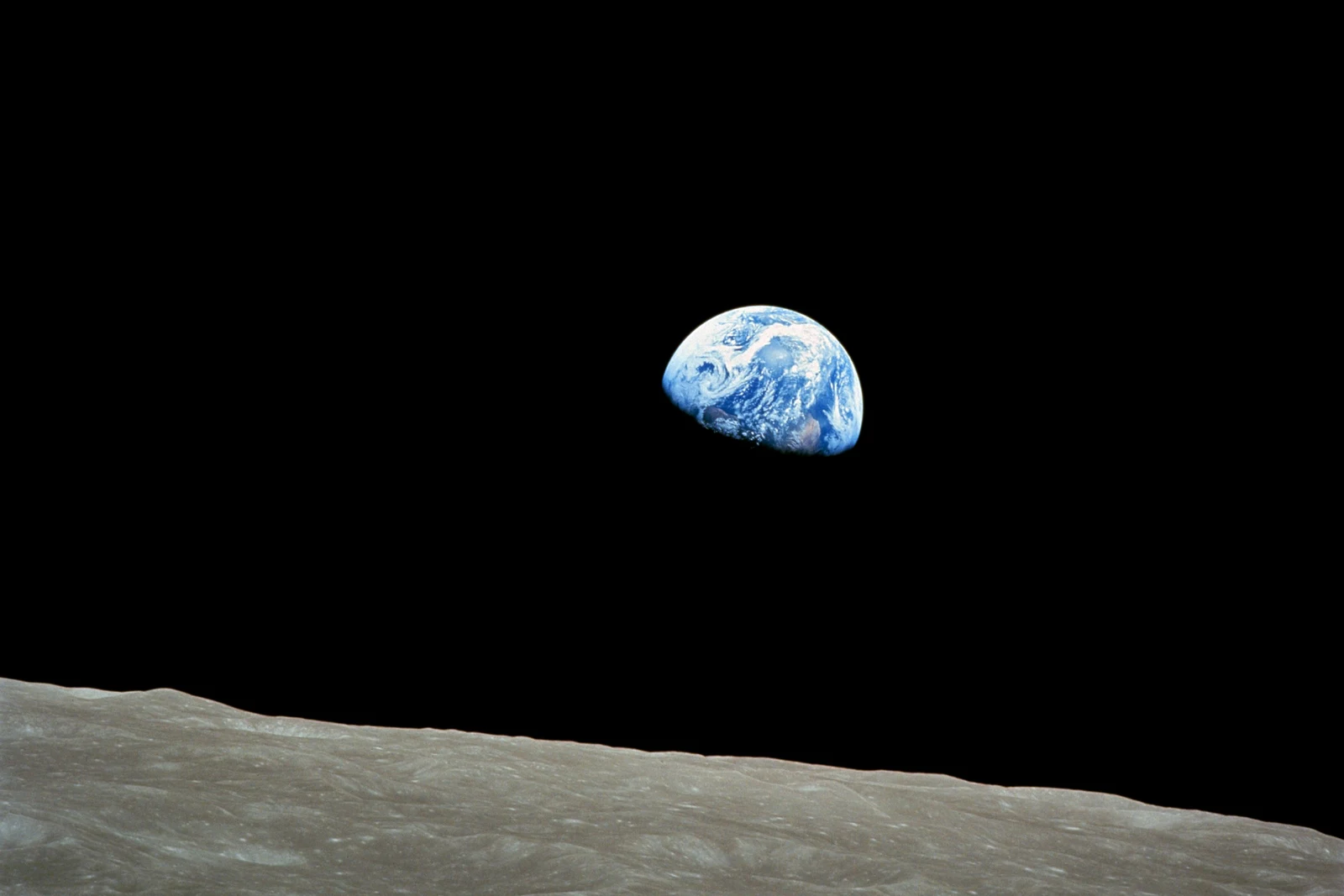
Cover image: “Earthrise”, the Earth rising over the lunar horizon, photographed by Bill Anders from Apollo 8 on 24 December 1968. NASA, public domain — https://commons.wikimedia.org/wiki/File:NASA-Apollo8-Dec24-Earthrise.jpg