
On 20 August 2011 Marc Andreessen published Why Software Is Eating the World in the Wall Street Journal: more and more industries were being run by software companies and delivered as online services. In May 2017 Jensen Huang, Nvidia’s co-founder and CEO, gave the sequel in an interview with MIT Technology Review: software is eating the world, but AI is going to eat software.
In 2026 the second sentence shows up in the repositories. Recent months on GitHub show what happens when writing and rewriting software costs less and less.
Applications rewritten in a few days
REA, Reverse Engineer Anything, was published on 14 April 2026 under the MIT licence and as of 12 October has more than 135,000 stars. Through an MCP server it connects a coding agent to tools for inspecting native binaries, JavaScript and Electron applications, .NET assemblies and websites, relying on Hopper, Ghidra or IDA for native analysis. The README describes the typical use: the user spots a feature in an app that they would like in their own product, asks the agent to study it without the source code, and gets an explanation, with the evidence collected, and a version to integrate into their project. The project warns that it should only be used on software the user owns or is authorised to examine, and that licences for commercial tools remain the user’s responsibility.
PhotoCraft was created on 30 September 2026 by the storytold organisation, the group that develops ArtCraft. The first commit contains five lines in two files, and in twelve days the repository has gathered over 1,700 commits, more than two hundred contributors and more than 51,000 stars. It presents itself as a clean-room reimplementation of Adobe Photoshop written in Rust, built only from public specifications and observed behaviour, without proprietary code. It has layers, masks, non-destructive adjustments, styles, type and vectors, and it reads and writes PSD files: reopening and resaving the 309 files of the psd-tools test corpus, 307 produce the same image as the original. Every menu item, tool and dialog maps to one of more than 500 commands in a single registry, which can be called from the interface, the command line, a JSON channel or an MCP server, and therefore by an agent too. The README points new contributors, people and agents alike, to the same instructions file, AGENTS.md.
PhotoCraft’s authors write that the project is in alpha and does not yet replace Photoshop for everyday professional work: the generative features, fifteen tools, advanced typography and plug-in compatibility are missing. Photoshop needed decades to reach this functional surface. An open project working with agents as well needed less than two weeks for a still partial reproduction.
PhotoCraft is not an isolated case. On the same 30 September the organisation published LightCraft, VectorCraft, FilmCraft and PdfCraft, which present themselves as clean-room reimplementations of Lightroom, Illustrator, Premiere Pro and Acrobat, and on 1 October EffectCraft and DesignCraft, which follow After Effects and InDesign. On 7 October came WordCraft, GridCraft and DeckCraft for Word, Excel and PowerPoint, CADCraft for AutoCAD and SoundCraft for Pro Tools. In one week open foundations appeared for most of the Adobe suite, the core of Office and two reference professional tools such as AutoCAD and Pro Tools, all written in Rust. These are very young projects, which their READMEs describe as in early development or moving fast, and the distance from the original products has to be measured case by case.
The market signal
At the end of January 2026 Anthropic released a set of plug-ins for Claude Cowork that automate legal, sales, marketing and data-analysis tasks. According to Reuters, by 4 February the S&P 500 software and services index had fallen almost 13% in five sessions, and 26% from its October 2025 peak, while the S&P 500 as a whole hit a record high. Thomson Reuters had lost 16% in one day, the stock’s biggest daily drop on record.
Many analysts judged the reaction excessive. J.P. Morgan’s Mark Murphy called it an illogical leap, and several observers pointed out that companies with specialised data, in finance and law, have something an agent cannot rebuild on its own. As I read it, the fear concerns per-seat pricing, in a world where the work is no longer done only by people sitting in front of a screen.
Satya Nadella, Microsoft’s CEO, had described the mechanism on a podcast in December 2024. Business applications are largely databases with business logic on top, and that logic moves into agents, which work across several databases regardless of the application managing them.
Where the value moves
Software does not disappear. What people pay for changes. When an application’s code can be rebuilt, value moves to what cannot be rebuilt with a prompt.
- Value-added services. Integration with existing systems, configuration around the real process, support, updates, regulatory compliance and someone who answers when something goes wrong. It is the part customers struggle to do themselves even when the code is free, as decades of free software have shown.
- Data. Curated, specialised, up-to-date data with verifiable provenance, together with the feedback that comes from real use. An agent can rewrite a management system, but it cannot invent the clinical history of a population or a country’s annotated case law.
- All-inclusive as-a-service. Infrastructure, models, software, security and operations in a single service, paid for by use or by outcome. The customer buys the ability to do something, and the licence becomes an internal cost line for the supplier.
- The business unit as a service. A whole business function, such as accounting, customer support, security monitoring or document management, delivered by agents and people together, with service levels and responsibility for the result. Foundation Capital calls it service-as-software and puts the opportunity over the next five years at $4.6 trillion, half in salaries and half in outsourced IT and business process services.
The common thread is responsibility. People pay whoever guarantees that something works on the right data and within the rules, and answers for it.
What I think
Software is still needed everywhere, while the cost of writing it is falling fast and the business model that sold code as a scarce good is losing ground. Those who build solutions have to move towards services, data and managed functions, and it is the work I see growing in the projects I follow as well.
There is, however, a problem growing at the same speed, and it is security. The tools that lower the cost of writing software also lower the cost of attacking it. An agent that uses REA to reconstruct how a binary works does the same job for someone looking for a feature to copy and for someone looking for a vulnerability to exploit, and it is reasonable to expect the time between a patch being published and a working exploit to shrink.
Code generated in bulk also puts pressure on the supply chain. In the study by Spracklen and colleagues presented at USENIX Security 2025, across 576,000 code samples produced by 16 models, non-existent packages averaged at least 5.2% of those suggested by commercial models and 21.7% of those suggested by open ones. These are names an attacker can register in advance on npm or PyPI, the technique now called slopsquatting. Agents with access to tools, keys and repositories then widen the attack surface: an instruction hidden in a document, a web page or the response of an MCP server can turn into an action executed with the agent’s privileges. OWASP ranks prompt injection first among the risks for LLM-based applications.
Security therefore has to be raised to the highest possible level, in architecture and in organisation. In architecture it means verifiable provenance of code and models, with signatures and SBOMs, pinned and checked dependencies, sandboxed agents with least privilege and authorisation decided outside the model, action logs that stand up to inspection, and security tests inside the continuous integration pipeline on every change. In organisation it means that security reports to the top and is part of projects from the start. In Europe it is also an obligation: since 11 September 2026 the Cyber Resilience Act requires manufacturers to send ENISA and the competent CSIRT an early warning within 24 hours about actively exploited vulnerabilities in their products, and from 11 December 2027 security by design becomes a requirement for placing them on the market. These are the issues I work on with Admina and DebugABot.
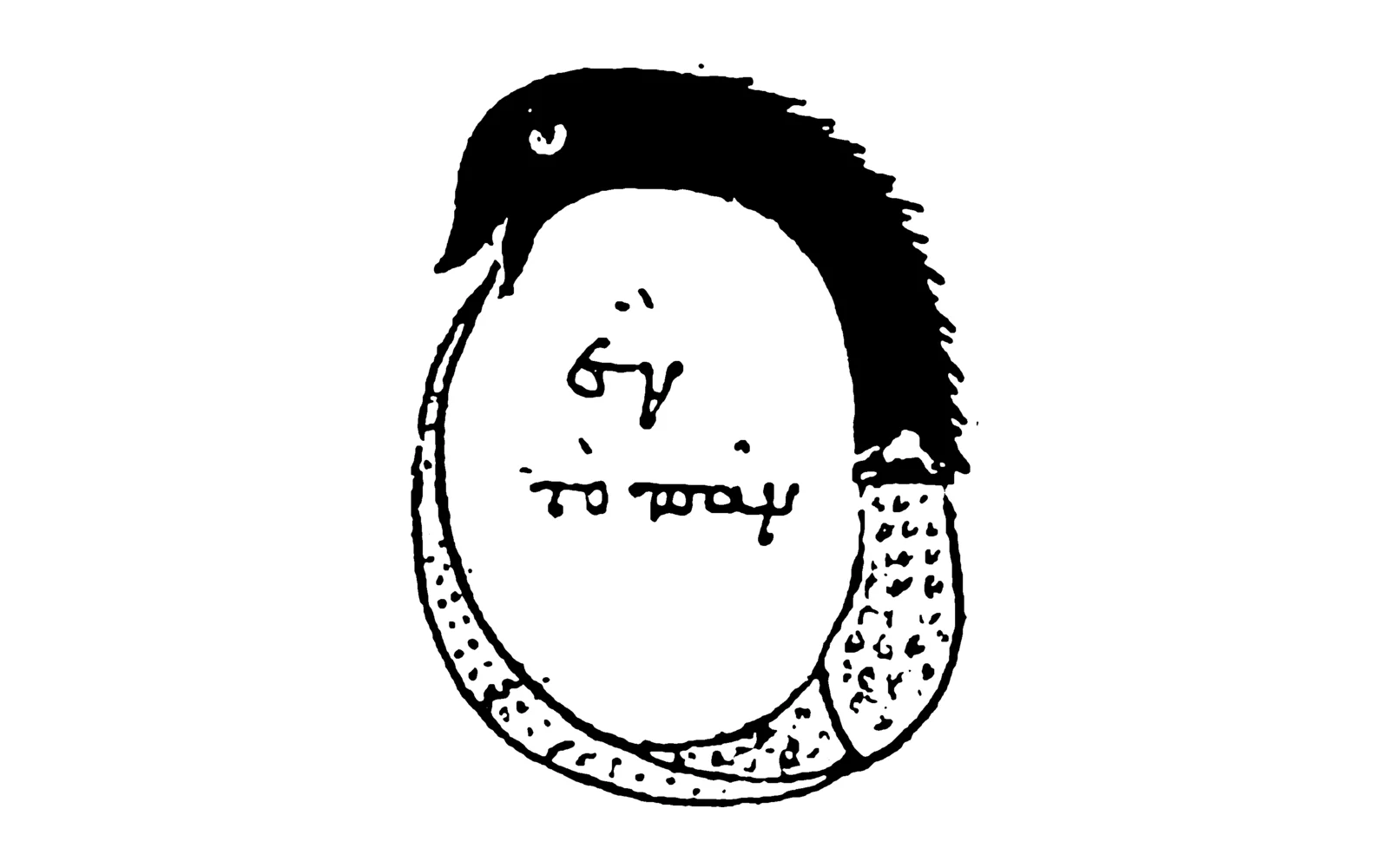
One more thing about the title. The AI that is eating software is itself software: trained parameters run by a program. So would be any superintelligence. And in the end so is our own intelligence, which runs on a substrate built from a genetic code, as I wrote about the cell that compiles itself. Intelligence eating software is software eating itself, like the Ouroboros on the cover, or the TVA handbook in Loki, which O.B. writes taking inspiration from Victor Timely, who as a child had learnt from that very handbook.
So far we have closed the loop ourselves: we wrote the code the models learned from, and the models now write the code the next ones will learn from. With each turn the cycle tightens and speeds up, while the step that depends on us, writing, reviewing, deciding, stays at the pace of a biological intelligence. At some point we will probably not keep up, and we too, software as we are, will end up outside the Ouroboros we set in motion. What happens then is the open question of these years, and it is why governance and security have to be built now, while we are still part of the loop.
- Marc Andreessen, Why Software Is Eating the World, the reprint on a16z’s website — https://a16z.com/why-software-is-eating-the-world/
- Quote Investigator, the origin of Andreessen’s phrase — https://quoteinvestigator.com/2018/01/24/software/
- MIT Technology Review, the interview with Jensen Huang of 12 May 2017 — https://www.technologyreview.com/2017/05/12/151722/nvidia-ceo-software-is-eating-the-world-but-ai-is-going-to-eat-software/
- REA, the repository — https://github.com/morluto/rea
- PhotoCraft, the repository — https://github.com/storytold/photocraft
- storytold, the GitHub organisation with all the Craft projects — https://github.com/storytold
- Reuters, software stocks hit after Anthropic’s tools, 4 February 2026 — https://www.investing.com/news/stock-market-news/us-software-stocks-hit-by-anthropic-wakeup-call-on-ai-disruption-4485524
- Cloud Wars, Satya Nadella on business applications in the agent era — https://cloudwars.com/?p=75498
- Foundation Capital, AI leads a service as software paradigm shift — https://foundationcapital.com/ai-service-as-software/
- Spracklen and colleagues, We Have a Package for You!, package hallucinations by code models, USENIX Security 2025 — https://arxiv.org/abs/2406.10279
- OWASP, LLM01:2025 Prompt Injection — https://genai.owasp.org/llmrisk/llm01-prompt-injection/
- Jones Day, the Cyber Resilience Act reporting duties from 11 September 2026 — https://www.jonesday.com/en/insights/2026/07/eu-cyber-resilience-act-24hour-reporting-duties-start-september-11-2026
- Wikipedia, 1893, the Loki episode in which Timely receives the TVA handbook — https://en.wikipedia.org/wiki/1893_(Loki)
- Wikipedia, Heart of the TVA, the Loki episode on the handbook paradox — https://en.wikipedia.org/wiki/Heart_of_the_TVA
Cover image: the Ouroboros from the Chrysopoeia of Cleopatra in the Codex Marcianus graecus 299, folio 188v, 10th–11th century. The inscription in the middle, «ἓν τὸ πᾶν», means «one is the all» — public domain — https://commons.wikimedia.org/wiki/File:Chrysopoea_of_Cleopatra_1.png.